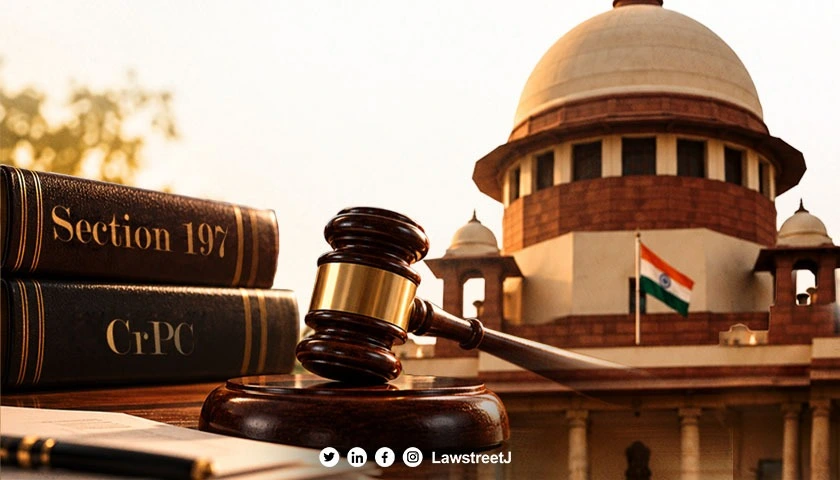
New Delhi: The Supreme Court has set aside a Bombay High Court order that had quashed criminal proceedings against a City Survey Officer, holding that the acts alleged, conspiring to prepare forged documents and presenting them as genuine to alter land records, cannot be said to be in discharge or purported discharge of official duty, so that neither Section 197 CrPC nor the Maharashtra Amendment to Section 156(3) CrPC, which requires sanction before a Magistrate orders investigation against a public servant, is attracted.
A Bench of Justice K.V. Viswanathan and Justice Alok Aradhe allowed Criminal Appeal Nos. 5370-5371 of 2026 (2026 INSC 1235), filed by Ashok against Mahesh Fulpagare, the City Survey Officer, and the State of Maharashtra. The High Court’s order of 27.11.2024 in Criminal Application Nos. 1371 of 2020 and 3235 of 2021 had quashed RCC No. 1020 of 2023 and RCC No. 119 of 2024 before the Chief Judicial Magistrate, Dhule, in which charge sheets were filed under Sections 465, 466, 468, 471, 474, 420, 120B and 34 IPC.
The High Court had held that, under Maharashtra Act XXXIII of 2016, even a Section 156(3) investigation against a public servant for acts done in the discharge of official duty needs prior Section 197 sanction. It had also held that the deemed-sanction proviso, which operates if the sanctioning authority does not decide within 90 days, did not help the complainant, as the applications were made to the Settlement Commissioner and Director of Land Records, who in its view were not the competent authority since the State Government was the removing authority.
The prosecution case, as recorded, arose from a civil decree of 01.08.2018 in Special Civil Suit No. 53 of 2003 declaring certain sale deeds void, on the basis of which the decree holders sought mutation. It is alleged that the first accused’s mutation application was unsigned and unsupported by documents, that it was later altered, and that the City Survey Officer and an Examination Surveyor, without hearing or verification, approved Mutation Entry No. 7062 on 16.11.2018, removing the Priyadarshini Charitable Trust, whose trustee is the appellant, and recording 19 persons. The District Superintendent of Land Records cancelled the entry on 30.11.2019. The appellate court had stayed the decree on 22.11.2018. These are allegations in the charge sheets, and no court has recorded a finding on them.
The appellant argued that forgery can never be part of official duty, so that Section 156(3) as amended had no application, and that in any case sanction had been sought from the competent authority. The State supported this, saying the act must bear a reasonable nexus with official duty, and that fabricating records can never be so. The respondent argued that the mutation was done in official capacity after taking the opinion of the District Government Pleader, and that an erroneous order does not make for criminality.
The Bench reproduced the Maharashtra Amendment to Section 156 and Section 197 CrPC and held:
“We are inclined to hold that the acts complained of were not in discharge of or in purported discharge of official duty. Hence, we are not required to examine the aspect of deemed sanction and the issue of the authority competent to grant sanction, insofar as the present facts are concerned.”
It relied on Om Prakash Yadav v. Niranjan Kumar Upadhyay (2024 SCC OnLine SC 3726), which sums up the law on Section 197, including that the act must be integrally connected to official duties, that the “quality” of the act is to be examined, and that the mere opportunity furnished by office is not enough. The Court recalled that the cited decision recognised that criminal conspiracy to create false or fabricated documents cannot fall under the protective umbrella of Section 197, since it can be no part of the official duty of a public servant to fabricate documents.
Applying this, the Bench said the case against the respondent was of conspiring to prepare forged documents and falsely present them as genuine, along with manipulation of property records and a mutation entry intended to cheat. It concluded that Section 197 read with the Maharashtra Amendment is not attracted. It clarified that its observations were only for deciding the question of sanction and that the trial would proceed independently on its own merits.
The High Court’s order was set aside, the appeals allowed, and RCC Nos. 1020 of 2023 and 119 of 2024 were restored to the file of the Chief Judicial Magistrate, Dhule, to proceed in accordance with law.
Appearances:
For the Appellant: Mr. Sagar Pahune Patil, Advocate.
For the State: Mr. Raman Yadav, Advocate.
For Respondent No. 1: Mr. Siddharth S. Chapalgaonkar, with Ms. Sneha Sanjay Botwe, Advocates.
Case Title: Ashok vs. Mahesh & Anr., Criminal Appeal Nos. 5370-5371 of 2026 (arising out of SLP (Crl.) Nos. 7056-7057 of 2025), 2026 INSC 1235