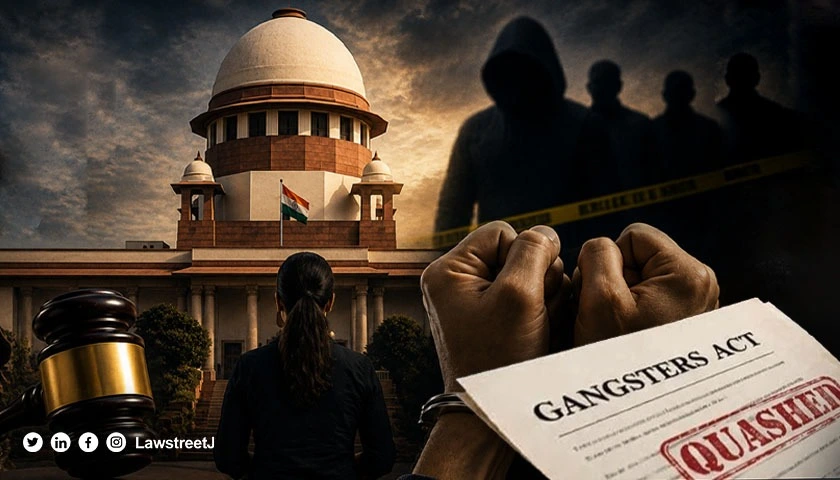
New Delhi: Observing that a right to a speedy trial is not only the prerogative of the accused, but is also a valuable right of the victim, the Supreme Court on Monday (August 17) set aside the Allahabad High Court's order which had kept a murder trial against an accused in abeyance merely because a proceeding under the UP Gangsters Act was pending against him.
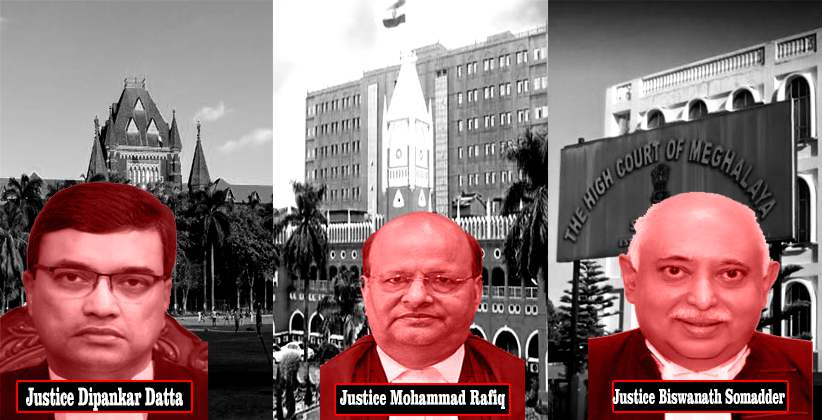
A Bench of Justices K.V. Viswanathan and Arun Palli was hearing an appeal filed by the brother of the deceased against the High Court's order dated August 25, 2025, which had reversed the Sessions Court's refusal to keep the murder trial in abeyance pending conclusion of proceedings under the Uttar Pradesh Gangsters and Anti-Social Activities (Prevention) Act, 1986.
The appellant had lodged an FIR in September 2023 alleging that his brother was mercilessly assaulted and beaten to death with lathis, stones and metal rods by nine accused persons. A chargesheet was filed under Sections 147, 323, 504, 506, 302 and 427 of the Indian Penal Code, and the case was committed to the Court of the Additional District and Sessions Judge, Lalitpur, as Sessions Trial No. 934 of 2023. Separately, on the basis of a Gang Chart, an FIR was also registered against the accused under the Gangsters Act, giving rise to Gangsters Sessions Trial No. 1 of 2024.
While the murder trial was at an advanced stage, with the prosecution's evidence complete and statements under Section 313 CrPC scheduled to be recorded, the accused moved an application seeking that the trial be kept in abeyance, contending that the Gangsters Act trial was required to take precedence under Section 12 of that Act. The Sessions Judge dismissed the application, relying on Dharmendra Kirthal v. State of U.P., (2013) 8 SCC 368, and holding that no clash of dates existed since the Gangsters Act trial had not even begun. The High Court, in revision, took the contrary view and directed that the murder trial be kept in abeyance until the Gangsters Act proceedings were expedited.
Interpreting Section 12 of the Gangsters Act, the Supreme Court held that the provision was never intended to freeze other proceedings against the accused until the Gangsters Act trial concluded. Referring to its earlier ruling in Dharmendra Kirthal, the Court reiterated that the object of Section 12 was to ensure that a trial under the Gangsters Act does not linger owing to a clash of dates with proceedings in other courts, and not to deny a fair and speedy trial to an accused facing prosecution for other offences.
The Court further held that Section 12 had to be read harmoniously with Section 346 of the Bharatiya Nagarik Suraksha Sanhita, 2023 (corresponding to Section 309 CrPC), which mandates that trials proceed on a day-to-day basis once evidence has begun and permits adjournments only for recorded reasons. Read together, the Court concluded that Section 12 contemplates precedence for the Gangsters Act trial only where dates genuinely clash, and does not authorise an indefinite stay of an unrelated and more advanced trial.
Emphasising that the right to a speedy trial under Article 21 belongs equally to the victim, the Court, relying on its decision in Rattiram v. State of M.P., (2012) 4 SCC 516, observed that “there is no reason to give all the benefits on account of the delay in trial to the accused and to completely deny all justice to the victim of the offence.” The Court noted that accepting the accused's interpretation of Section 12 would allow it to be used as a device to indefinitely stall trials in serious offences, eroding evidence and witness memory with the passage of time.
Applying these principles, the Court held that the Sessions Judge had correctly found no clash of dates warranting abeyance, since the Gangsters Act trial was yet to begin when the murder trial was on the verge of conclusion. It held that the High Court had erred in reversing this finding, more so when the High Court's own order had, in an earlier part of its reasoning, itself recognised that Section 12 was not meant to stall other proceedings.
The Court recorded that pursuant to its interim order dated April 13, 2026, staying the High Court's order and directing early conclusion of the trial, the Sessions Court had since concluded Sessions Trial No. 934 of 2023 and convicted all the accused under Section 302 of the IPC along with other offences. The appeal was accordingly allowed and the High Court's order dated August 25, 2025 was set aside.
Appearances:
For the Appellant: Mr. Aviral Kashyap, Advocate.
For Respondent No. 1: Mr. Ashish Pandey, Advocate.
For the State: Mr. Arup Banerjee, Advocate.
Case Title: Keshvendra Singh vs. Shankar Singh And Anr. Special Leave Petition (Crl.) No. 2815/2026