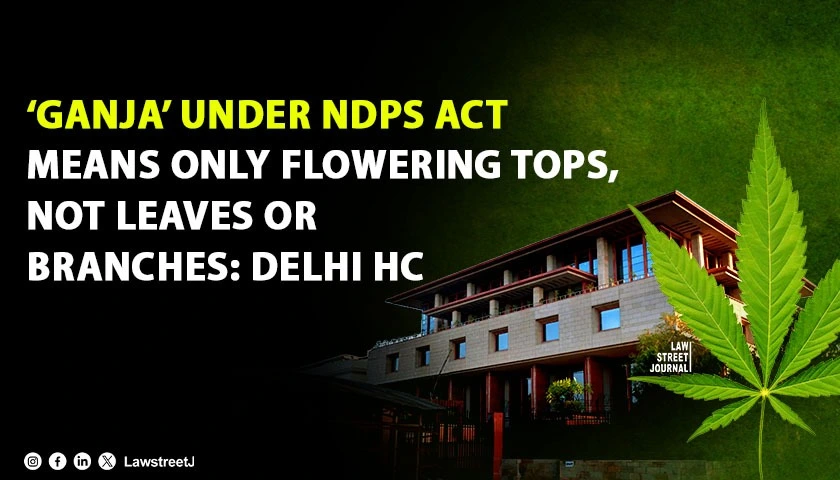
New Delhi: The Delhi High Court has held that dried leaves and small branches of the cannabis plant do not fall within the statutory definition of “ganja” under the Narcotic Drugs and Psychotropic Substances Act, 1985 (NDPS Act), and that when seized material is weighed inclusively without isolating the qualifying flowering or fruiting tops, the actual quantity of ganja cannot be determined at the stage of bail.
On this basis, a Single Judge Bench of Justice Prateek Jalan granted regular bail to two accused persons charged under Sections 20/29 of the NDPS Act, holding that the stringent conditions under Section 37 of the Act were rendered doubtful in the absence of a reliable determination of commercial quantity.
The applications were filed before the Delhi High Court under Section 483 of the Bharatiya Nagarik Suraksha Sanhita, 2023 (BNSS). Both applicants had been apprehended while carrying a black bag containing 21.95 kilograms of a substance alleged to be ganja.
According to the prosecution, the Seizure Memo recorded that the bag was full of dried leaves and small branches, which appeared to be ganja by smell and sight. Upon examination of their mobile phones, it was found that Shahid @ Aabu had received photographs of the narcotic substance from one Yunus @ Mukhiya, and the phones also reflected Call Detail Record connectivity between the applicants and the said co-accused, who remains at large.
The applicants, through their counsel, argued that the seized substance did not answer the statutory definition of “ganja” under Section 2(iii)(b) of the NDPS Act, which defines ganja as the flowering or fruiting tops of the cannabis plant, excluding seeds and leaves when not accompanied by the tops. They contended that since the Seizure Memo described the material as dried leaves and small branches, and the entire substance was weighed without separating the non-qualifying components, the actual quantity of ganja, if any, could not be determined. Consequently, they argued, the presumption of commercial quantity required to attract the rigours of Section 37 of the NDPS Act did not arise.
The prosecution, on the other hand, pointed to the Forensic Science Laboratory (FSL) report dated 21.02.2025, which confirmed the sampled material to be ganja within the meaning of the Act. With the total recovery exceeding 20 kilograms, the threshold for commercial quantity, the Additional Public Prosecutor submitted that Section 37 of the Act would apply, making the grant of bail subject to more stringent conditions.
The Court examined the FSL report closely. While the report described the exhibit as dried greenish-brown coloured flowering and fruiting tops, vegetative material, and confirmed it to be ganja, the Seizure Memo itself referred to dried leaves and small branches. The Magistrate’s Court order at the time of sampling had noted the material as a muddy brown substance. These discrepancies, the Court found, were significant.
Relying on coordinate bench decisions in Ravina Kumari v. State (NCT of Delhi) [BAIL APPLN. 1256/2024] and Ashok Kumar v. State Govt. of NCT of Delhi [BAIL APPLN. 2962/2025], as well as its own earlier order in Manjay Kumar v. State NCT of Delhi [BAIL APPLN. 4206/2025], the Court reiterated the legal position on the definition of ganja.
The judgment in Ravina Kumari had held that in a heterogeneous mixture comprising both flowering tops and non-qualifying material such as leaves, stems, and stalks, only the weight of the flowering and fruiting tops constitutes ganja for the purposes of the NDPS Act. The weight of leaves and stalks, which do not independently fall within the statutory definition, cannot be added to determine whether the quantity crosses the commercial threshold.
Applying this principle, the Court noted that the total weight of 21.95 kilograms was only marginally above the 20-kilogram commercial quantity threshold for ganja. Since the material had been weighed without isolating the qualifying components, the actual quantity of ganja could not be ascertained at this stage. In such circumstances, there existed a prima facie doubt as to whether the seizure constituted a commercial quantity, rendering the applicability of Section 37 of the NDPS Act doubtful. The Court observed that the weight of the actual ganja recovered is a matter of trial.
Turning to the personal circumstances of the applicants, the Court noted that Mujabil had been in custody for approximately one year and four months and was only 18 years of age at the time of arrest. Shahid @ Aabu had been in custody for around one year and had previously been released on interim bail on three occasions without any allegation of misuse. The prosecution confirmed that neither applicant had any prior involvement in criminal cases. The charges had been framed, but prosecution evidence had not yet commenced, with 16 witnesses cited by the prosecution, indicating that the trial was likely to take considerable time.
The Court directed that both applicants be released on bail upon furnishing personal bonds of Rs. 35,000 each with one surety each in the like amount, and imposed standard conditions, including appearance before the Special Court on all dates of hearing, surrender of passports, if any, continued residence at the address as per prison records, submission of mobile numbers to the investigating officer, and prohibitions against contacting prosecution witnesses, tampering with evidence, or committing any offence during the pendency of the trial.
The Court clarified that its observations were solely for the purpose of adjudicating the bail applications and should not be construed as an expression of opinion on the merits of the case.
Case Details:
- Case Title: Mujabil v. GNCT of Delhi & Shahid @ Aabu v. State (NCT of Delhi)
- Case Numbers: BAIL APPLN. 140/2026 & BAIL APPLN. 384/2026
- Court: Delhi High Court
- Bench: Justice Prateek Jalan


![Delhi High Court Sets Aside Arbitral Tribunal's Award Against NHAI in Highway Project Delay Case [Read Judgment]](/secure/uploads/2023/07/lj_9605_23374c2e-392c-4491-a2fe-f2f12fc5272f.jpg)
![Delhi Court Rejects Stay Request in Defamation Case Against Rajasthan CM Ashok Gehlot [Read Order]](/secure/uploads/2023/08/lj_5208_80de1ddc-d76a-4f7f-b180-408e3ae14fb4.jpg)