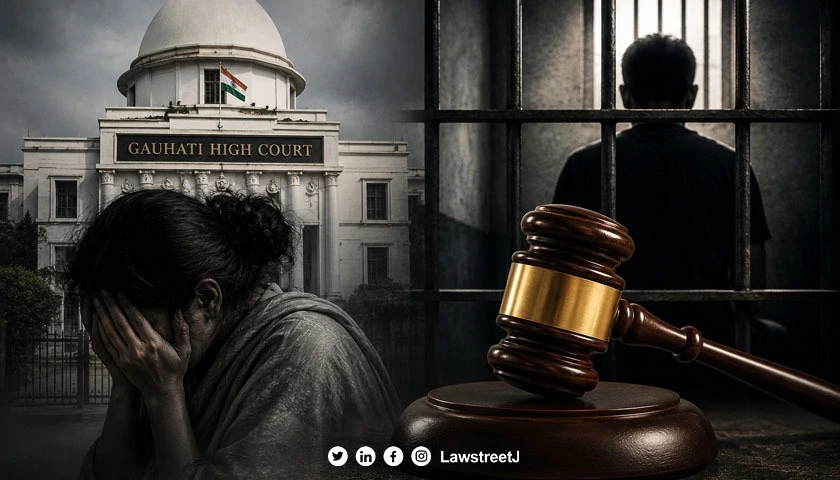
Aizawl: The Gauhati High Court (Aizawl Bench) has dismissed a criminal appeal filed by, a 33-year-old man, against his conviction for raping his own mother, upholding both his conviction under Section 376(2)(f) of the Indian Penal Code and the sentence of 15 years' rigorous imprisonment imposed by the trial court.
A Division Bench of Justice Michael Zothankhuma and Justice Budi Habung was hearing a criminal appeal filed against the judgment dated 05.07.2023 passed by the Additional Sessions Judge-1, Aizawl, in S.R. No. 110/2019, convicting the appellant, under Section 376(2)(f) IPC and sentencing him to 15 years' rigorous imprisonment along with a fine of Rs.10,000/-, in default, three months' further rigorous imprisonment, vide sentence order dated 07.07.2023.
The prosecution case was that on 23.07.2019, the appellant's mother lodged an FIR at Darlawn Police Station stating that her son had raped her at their home that evening. Pursuant to investigation, the appellant was charge-sheeted under Section 376(2)(f) IPC, and was convicted by the trial court after examination of five prosecution witnesses.
Appearing for the appellant, the Legal Aid Counsel submitted that there were discrepancies between the prosecutrix's statement recorded under Section 164 CrPC and her testimony before the trial court. It was further submitted that the appellant's sister, who had been cited as a witness in the charge-sheet and to whom the prosecutrix had first confided about the incident, was not examined by the trial court, and that this had vitiated the trial.
The Additional Public Prosecutor for the State opposed the appeal, submitting that there was no discrepancy between the Section 164 CrPC statement and the trial testimony that touched upon the core allegation of rape. It was submitted that the medical evidence, which recorded a fresh laceration on the labia minora of the prosecutrix, corroborated her testimony, and that the evidence of a neighbour, to whom the prosecutrix had confided about the assault on the same night, further supported the prosecution case. It was also submitted that there was no reason for the appellant's mother to falsely implicate her own son in a case of this nature.
On a comparison of the prosecutrix's Section 164 CrPC statement with her deposition before the trial court, the Court found no discrepancy touching the core allegation and held that her testimony was truthful, reliable, and duly corroborated. The Court noted that the medical evidence supported the prosecutrix's version, and that nothing in the appellant's statement under Section 313 CrPC cast doubt on her testimony. The Court also relied on the neighbour's evidence regarding the prosecutrix's frightened demeanour and her admission on the night of the incident as corroborating the trauma she had suffered.
Referring to the Supreme Court's ruling in R. Shahji v. State of Kerala, (2013) 14 SCC 266, the Court reiterated that a statement recorded under Section 164 CrPC could be used both for corroboration and contradiction.
The Court also drew upon the Supreme Court's recent decision in Bhanei Prasad alias Raju v. State of Himachal Pradesh, 2025 SCC OnLine SC 1636, concerning a conviction under the POCSO Act for rape of a minor by her father, and observed that its reasoning would apply, to a certain degree, to the facts before it, given that the perpetrator was the prosecutrix's own son. The Court quoted the Supreme Court's observation that “incestuous sexual violence committed by a parent is a distinct category of offence that tears through the foundational fabric of familial trust and must invite the severest condemnation in both language and sentence.”
Rejecting the argument regarding non-examination of the appellant's sister, the Court held that her absence did not vitiate the trial or cause prejudice to the appellant, since she was not an eye-witness to the incident.
Holding that there was no reason for the prosecutrix to have fabricated a case that would tarnish her own reputation as well as that of her family, the Court found no ground to interfere with the conviction and sentence, and dismissed the appeal. The Bench directed that the fees of the Legal Aid Counsel be paid by the State Legal Services Authority, in appreciation of his assistance to the Court.
Appearances:
For the Appellant: Mr. H. Zodinsanga, Legal Aid Counsel.
For the Respondent: Ms. Mary L. Khiangte, Addl. P.P., Mizoram.
Case Title: Lalzarmawia vs. State of Mizoram, Crl.A(J)/28/2025


![Justice Nongmeikapam Kotiswar Singh appointed as acting Chief Justice of Gauhati High Court [Read Press Release]](/secure/uploads/2023/01/lj_9707_5c969d0f-570f-400a-ba8b-3b65cf825540.jpg)
![Collegium Recommends Chief Justices of Delhi, Rajasthan, and Gauhati High Courts for Elevation to Supreme Court [Read Order]](/secure/uploads/2023/11/lj_9736_933a94de-bdaf-43de-944b-b0e58e17edb5.jpg)
![Supreme Court Mandates Strict Scrutiny in Sexual Harassment Allegations at Work [Read Judgment]](/secure/uploads/2023/11/lj_3478_eef290f2-6acf-4296-9ee0-adf54f275609.jpg)