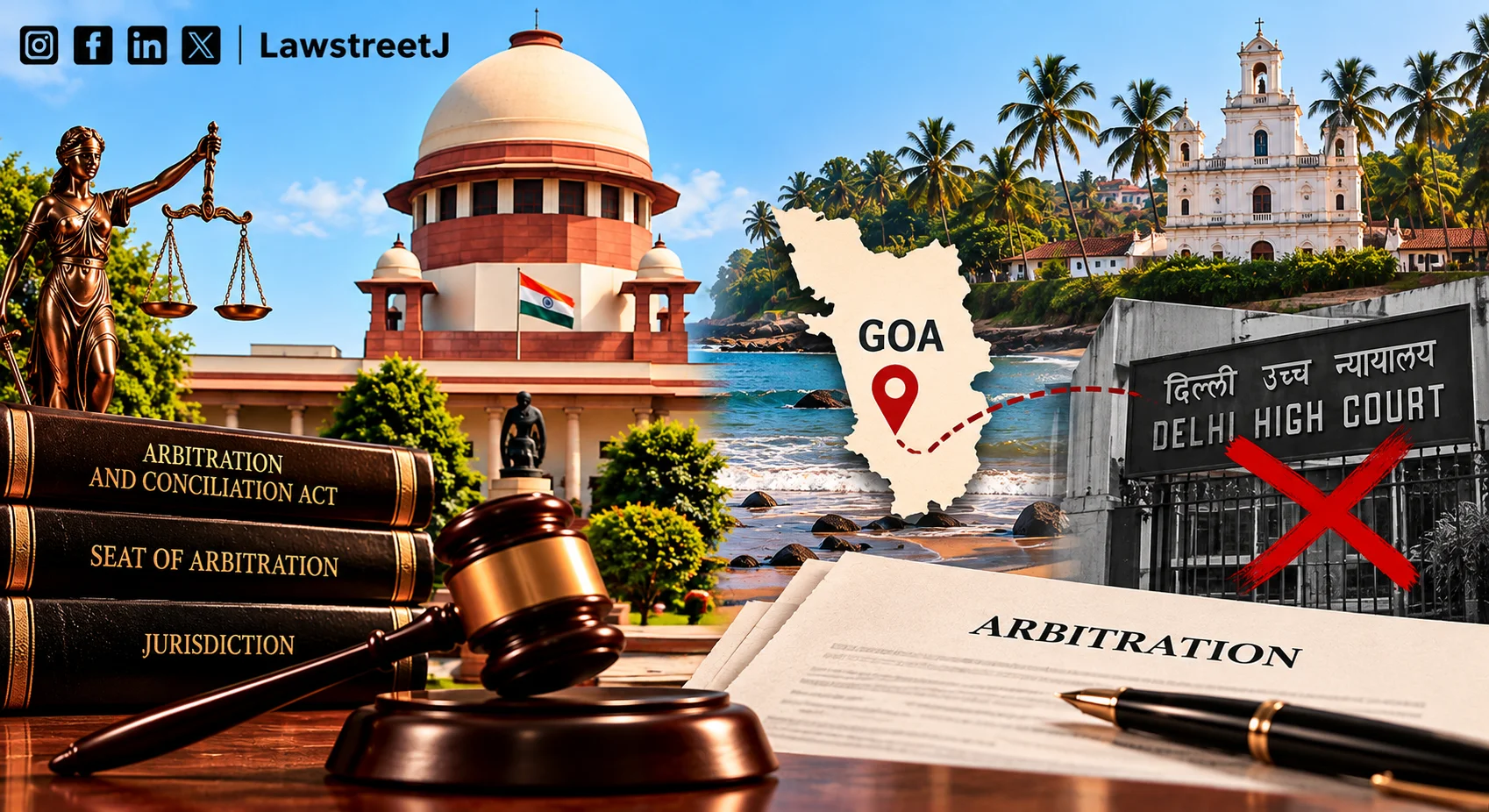
New Delhi: The Supreme Court has held that, where an arbitration clause names two places for arbitration and the governing law clause confers exclusive jurisdiction on courts at one of them, the place with exclusive jurisdiction is the juridical seat, and has accordingly set aside a Delhi High Court order appointing an arbitrator under Section 11(6) of the Arbitration and Conciliation Act, 1996, holding that the Delhi High Court lacked jurisdiction as the seat of arbitration was Goa.
A Bench of Justice Manoj Misra and Justice Vijay Bishnoi delivered the judgment on October 12, 2026, reported as 2026 INSC 1109, in a civil appeal arising out of SLP (C) No. 35915 of 2025, filed by Arcis Clean Energy Pvt. Ltd. against Parshva Innovation. The judgment was authored by Justice Manoj Misra. The appeal challenged the order dated 11th November 2025 of the Delhi High Court, which had appointed an arbitrator to resolve disputes arising out of a Franchise Agreement dated 03rd August 2023.
The respondent had proposed the name of a sole arbitrator by a notice dated 25th March 2025, which the appellant rejected by a letter dated 19th April 2025, following which the respondent approached the Delhi High Court under Section 11(6). The arbitration clause, Clause 32, provides in Clause 32.4 that the precise location of the arbitration shall be within Delhi, and in Clause 32.5 that the arbitration proceedings will be held in Goa. Clause 38, the governing law clause, provides that the parties submit to the exclusive jurisdiction of competent courts in Goa.
The appellant argued that Clause 32.4 related only to the venue, while Clauses 32.5 and 38 fixed Goa as the juridical seat, and that the High Court mistook the venue for the seat. It relied on Indus Mobile, Swastik Gases, BGS SGS SOMA JV v. NHPC, Arif Azim and Activitas Management. The respondent argued that the arbitration clause is independent of the rest of the contract, so that Clause 38 does not determine the seat, that Clause 32 specifically placed the location in Delhi, and that Clause 32.4, coming first, prevails over the later clause. It relied on Sasan Power and several High Court decisions.
Reviewing the law, the court noted that, in Indus Mobile, a seat is akin to an exclusive jurisdiction clause, so that once the seat is determined the courts at that place have exclusive jurisdiction to regulate the arbitral proceedings. Drawing on Swastik Gases, Brahmani River Pellets and Activitas Management, it said that parties can choose their place of arbitration and confer exclusive jurisdiction on the courts at a particular place, regardless of where the cause of action arose, and that the absence of words like "exclusive" or "only" is not decisive.
The court then applied the test laid down in BGS SGS SOMA and affirmed in Arif Azim, under which a place designated as venue can be construed as the seat only if, among other conditions, only one place is designated and the arbitral proceedings are fixed to that place alone without any scope of change. It held that, here, both Delhi and Goa are mentioned as places for holding arbitration, so the venue would not automatically be the seat, and that the governing law clause was therefore helpful in determining the seat.
Holding that Clause 38 confers exclusive jurisdiction on courts at Goa and Clause 32.5 provides that proceedings will be held in Goa, the court concluded that the parties had agreed that Goa is the juridical seat and Delhi is just a venue. It rejected the respondent's argument that the arbitration clause alone governs the seat, because the clause itself mentions two places, and said that, citing Mankastu Impex, the mere expression place of arbitration is not the basis to determine the seat. It said that Clauses 32.4 and 32.5, though in apparent conflict, must be construed harmoniously so that neither becomes redundant, and read with Clause 38.
The court distinguished the decisions relied on by the respondent, including Sasan Power, which holds that an arbitration agreement is independent of the main contract, on the ground that the arbitration clause here itself specifies two places, so that the governing law clause cannot be ignored, while the other cases concerned a single place or different circumstances.
Concluding on a reading of the Agreement in its entirety that the juridical seat is Goa, it held that the Delhi High Court lacked jurisdiction to entertain the application under Section 11(6), allowed the appeal and set aside the High Court's order, leaving the parties at liberty to take recourse to appropriate proceedings before the jurisdictional High Court. Pending applications were disposed of.
Case Title: Arcis Clean Energy Pvt. Ltd. vs. Parshva Innovation, Civil Appeal arising out of SLP (Civil) No. 35915 of 2025 (2026 INSC 1109)