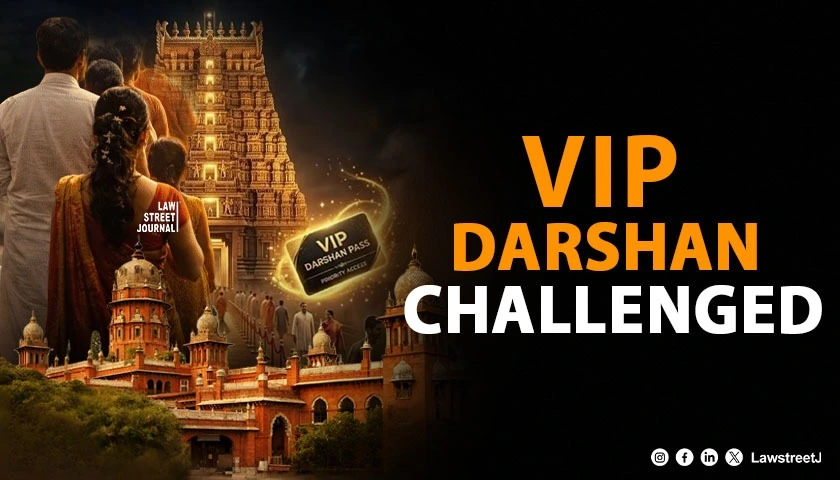
Chennai: The Madras High Court recently addressed the contentious issue of preferential treatment within religious institutions, orally remarking that all are equal before God and questioning the necessity of special access for dignitaries.
On Friday, May 29, 2026, a Division Bench comprising Justice G.R. Swaminathan and Justice V. Lakshminarayanan deliberated on a petition seeking the abolition of VIP darshan and special paid tickets in temples across Tamil Nadu.
The court’s observations struck at the heart of administrative practices in state-managed temples, emphasizing that no individual, regardless of political standing, should expect divine priority over ordinary citizens.
The proceedings were initiated by P. Chockalingam, the current President of the Vishwa Hindu Parishad’s North Tamil Nadu unit. In his plea, Chockalingam identified himself as an interested person under Section 6(15)(b) of the HR&CE Act, thereby establishing his standing to challenge the current system. The petitioner’s primary contention is that the current regime of ‘break darshan,’ ‘special darshan,’ and ‘VIP darshan’ creates a stark economic divide within sacred spaces, forcing common devotees to endure indefinite waiting periods while those with material means or political influence receive immediate access.
Central to the petitioner’s argument is the philosophical foundation of Sanatana Dharma, which he asserts does not discriminate on the basis of caste or material wealth. The plea emphasizes that ancient religious scriptures do not contain provisions for special darshan facilitated by monetary payments. Instead, the petitioner describes these practices as a “new innovation” developed by the respondent department to generate revenue and exploit the religious fervour of devotees. By charging amounts as high as ₹300 to ₹500 for expedited access, the department is alleged to be promoting class-based discrimination.
The petition further argues that these practices are in direct violation of the Constitution of India, specifically Articles 14, 19, 21, and 25. The legal challenge suggests that the introduction of such priority systems occurred primarily after Dravidian political parties assumed power in the state, transforming the nature of temple visits into a managed commercial transaction.
During the hearing, Justice G.R. Swaminathan expressed sharp skepticism toward the sense of entitlement often displayed by political figures. He remarked that ministers and members of the Legislative Assembly (MLAs) should not believe they can enter a temple at any time with the expectation that “God will be waiting for them.”
Responding to these concerns, Additional Advocate General P.V. Balasubramaniam submitted a report to the court asserting that there was no such delay in the temple’s timings on the day in question. Despite this clarification regarding the specific incident, the broader legal challenge against the VIP darshan system remains active. The state’s counsel requested additional time to file a comprehensive counter-affidavit addressing the various constitutional and scriptural points raised in the public interest litigation (PIL). Consequently, the Bench adjourned the matter for six weeks to allow the government to formalize its response.
While the petitioner seeks the general abolition of paid and VIP access, the plea does include specific exceptions for groups requiring genuine assistance. The proposed system would still allow special free darshan for jeeyars, senior citizens, differently abled persons, pregnant women, newly married couples, as well as heads of state and constitutional authorities. Furthermore, the petition requests that the court direct all temples under the HR&CE Department’s control to provide essential infrastructure, such as wheelchairs, to ensure that the elderly and infirm can navigate temple premises with dignity.
The petitioner maintains that the exploitation and “fleecing” of devotees in the name of management is unacceptable, particularly when it contradicts the fundamental tenets of the faith that the department is tasked with protecting. With the next hearing scheduled after the filing of the state’s counter-affidavit, the outcome of this case could lead to a significant overhaul of how hundreds of temples in Tamil Nadu manage their daily operations and interact with their most influential visitors.
Case Title: P. Chockalingam v. The Additional Secretary to Government



![TN Medical Council declares change of gender identity of LGBTQIA+ as misconduct [Read Notification]](/secure/uploads/2022/12/lj_5268_5cebb05a-97fb-40fb-8045-25cdf8f4207a.jpg)
![Madras High Court Directs Tamil Nadu Government to Ensure Quota for Transgenders in Local Body Elections [Read Order]](/secure/uploads/2023/08/lj_2507_7a03d113-08b1-4670-b6fb-9058aee481d0.jpg)
![Anti Corruption sleuths acted like "puppets in The Muppet Show", HC notice to ex TN CM in disproportionate assets case [Read Order]](/secure/uploads/2023/09/lj_8675_7b37fc02-1b2d-4f4a-9816-3df20545b37e.jpg)