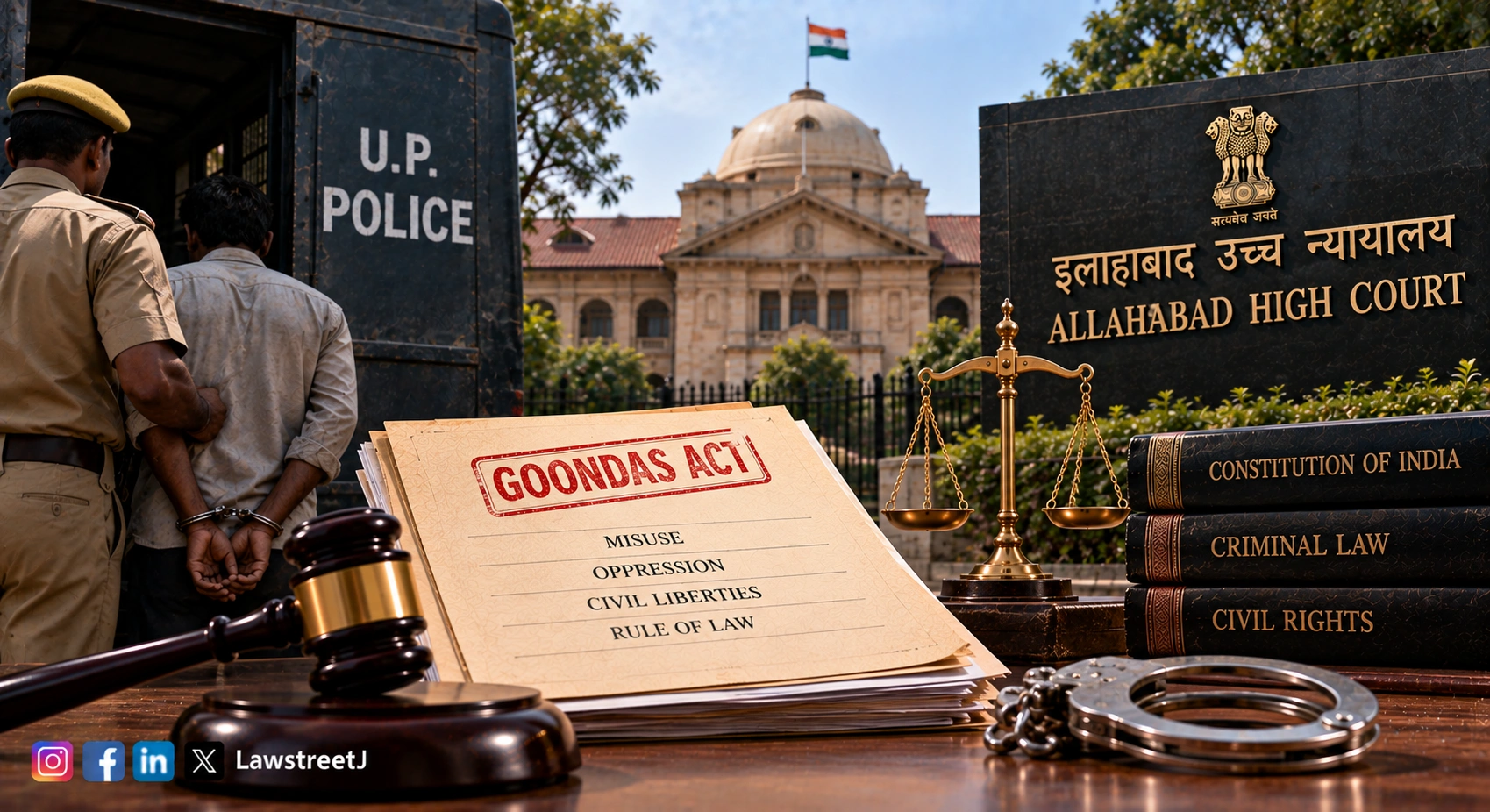
Lucknow: The Lucknow Bench of the Allahabad High Court has quashed an order externing a man from Gonda district under the U.P. Control of Goondas Act, 1970, holding that his involvement in a solitary criminal case, after his acquittal in an earlier one, could not establish that he was a habitual criminal within the meaning of the Act.
Justice Subhash Vidyarthi was hearing a writ petition under Article 226 of the Constitution challenging an order dated 11.05.2026 passed by the District Magistrate, Gonda, declaring the petitioner a Goonda and externing him from the district for six months, as well as an appellate order dated 12.08.2026 passed by the Commissioner, Devi Patan Mandal, Gonda, dismissing his appeal against the externment.
The impugned order was based on a police report describing the petitioner as a person of criminal nature involved in two cases one from 2010 concerning an alleged assault on a shopkeeper, and another from 2020 relating to alleged brick-batting at a complainant's house during the pandemic along with a beat information report verified in an inquiry. The petitioner contended before the appellate authority that he had already been acquitted in the 2010 case by the Chief Judicial Magistrate, Gonda, in 2017, and that he was now facing prosecution in only one case, lodged for political reasons.
Although the acquittal was placed on record and found mention in the appellate order, the Commissioner nevertheless recorded a finding that the petitioner remained involved in both cases, including the one in which he stood acquitted. The State, in its counter affidavit, did not dispute the fact of acquittal.
Examining the definition of ‘Goonda’ under Section 2(b) of the Act and the settled principles governing such declarations, the court reiterated that habitual conduct requires repeated and persistent acts showing a propensity to offend, that a reasonable nexus must exist between the alleged acts and the proceedings, and that the legislation is preventive rather than punitive and must be used sparingly against genuine threats to public order rather than as a tool of oppression.
The court held that involvement in a case in which the petitioner already stood acquitted could not be used as a ground to brand him a Goonda, and that mention of the acquitted case in the police report suggested the police had “deliberately portrayed a false picture of the petitioner” before the District Magistrate. It further held that the Commissioner's failure to account for the acquittal while deciding the appeal reflected non-application of mind, rendering the appellate order unsustainable. As for the beat information report, the court observed that since no opportunity of hearing had been granted to the petitioner before it was verified, it could not be relied upon consistently with principles of natural justice.
The court found that involvement in a single case lodged in 2020 could not establish habitual criminality, and that the six-year gap between the alleged acts and the 2026 externment order showed no reasonable nexus between the two. Noting that the petitioner was not shown to be a threat to public order and was already being dealt with under the ordinary penal law, the court observed that the case was “a glaring example of the abuse” of the Goonda Act, which numerous cases before it showed the State persistently using as a tool of oppression rather than public-order enforcement.
The writ petition was accordingly allowed, and both the externment order passed by the District Magistrate, Gonda and the appellate order passed by the Commissioner, Devi Patan Mandal, Gonda were quashed.
Appearances:
For the Petitioner: Mr. Kunwar Bahadur Singh, Advocate.
For the State: Mr. Ravi Srivastava, learned A.G.A.
Case Title: Zahid Ali vs. State of U.P. Thru. Prin. Secy./Addl. Chief Secy. Deptt. of Home Lko. and 4 Others, Criminal Misc. Writ Petition No. 8680 of 2026


!["No Loudspeakers For Azan, No Fundamental Right To Create Noise," Says Allahabad HC To Two Mosques [Read Judgment]](/secure/uploads/2020/01/lj_4995_Allahabad_HC_AZAN.jpg)