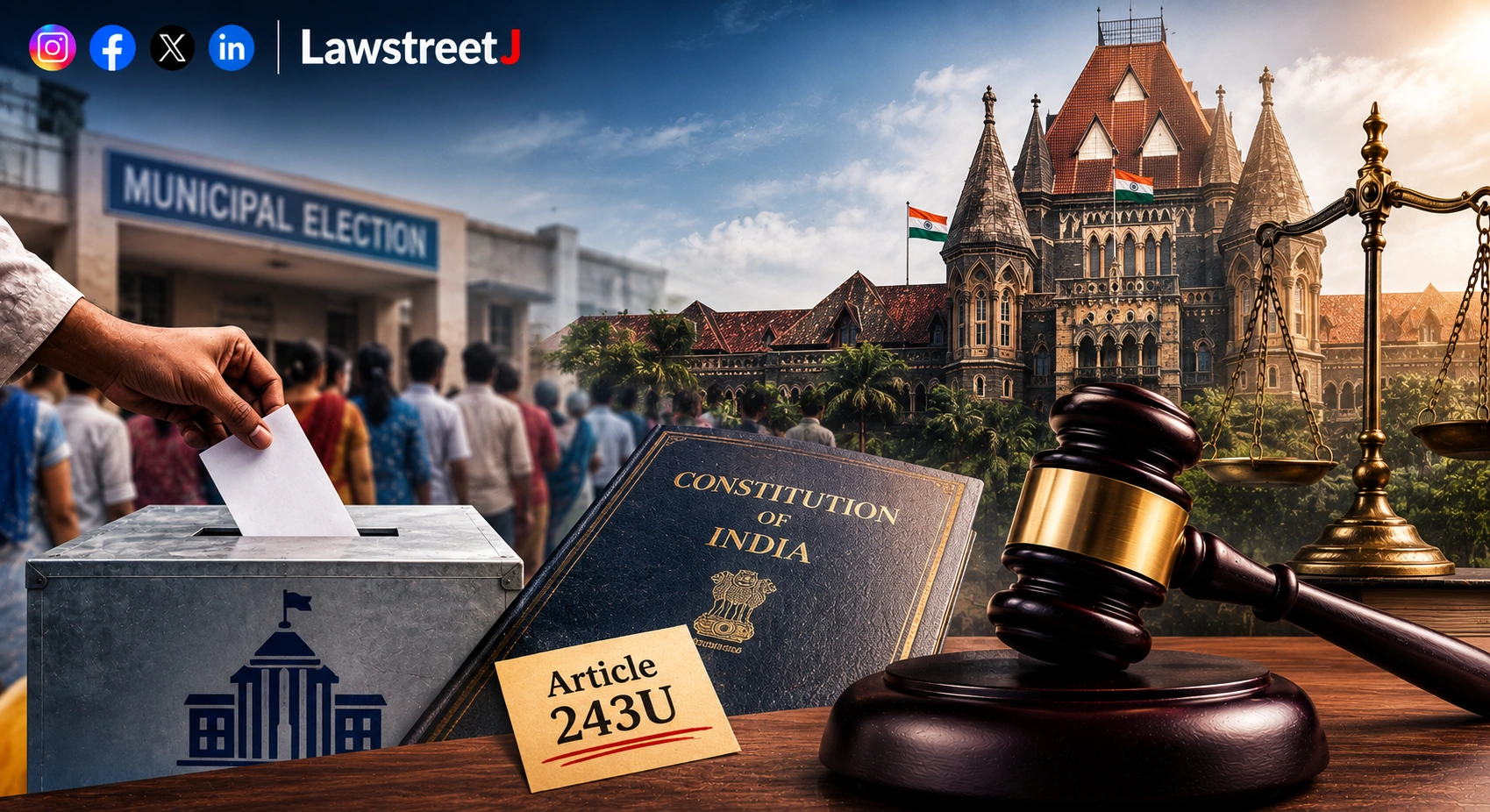
Goa: The High Court of Bombay at Goa has held that the constitutional mandate under Article 243U for timely municipal elections is binding and non-negotiable, even where the State Legislature validly amends the electoral framework after the elections have fallen due, while upholding the Goa Municipalities (Amendment) Ordinance, 2026 and fixing a strict, court-supervised timetable to complete the overdue elections to eleven Municipal Councils.
A Division Bench of Justice Valmiki Menezes and Justice Hiten S. Venegavkar (authoring the judgment) was hearing a batch of writ petitions, concerning the general elections to eleven Municipal Councils in Goa whose terms had expired between March and May 2026 without elections being held, following which the State had appointed Administrators to run them.
Before the elections could be held, the Governor of Goa promulgated the Goa Municipalities (Amendment) Ordinance, 2026 on 22 April 2026, altering the statutory regime governing composition, delimitation and reservation of wards, at a stage when the State Election Commission had already undertaken substantial preparatory steps under the pre-existing law. The Election Commission subsequently declared the earlier delimitation exercise null and void on 21 May 2026, prompting a further challenge.
The petitioners contended that Article 243U embodied an unqualified constitutional command requiring elections to be completed before expiry of a Municipality's five-year tenure, that this obligation could not be defeated by introducing a fresh statutory exercise after the elections had already become due, and that the Ordinance was constitutionally infirm under Articles 14, 213 and 243U. In the alternative, it was argued that even if the Ordinance was valid, it ought not to displace the electoral process already substantially completed under the earlier law.
The Advocate General, Mr. Devidas J. Pangam, opposed the petitions, submitting that Article 243U imposes a mandate for timely elections but does not suspend the State Legislature's power to alter the electoral framework, that the Ordinance carried the same force as an Act of the Legislature and could be struck down only on recognised grounds of legislative competence, constitutional limitation, fundamental rights or manifest arbitrariness, none of which, according to the State, was established.
Framing eight questions for determination, the court held that while Article 243ZG(a) barred adjudication of the delimitation law's merits and the Ordinance-making power was validly exercised, the timing of the legislative intervention did not excuse the continuing breach of Article 243U. The Bench declined to strike down the Ordinance or exclude it from the present election, and equally declined to freeze the process under the superseded law, holding instead that a valid intervening statute must be implemented with the compression of every avoidable delay so as to end the constitutional default at the earliest lawful date.
Articulating what it termed the principle of constitutional non-manipulability of the electoral calendar, the court observed as follows:
“The constitutional electoral calendar is not an instrument of governmental adjustment. A constitutional authority may exercise every power lawfully conferred upon it, but the timing and manner of that exercise cannot proceed on the assumption that a fixed constitutional election date will automatically yield to whatever period the exercise ultimately consumes. This is the principle of constitutional non-manipulability of the electoral calendar.”
Applying this principle, the Bench directed the State Election Commission, the State Government and the Goa State Commission for Backward Classes to complete delimitation, the contemporaneous empirical inquiry for OBC reservation, and publication of final reservation in a fixed sequence, culminating in declaration of the election programme by 10 December 2026 and declaration of results for all eleven Municipal Councils by 4 January 2027 at the outermost. The court clarified that every date fixed was an outer limit, that proximity to the Legislative Assembly election or administrative inconvenience would not justify postponement, and that compliance would be personally supervised by the State Election Commissioner, the Chief Secretary and the Member Secretary of the Backward Classes Commission.
The Petitions were accordingly disposed of, upholding the Ordinance while making Rule absolute to the extent of the directions issued, with no order as to costs.
Appearances:
For the Petitioners: Mr. Siddharth Nunes; Mr. Abhijit Gosavi with Ms. Krupa Naik and Mr. Gaurang Kerkar; Mr. Chaitanya Padgaonkar with Ms. Anushri Naik Dessai and Mr. Shlok Rai; Mr. Gaurish Agni with Mr. Yash Naik and others, Advocates.
For Respondent Nos.1 and 3 (State of Goa): Mr. Devidas J. Pangam, Advocate General, with Additional Government Advocates.
For the Goa State Election Commission: Mr. Somnath B. Karpe with Mr. Anand Shirodkar, Advocates.
For the Goa State Commission for Backward Classes: Mr. Hanumant D. Naik with Ms. Divya Naik and Ms. Dipti Kambli, Advocates.
Case Title: Nimesia Faleiro vs. State of Goa & Ors., along with connected Writ Petitions No. 1069, 1073, 1071 and 1072 of 2026, WP-300/2026 [2026:BHC-GOA:1718-DB]



![Husband Can Also Claim Alimony/Maintenance From Wife: Bombay High Court Orders Woman To Pay Alimony To Ex-Husband [Read Order]](/secure/uploads/2022/04/lj_2823_Divorce.jpg)