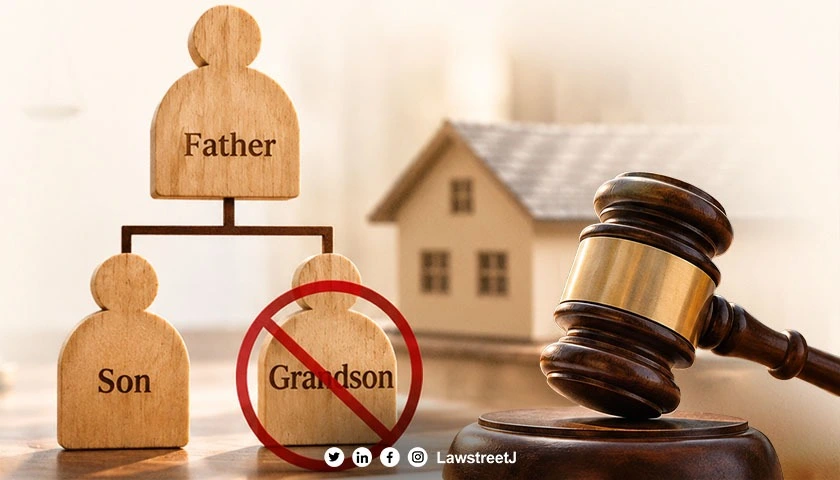
New Delhi: The Supreme Court has held that a grandson cannot claim a share by birth in property that his father received on a partition of the grandfather’s property, because that share becomes the father’s exclusive property in his individual capacity under Section 8 of the Hindu Succession Act, 1956, and has dismissed a Chennai minor’s suit for partition against his father’s purchasers.
A Bench of Justice Sunita Agarwal and Justice Augustine George Masih delivered the judgment on 6 November 2026 (2026 INSC 1208), authored by Justice Agarwal, in Civil Appeal No. 7020 of 2012.
The suit (O.S. No. 1698 of 1997) was filed by J. Rajesh, a minor, through his mother and natural guardian, for partition and possession of a half share in 1,811 sq. ft. of land in Chennai, which he said was ancestral property of his grandfather, N. Ramakrishnan. The appellant was born on 06.01.1994. A suit for partition of the grandfather’s property had been filed in 1993 by the father’s sister, and was decreed on a compromise dated 03.02.1994, under which the father got the suit land. The father sold it to defendants 2 and 3 by sale deeds dated 03.04.1997 and 17.04.1997, and the appellant did not challenge the compromise decree or the sale deeds.
The Trial Court passed a preliminary decree for partition, but the First Appellate Court set it aside, and the High Court in its judgment dated 11.08.2010 held that the appellant did not acquire a right by birth in the property which came to his father on partition. In the Supreme Court, the appellant’s counsel relied on Section 29-A of the Hindu Succession (Tamil Nadu Amendment) Act, 1989, saying that the father’s share did not become self-acquired, that the appellant was not made a party to the compromise decree despite having been born before it was passed, and that the purchasers could not acquire greater rights than the father. The father remained ex parte until his death in 2024.
The respondents argued that the case concerns a grandson seeking succession in his grandfather’s property, which is governed by Section 8 of the 1956 Act, under which a son’s son is not a Class I heir, that Sections 6 and 29-A are not attracted, and that the father was the absolute owner after the compromise and could sell it. They also said that the suit, filed with the father not contesting it, was collusive, and that the purchasers were innocent.
The Court relied on Commissioner of Wealth Tax v. Chander Sen, Yudhishter v. Ashok Kumar and later decisions of the Court, which hold that property inherited by a son under Section 8 is held by him in his individual capacity and not as karta of his own undivided family, since the express words of Section 8, which exclude a son’s son but include a predeceased son’s son, cannot be ignored.
The Court held that, on the death of N. Ramakrishnan, the property devolved on his Class I heirs under Section 8 and did not constitute joint family property of the son’s own branch, including the grandson. Under the compromise decree, each heir became exclusive owner of the share allotted, as tenants in common and not joint tenants, so the joint coparcenary did not continue. Since the succession opened before the appellant was born, there was no question of devolution of an interest in the suit property upon him.
On Section 29-A of the Tamil Nadu Act, the Court said that it concerns daughters’ coparcenary rights and that, since the grandfather’s share was partitioned among Class I heirs in 1993-94 and the appellant’s father was alive, Sections 6 and 29-A had no application. The appellant, it held, was not a “surviving coparcener” on his grandfather’s death. It also noted that he sued in 1997 without challenging the partition decree or the sale deeds during his father’s lifetime.
The Court concluded that, on the partition decree, the property that fell to the share of the appellant’s father “became his exclusive property in his individual capacity” and was not coparcenary, so there was no question of the appellant acquiring rights in it by birth. Finding no infirmity in the High Court’s judgment, it dismissed the appeal with no order as to costs and disposed of all pending applications.
Appearances: For the Appellant: Mr. K. Paari Vendhan, Advocate. For the Respondents: Mr. K.K. Mani, Advocate.
Case Title: J. Rajesh (Minor) through his Mother and Natural Guardian J. Gomathi v. M. Kumaran (Dead) through LRs and Others, Civil Appeal No. 7020 of 2012