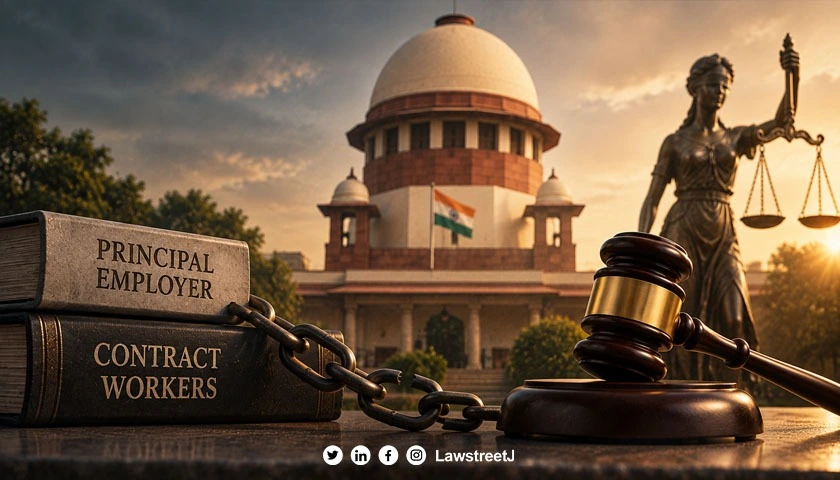
New Delhi: The Supreme Court has set aside a Bombay High Court order that had fastened liability to pay gratuity on the Oil and Natural Gas Corporation Ltd. (ONGC) as principal employer of workers engaged through a contractor, holding that the Controlling Authority under the Payment of Gratuity Act had no jurisdiction to adjudicate the question of employer liability, its power being confined to computing the amount payable to an "employee".
A Bench of Justices Ahsanuddin Amanullah and Manmohan was hearing a batch of civil appeals filed by ONGC, arising out of Special Leave Petitions including SLP(C) No. 498/2024, SLP(C) No. 27228/2023, SLP(C) No. 27407/2023 and SLP(C) No. 499/2024, against a common order of the Bombay High Court.
The appeals arose from a common order dated 23.08.2023 passed by the Bombay High Court in a batch of writ petitions, by which the liability to pay gratuity to several private respondents, workers who had been engaged through contractors to work at ONGC's establishments, was fastened on ONGC. The Controlling Authority had initially held ONGC liable to pay gratuity to these workers despite being informed that it had no jurisdiction to decide questions of liability and that ONGC was not their employer. The Appellate Authority reversed this finding in ONGC's favour, but the High Court, in the impugned order, reversed the Appellate Authority and restored the Controlling Authority's finding of liability against ONGC. Notice had been served on all respondents, but only a limited number entered appearance, and none, apart from respondent No. 8, a contractor, appeared before the Court when the matter was heard; a counter affidavit filed on behalf of respondent Nos. 1 to 7 relied mainly on the length of their service without addressing the jurisdictional objection raised by ONGC.
Learned Solicitor General Mr. Tushar Mehta, appearing for ONGC, submitted that under Section 4 of the Payment of Gratuity Act, gratuity is payable only to an "employee", and that the private respondents were not employees of ONGC, there being no employer-employee relationship between them. He submitted that under Section 21(4) of the Contract Labour (Regulation and Abolition) Act, 1970, the principal employer's residual responsibility extends only to wages and not to gratuity, which is a distinct component excluded from the definition of wages under Section 2(vi) of the Payment of Wages Act, 1936. He relied on Clause 12.4.1 of the contract between ONGC and the contractor, which expressly stated that the agreement was a job contract at arm's length and created no employer-employee relationship between ONGC and the contractor's employees. He further submitted that the Controlling Authority's jurisdiction under the Gratuity Act was confined to computing the amount of gratuity payable, and that adjudicating and fastening liability on ONGC was wholly beyond its jurisdiction. He relied on a recent decision of a coordinate Bench in Municipal Council, Nandyal Municipality v. K. Jayaram, dated 16.12.2025, holding that a worker sent to an establishment through a contractor cannot claim an employer-employee relationship with the principal employer.
Counsel for respondent No. 8, the contractor, submitted that liability did not rest on him, since any amount payable would ultimately have to come from the principal employer, namely ONGC.
The Court agreed with the Solicitor General that the proceedings before the Controlling Authority were not maintainable to the extent they sought adjudication of liability, since the only power conferred on the Controlling Authority under the statute was to compute the amount payable to an "employee", and that the Appellate Authority had rightly interfered on this ground. It held that the High Court's reversal of the Appellate Authority's order was not justified, and found the Solicitor General's contentions under the Payment of Wages Act and the CLRA Act to be sustainable as well, though it declined to rely further on the Nandyal Municipality decision given the order it proposed to pass.
Accordingly, on the short ground that the Controlling Authority lacked jurisdiction to decide the dispute raised by the private respondents, the Court allowed the appeals, set aside the High Court's order, and revived the order of the Appellate Authority. It clarified, however, that since the gratuity amount claimed had already been paid to the workers pursuant to an earlier order of the Court dated 15.12.2023, no recovery would be made from them. The appeals, along with pending applications, were disposed of in these terms.
Case Title: M/s Oil and Natural Gas Corporation Ltd. vs. Suryakand D. Lad & Ors., Civil Appeal arising out of SLP(C) No. 498/2024, with connected appeals arising out of SLP(C) No. 27228/2023, SLP(C) No. 27407/2023 and SLP(C) No. 499/2024