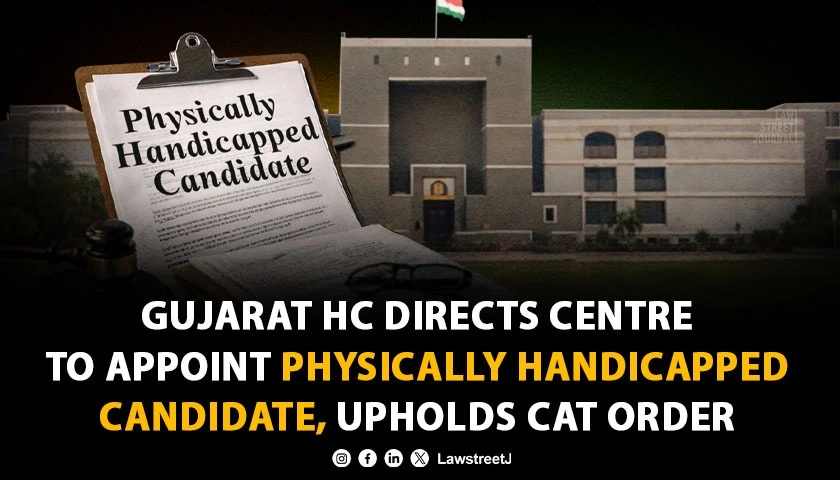
Gujarat: The Gujarat High Court dismissed a writ petition filed by the Union of India challenging a Central Administrative Tribunal (CAT) order directing the appointment of a physically handicapped candidate as Postal Sorting Assistant.
The Division Bench comprising Justice N.S. Sanjay Gowda and Justice J.L. Odedra delivered the judgment on March 16, 2026, in Special Civil Application No. 16411 of 2023.
The respondent, Chirag, son of Hashmukhrai Nandlal Bhatt, had applied for the post of Postal Sorting Assistant under the Union of India. The post carried an educational eligibility condition requiring candidates to have passed the 10+2 examination with English as a compulsory subject.
Upon submission of his application, the authorities examined the respondent’s mark sheet and found that English was not listed as a compulsory subject in his 10+2 examination. However, proceedings revealed that the respondent had indeed studied and passed English, albeit as an additional subject rather than a compulsory one. On this basis, the Union of India rejected his application, contending that he did not meet the prescribed educational qualification and that there had been a misrepresentation of fact on his part.
Aggrieved by the rejection, the respondent approached the Central Administrative Tribunal seeking relief. At the CAT, it was revealed that an identical controversy involving similarly placed candidates had already been litigated previously. The Union’s argument that passing English as an additional subject rather than a compulsory subject rendered a candidate ineligible had been specifically considered and rejected in that earlier round of litigation. The CAT had accepted that position, and the order passed by the CAT in those earlier proceedings had been confirmed by the Division Bench of the Gujarat High Court in SCA No. 10463 of 2015 and connected matters.
Taking note of this settled legal position, the CAT concluded that the rejection of the respondent’s application was not justified. It quashed the order of rejection and directed the Union of India to issue an order of appointment in favour of the respondent.
Unwilling to accept this outcome, the Union of India filed the present writ petition before the Gujarat High Court challenging the CAT’s order.
Before the High Court, the Union pressed two main arguments. The first was on the merits of eligibility, contending that the respondent’s mark sheet plainly showed he had not passed 10+2 with English as a compulsory subject, and therefore the rejection was justified. The second argument was that the respondent was a “fence sitter.” The Union contended that he had not acted promptly and had approached the CAT only after observing that similarly situated candidates had already succeeded in their legal proceedings. According to the Union, such conduct disentitled the respondent from receiving any relief.
The High Court rejected both contentions. On the question of eligibility, the Court noted that the very same argument had been addressed and conclusively rejected by the Division Bench in SCA No. 10463 of 2015. In those proceedings, the question of whether passing English as an additional subject satisfied the requirement of having English as a compulsory subject was directly considered. Since that matter had been concluded at the level of a Division Bench of the same Court, the Union could not re-agitate the issue in the present proceedings.
On the “fence sitter” argument, the Court noted the undisputed and important fact that the respondent was a physically handicapped candidate. The Court held that, given this particular circumstance, applying the doctrine of fence sitter in its strict sense would not be appropriate. The Court observed that it is the legislative policy of the nation to encourage persons with physical disabilities and that reservations are also extended to them by law. The Court further observed that the post of Postal Sorting Assistant is one that can ideally accommodate persons who suffer from disabilities. In this backdrop, the Court held that the mere fact that the respondent approached the CAT with some delay could not be a ground to deny him relief.
The Court also pointed to a procedural aspect that further weakened the Union’s position on the delay argument. While entertaining the respondent’s application, the CAT exercised its discretion to condone the delay in filing. This order condoning the delay was never challenged by the Union of India. Since it was not challenged, it had attained finality. The Court therefore held that the question of delay was no longer available to the Union as a ground to oppose the respondent’s claim.
Finding no merit in either of the two contentions raised by the Union, the High Court declined to interfere with the CAT’s order and dismissed the writ petition.
Appearance:
For the Petitioners: Mr. Shushil R. Shukla, Advocate
For the Respondent: Mr. Anand B. Gogia and Ms. Kajal L. Kalwani, Advocate
Case Title: The Union of India & Ors. versus Chirag S/o Hashmukhrai Nandlal Bhatt (2026:GUJHC:20531-DB)


.jpg)
![Gujarat High Court Denies Bail to Man for Obscene Comments on PM and Late Mother [Read Order]](/secure/uploads/2023/06/lj_1661_9baa7d8a-0faf-4761-b395-81c631cd129f.jpg)