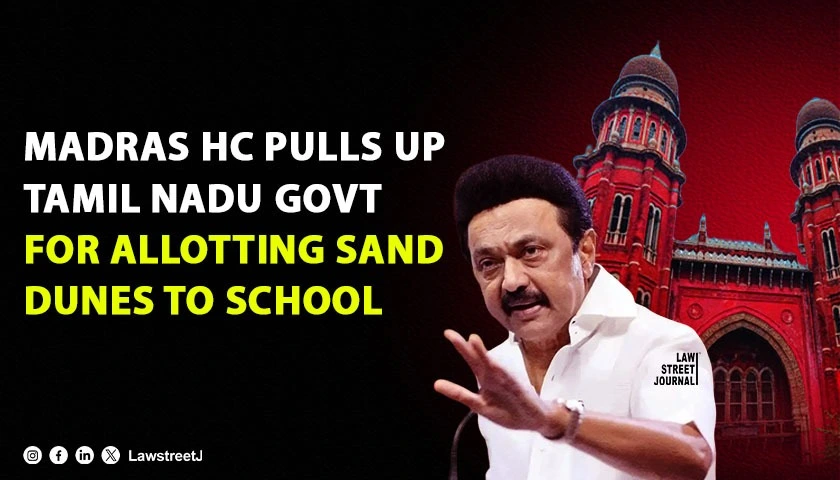
Chennai: The Madras High Court has strongly criticised the Government of Tamil Nadu for proposing to allot ecologically sensitive sand dune land to a private school as compensation for reclaiming the school’s original plot, which had been mistakenly auctioned off by the State in 1979 for temple purposes.
Justice D. Bharatha Chakravarthy, while disposing of the writ petition on February 25, 2026, quashed the impugned government order and directed fresh identification of suitable alternative land.
The dispute traces its roots to 1979, when the Tamil Nadu government allotted land measuring 5.77 acres in Koothapakkam Village, Cuddalore District, to St. Joseph’s Matriculation Higher Secondary School. The school paid full and valuable consideration for the land. However, years later, objections were raised by devotees of the Arulmigu Devanatha Swamy Temple, who claimed that the land in question had historically been associated with the temple and was wrongly auctioned after being taken over from the Hindu Religious and Charitable Endowments Department.
Acting on these objections, the government issued G.O. Ms. No. 322, School Education Department, dated December 7, 2009, resuming the land from the school. The school challenged this order before the Madras High Court in W.P. No. 27377 of 2009. During the hearing, both sides arrived at a settlement in the spirit of communal harmony. The school agreed to surrender the disputed land back to the temple on the condition that the government would allot alternative land of not less than 4.5 acres near Cuddalore town with road access. The court disposed of the petition on August 30, 2019, recording these undertakings and directing the Revenue Secretary to complete the exercise within three months.
Despite the court’s clear directions, the government took no meaningful steps for years. When a contempt petition was filed in 2025, the government issued G.O. Ms. No. 414, Revenue and Disaster Management and Land Settlement Department, dated July 1, 2025. Under this order, while the school’s original land was valued at Rs. 8,14,68,750, the alternative land proposed at S. No. 74/1, Periyapattu Village, Bhuvanagiri Taluk, Cuddalore District, was valued at a mere Rs. 2,17,78,875, which is less than 25 percent of the value of the land taken from the school. The proposed land was classified as “Government Poramboke, sand dune” and was located approximately 34 kilometres away from Cuddalore, with no road access whatsoever.
The school challenged the order, arguing that the allotment was grossly inequitable and that the land was entirely unsuitable for educational purposes. The petitioner further submitted that the market value of the original land was approximately Rs. 40 crores, making the government’s offer even more inadequate. The school contended that since it had voluntarily relinquished its land in good faith to maintain communal harmony, the State was bound to honour its promise by providing land of comparable value and utility.
The court came down heavily on the government’s conduct. Justice Chakravarthy observed that sand dunes are ecologically irreplaceable, as they serve as natural storm buffers, act as sand reservoirs, and provide crucial habitats for various species of flora and fauna.
Quoting French astrophysicist Hubert Reeves, the court remarked that man is the most insane species, as he worships an invisible God and destroys a visible Nature, unaware that the Nature he destroys is the very God he worships. The court found the government’s action to be a textbook example of this contradiction, noting that, in trying to protect the sentiments of temple devotees, the authorities had attempted to give away ecologically precious land that could itself be seen as a living form of the deity.
The court held that the government had acted in violation of the public trust doctrine by proposing to hand over such ecologically sensitive land. It referred to the Supreme Court’s ruling in Intellectuals Forum v. State of Andhra Pradesh, which held that the State holds public lands in trust and has a duty to preserve their traditional use. The court also cited the Supreme Court’s decision in State of Telangana v. Mohammed Qasim, which recognised that ecosystems are not merely objects for protection but subjects with fundamental rights to survive and exist.
During the proceedings, the State explored three alternative plots. The first, S. No. 137/2, covered only 2 acres and was located 12 kilometres from Cuddalore town, which the school found unacceptable. The second, S. No. 37/1, Arisi Periyankuppam Village, measured a mere 67 ares—far below the minimum required for a school. The third option, S. No. 146/7, Thiruvanthipuram Village, was found acceptable to the school. However, the government backtracked at the last moment, claiming that the land might be needed for public purposes, drawing sharp criticism from the court.
Therefore, while disposing of the writ petition, the court quashed G.O. Ms. No. 414 dated July 1, 2025, in its entirety.
The school was directed to approach the District Collector, Cuddalore, with a copy of the order. The Collector was directed to thoroughly investigate the feasibility of allotting land in S. No. 146/7 of Thiruvanthipuram Village and, if found suitable, allot an appropriate extent reflecting equal value to the school. If that land is not feasible, the Collector must identify any other suitable land within or around Cuddalore Corporation within four weeks, finalise it, and present it to the government for issuing necessary orders within six weeks.
If no suitable land is identified within the stipulated period, the court directed that the value of the land be refunded to the petitioner. No costs were awarded.
Appearances:
For the Petitioner: Father Xavier Arulraj, Senior Counsel, for M/s. Father Xavier Associates
For the Respondents: Mr. J. Ravindran, Additional Advocate General, assisted by Mr. S. Senthil Murugan, Special Government Pleader, for Respondents 1 to 4
Case Title:
St. Joseph’s Matriculation Higher Secondary School v. The Additional Chief Secretary, Government of Tamil Nadu and Others



![TN Medical Council declares change of gender identity of LGBTQIA+ as misconduct [Read Notification]](/secure/uploads/2022/12/lj_5268_5cebb05a-97fb-40fb-8045-25cdf8f4207a.jpg)
![Madras High Court Directs Tamil Nadu Government to Ensure Quota for Transgenders in Local Body Elections [Read Order]](/secure/uploads/2023/08/lj_2507_7a03d113-08b1-4670-b6fb-9058aee481d0.jpg)
![Anti Corruption sleuths acted like "puppets in The Muppet Show", HC notice to ex TN CM in disproportionate assets case [Read Order]](/secure/uploads/2023/09/lj_8675_7b37fc02-1b2d-4f4a-9816-3df20545b37e.jpg)