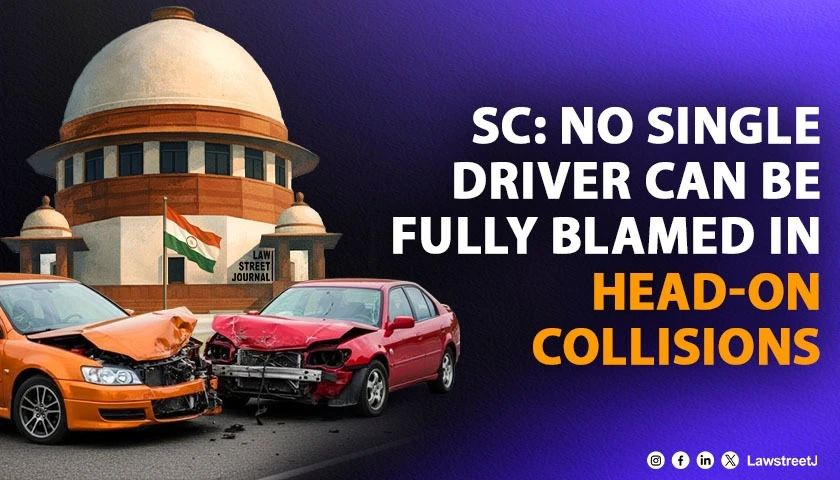
New Delhi: The Supreme Court of India has held that in cases arising out of motor accidents, particularly head-on collisions, the determination of negligence must be founded upon a balanced and objective assessment of the conduct of all parties involved.
The Court further held that once a Tribunal frames a specific issue, it is incumbent upon it to record a finding thereon supported by reasons, and that a failure to return a categorical finding on a material framed issue—such as the validity of the driving licence of the driver of the offending vehicle—renders the award incomplete and legally infirm.
Accordingly, the impugned judgments of the Motor Accident Claims Tribunal, Bhiwani, and the High Court of Punjab and Haryana were set aside, and the matter was remanded to the Tribunal for fresh adjudication.
The case originated from a road accident wherein Hari Om and Sher Singh were travelling by car from Madina to Mundhal. At around 3:30 PM, near Balambha Mor towards Meham, a Haryana Roadways bus driven by Rajender allegedly, in a rash and negligent manner, collided head-on with their vehicle, resulting in the death of both occupants. The incident was witnessed by Baljeet and his son, who were following the car at the time.
In the aftermath of the accident, an FIR was registered under Sections 279 and 304-A of the Indian Penal Code, 1860. Three separate claim petitions were thereafter instituted before the Motor Accident Claims Tribunal, Bhiwani. The legal heirs of Hari Om—his widow Parmila, his mother Guddi, and his father Baljeet Singh—filed a claim petition seeking compensation of ₹50,00,000, pleading that the deceased was an agriculturist and driver earning approximately ₹20,000 per month, and that a sum of ₹50,000 was incurred towards transportation and last rites.
A separate claim petition was instituted by the legal representatives of Sher Singh, aged about 45 years, who was stated to be an agriculturist and milk dairy operator earning approximately ₹35,000 per month, also seeking compensation of ₹50,00,000. A third petition was filed by Baljeet Singh as the owner of the car, seeking ₹2,00,000 for the damage caused to the vehicle, which was asserted to have been rendered wholly unfit for repairs.
The Tribunal framed seven issues for determination, including whether the accident occurred due to the rash and negligent driving of the bus by Respondent No. 1, Rajender; whether each set of claimants was entitled to compensation; and, crucially, whether Respondent No. 1 possessed a valid driving licence and whether the vehicle was being driven in violation of the terms and conditions of the insurance policy at the time of the accident.
By its award dated 28 September 2011, the Tribunal dismissed all three claim petitions, holding that the accident and the resultant fatalities were attributable entirely to the negligence of the deceased Hari Om, the driver of the car, and accordingly fastened no liability upon Respondent No. 1, Rajender; Haryana Roadways, Rohtak; or its insurer, ICICI Lombard. The Tribunal declined to return any finding on the issue relating to the validity of Rajender’s driving licence, reasoning that the said issue did not call for consideration in view of its finding that Rajender was not responsible for the accident.
The petitioners preferred appeals before the High Court of Punjab and Haryana, which, by its common judgment dated 26 March 2019, dismissed both appeals, finding no merit therein, and affirmed the findings and award of the Tribunal. The petitioners thereafter approached the Supreme Court under Article 136 of the Constitution of India.
On behalf of the petitioners, it was submitted that the courts below had gravely erred in dismissing the claim petitions, having failed to properly appreciate the material on record and the settled principles governing adjudication of claims under the Motor Vehicles Act, 1988. It was contended that the findings returned by the Tribunal and affirmed by the High Court were vitiated by misappreciation of evidence in attributing negligence solely to the deceased Hari Om, without due regard to the attending facts and circumstances, and that the impugned judgments suffered from manifest errors apparent on the face of the record, warranting interference by the Supreme Court in exercise of its extraordinary jurisdiction under Article 136.
Per contra, the respondents supported the impugned judgments as well-reasoned and based on proper appreciation of the material on record, and submitted that the findings were pure findings of fact not warranting interference, and that no case of perversity, illegality, or material irregularity had been made out.
The Supreme Court, speaking through Justice Sandeep Mehta, expressed perplexity at the findings of the courts below, which completely absolved Respondent No. 1, Rajender, of even any contributory negligence. The Court held that it was prima facie of the view that the conclusion attributing the entire blame for the accident to the deceased Hari Om—without attributing any degree of contributory negligence to the bus driver—appeared to have been arrived at in the absence of a proper and comprehensive consideration of the attendant facts and circumstances.
The Court reiterated the settled principle that in motor accident cases, the determination of negligence must be based on a balanced and objective assessment of the conduct of all parties involved, particularly where the circumstances suggest a possible sharing of responsibility. The complete exclusion of contributory negligence on the part of one driver in a head-on collision ordinarily warrants careful scrutiny of the surrounding circumstances, including the manner of driving, the point of impact, and other attendant factors—an exercise that the impugned findings did not reflect as having been undertaken.
The Court further held that a crucial aspect of the matter had been completely glossed over by both the Tribunal and the High Court. It noted that Respondent No. 1, Rajender, being the driver of the offending bus, would have been the best person to narrate the manner in which the accident took place. The specific plea of the claimants—that Rajender did not possess a valid and effective driving licence authorising him to drive a heavy passenger vehicle—coupled with the fact that, despite having appeared and filed a written statement, Rajender did not enter the witness box either on his own behalf or on behalf of Haryana Roadways, Rohtak, assumed considerable significance.
The Court held that these aspects were germane to the determination of negligence and attribution of responsibility for the accident, yet had not been duly considered by the courts below. The Court also noted the specific plea that Rajender was undergoing training under a senior driver at the relevant time, which made the question of his competence, authorisation, and the validity of his driving licence go to the very root of the matter.
The Court held that the Tribunal’s failure to return any categorical finding on the framed issue relating to the validity of Rajender’s driving licence—merely on the premise that he was not found responsible for the accident—amounted to non-consideration of a material issue arising from the pleadings, which bore directly upon the determination of liability.
The Court also reiterated that once an issue is framed, it is incumbent upon the adjudicating forum to record a finding thereon supported by reasons, particularly when the same has a bearing on the rights and liabilities of the parties. The question of whether the driver possessed a valid and effective driving licence was held to be relevant not only for determining the inter se liability between the insurer and the insured, but also to the overall adjudicatory exercise. In the absence of a reasoned determination on this vital aspect, the award was held to suffer from manifest infirmity. The High Court’s affirmation of the award, without independently examining this material issue, was similarly held to be erroneous.
Accordingly, the impugned judgments were set aside, and the matter was remanded to the Motor Accident Claims Tribunal, Bhiwani, for fresh consideration of Claim Petition Nos. 53 of 2009 and 48 of 2011 in accordance with law, after affording due opportunity to all parties and returning clear findings on all issues framed. The Registry was directed to forward a copy of the order to the Tribunal for necessary action.
The bench comprised Justice Vikram Nath, Justice Sandeep Mehta, and Justice Vijay Bishnoi.
Case Title: Parmila & Ors. v. Rajender & Ors. [SLP (C) No. of 2026 @ Diary No. 27743/2022] [2026 INSC 420]