New Delhi: The Supreme Court has set aside a judgment of the Orissa High Court which had held that a petition under Section 34 of the Arbitration and Conciliation Act, 1996 filed by Mahanadi Coalfields Ltd. before the District Judge, Sundargarh was not maintainable, holding that the High Court had erred both in treating Cuttack as the juridical seat of arbitration and in holding the petition to be barred by limitation.
Justice Sanjeev Sachdeva, delivering the judgment for the Bench also comprising Justice Sanjay Kumar, was hearing a civil appeal filed by Mahanadi Coalfields Ltd. and others against the judgment dated 20.06.2025 of the High Court, whereby the High Court had allowed a writ petition filed by the Respondent, M/s GSCO (Gurmeet Singh and Company) Infrastructure Pvt. Ltd., and held that the Section 34 petition filed by the Appellants was not maintainable for want of territorial jurisdiction and being barred by limitation.
The dispute arose out of a 2012 tender for hiring of heavy earth-moving machinery for works at the Kulda Open Cast Project in Sundargarh, awarded to the Respondent. Disputes having arisen during execution of the contract, which contained no arbitration clause, the Respondent approached the High Court at Cuttack, which by a common order dated 25.03.2019 appointed a Sole Arbitrator under Section 11(6) of the Act. After the Arbitrator passed a common Award on 25.10.2021 in the Respondent's favour, the Appellants filed three petitions under Section 34 of the Act before the District Judge, Sundargarh, seeking to set aside the Award.
The Respondent objected to the maintainability of these petitions on two grounds: that they were barred by limitation, and that the District Judge, Sundargarh lacked territorial jurisdiction since the seat of arbitration was Cuttack. Though the District Judge rejected these objections, the High Court, in the impugned judgment, upheld both objections, holding that since the Arbitrator had been appointed by the High Court at Cuttack in exercise of its power under Section 11(6), Cuttack was the seat of arbitration and, by virtue of Section 42 of the Act, alone had jurisdiction over all subsequent applications including the Section 34 petitions.
The Learned Attorney General, appearing for the Appellants, submitted that the finding of limitation was contrary to the admitted facts, since the petitions under Section 34 were filed on 08.12.2021, well within three months of the Award dated 25.10.2021. Mr. Ashok Panigrahi, learned Senior Counsel appearing for the Respondent, fairly conceded that the High Court's finding on limitation was erroneous.
On the question of jurisdiction, the Attorney General submitted that the contract itself, under Clause 12 of the General Terms and Conditions and Clause 40 of the eTender Notice, stipulated that disputes would be subject to the jurisdiction of the court within whose territory the work was executed, namely Sundargarh, and that no Commercial Court having been notified for Sundargarh, the Section 34 petitions were rightly filed before the District Judge there.
Accepting these submissions, the Court held that the order dated 25.03.2019 referring the disputes to the Arbitrator did not specify any seat or venue, and there was no agreement between the parties designating Cuttack as the seat. The arbitral proceedings, the Court noted, were held at Cuttack only for the convenience of the Arbitrator, which by itself could not determine the juridical seat. Distinguishing Bharat Aluminium Co. v. Kaiser Aluminium Technical Services Inc., Indus Mobile Distribution Pvt. Ltd. v. Datawind Innovations Pvt. Ltd. and BGS SGS Soma JV v. NHPC Ltd., the Court held that none of these decisions assisted the Respondent since no seat had ever been expressly designated or consented to.
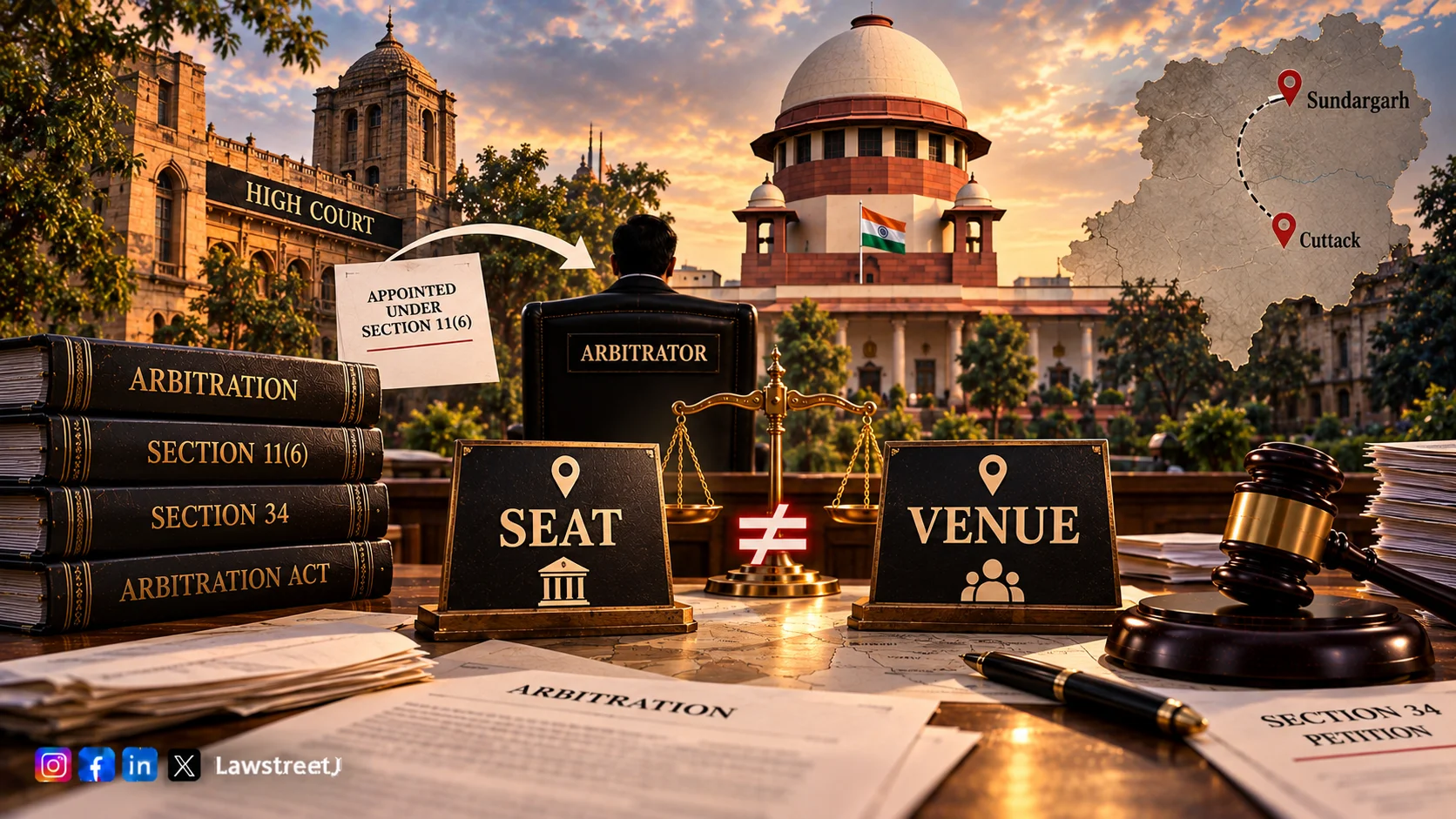
The Court observed that “there is a distinction between ‘seat’ and ‘venue’ of arbitration. While ‘Seat’ determines the Courts exercising supervisory jurisdiction over the arbitration proceedings, ‘Venue’ merely denoted the physical location where the sitting are held.”
The Court further held that the High Court had erred in equating the seat of arbitration with the seat of the High Court itself, clarifying that a High Court exercises jurisdiction over the entire State, and that all Commercial or District Courts within its territorial jurisdiction would be competent to entertain a Section 34 petition unless the parties had agreed otherwise or a seat had been specifically determined.
Accordingly, the appeal was allowed, the impugned judgment of the High Court was set aside, and the Section 34 petitions filed by the Appellants were restored to the file of the District Judge, Sundargarh, with a direction to decide the same expeditiously in accordance with law.
Case Title: Mahanadi Coalfields Ltd. & Ors. vs. M/s GSCO (Gurmeet Singh and Company) Infrastructure Pvt. Ltd.