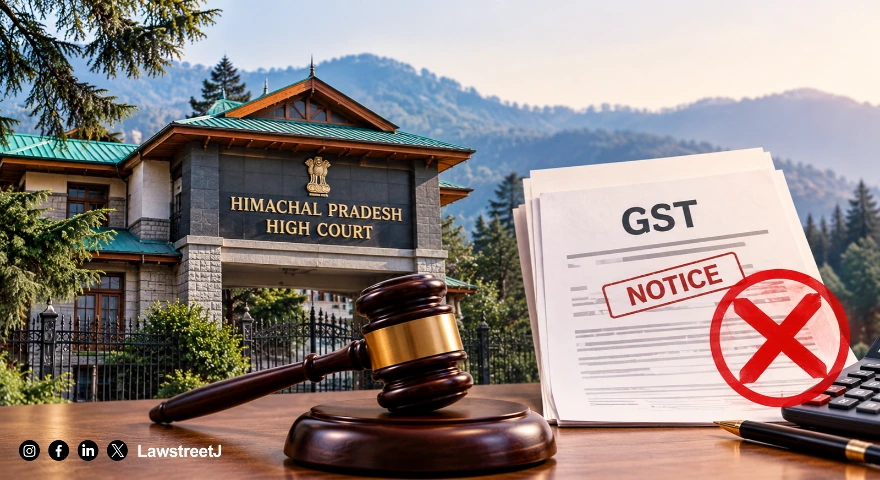
Shimla: The Himachal Pradesh High Court has set aside a show cause notice issued under Section 74 of the Himachal Pradesh GST Act, 2017 (corresponding to the CGST Act) to M/s Aditya Industries, holding that the notice merely recited the statutory words “fraud, wilful misstatement or suppression of facts” without correlating them with the allegations.
A Division Bench of Justice Ajay Mohan Goel and Justice Yogesh Jaswal, relying on two Supreme Court rulings, granted liberty to the department to issue a fresh notice, with limitation not to come in the way if issued within 60 days.
In CWP No. 3962 of 2026, the petitioner sought, among other reliefs, a declaration that Section 16(2)(c), the second proviso to Section 16(2)(d) and the proviso to Section 16(4) of the CGST Act are ultra vires the Constitution, and quashing of notices dated 02.07.2024 and 03.07.2024 denying it input tax credit (ITC). It argued, among other things, that the notice was time-barred, was issued without an ASMT-10 notice, and that it had paid tax to its sellers and held all documents required for ITC, and could not be forced to do the impossible by proving that the sellers had discharged their liability.
The Court did not enter into these issues. It examined the notice and found that the requirements of Section 74 were not met “in letter and spirit”. Section 74 applies where tax has not been paid or short paid, or ITC wrongly availed or utilised, “by reason of” fraud, wilful misstatement or suppression of facts to evade tax. The Court held that the officer must therefore be satisfied of one of these three, and that the statutory requirement has to be correlated with the allegations in the notice. “Mere mentioning of allegations and then making a bald assertion that the same amounts to either fraud or willful misstatement or suppression of facts, does not satisfy the mandate of Section 74,” it said.
The Bench relied on the Supreme Court’s decision in Tata Steel Ltd. v. Union of India (SLP (C) No. 16859/2026), which held that, for a Section 74 notice, the officer must be satisfied not merely that there is a mismatch of ITC or short payment but that fraud, wilful misrepresentation or suppression led to it, and that the foundational facts supporting that inference should be evident from the notice itself. The extended limitation period, the Supreme Court said, is not intended as mere lip service.
It also quoted from G.R. Infra Projects Ltd., Ratlam v. State of Madhya Pradesh (SLP (C) No. 33594 of 2025), where the Supreme Court observed that a notice that merely states “fraud or concealment of facts”, without stating how fraud was inferred or concealment detected, is insufficient, and that the use of “or” indicates that the officer himself was unsure which applied:
“What is required for the extended time to be applied are the allegations, which lead to the inference of a fraud or the concealment as attempted by the assessee resulting in suppression of facts, should emanate from the notice itself. It cannot be a mechanical use of the words ‘fraud, willful misstatement or suppression of facts’…”
In the notice before it, the department recorded that the registrations of the petitioner’s inward suppliers had been cancelled as non-existent and for other reasons, so that ITC under Section 16 could not be allowed, and that the taxpayer had therefore wrongly availed ITC “by reason of fraud, or any wilful-misstatement or suppression of facts to evade tax”. The Court held that this “is not what is mandated by law”. The alternative phrasing showed that the authority was itself unclear whether the petitioner’s act was fraud, wilful misstatement or suppression, whereas it “has to be very very clear and categoric”.
Finding the correlation lacking, the Court disposed of the petition by setting aside the show cause notice at Annexure P-3, and permitted the department, if so advised, to issue a fresh notice, with the issue of limitation not to arise if the notice is issued within 60 days of the order. At the petitioner’s request, the challenge to the constitutional validity of Sections 16(2)(c), 16(2)(d) and 16(4) of the CGST Act was kept open.
Appearances:
For the Petitioner: Mr. Ajay Vaidya, Advocate.
For the Respondents (State of H.P. & Others): Mr. Anup Rattan, Advocate General, with Mr. Sushant Keprate, Additional Advocate General.
Case Title: M/s Aditya Industries vs. State of H.P. & Ors., CWP No. 3962 of 2026, 2026:HHC:42146