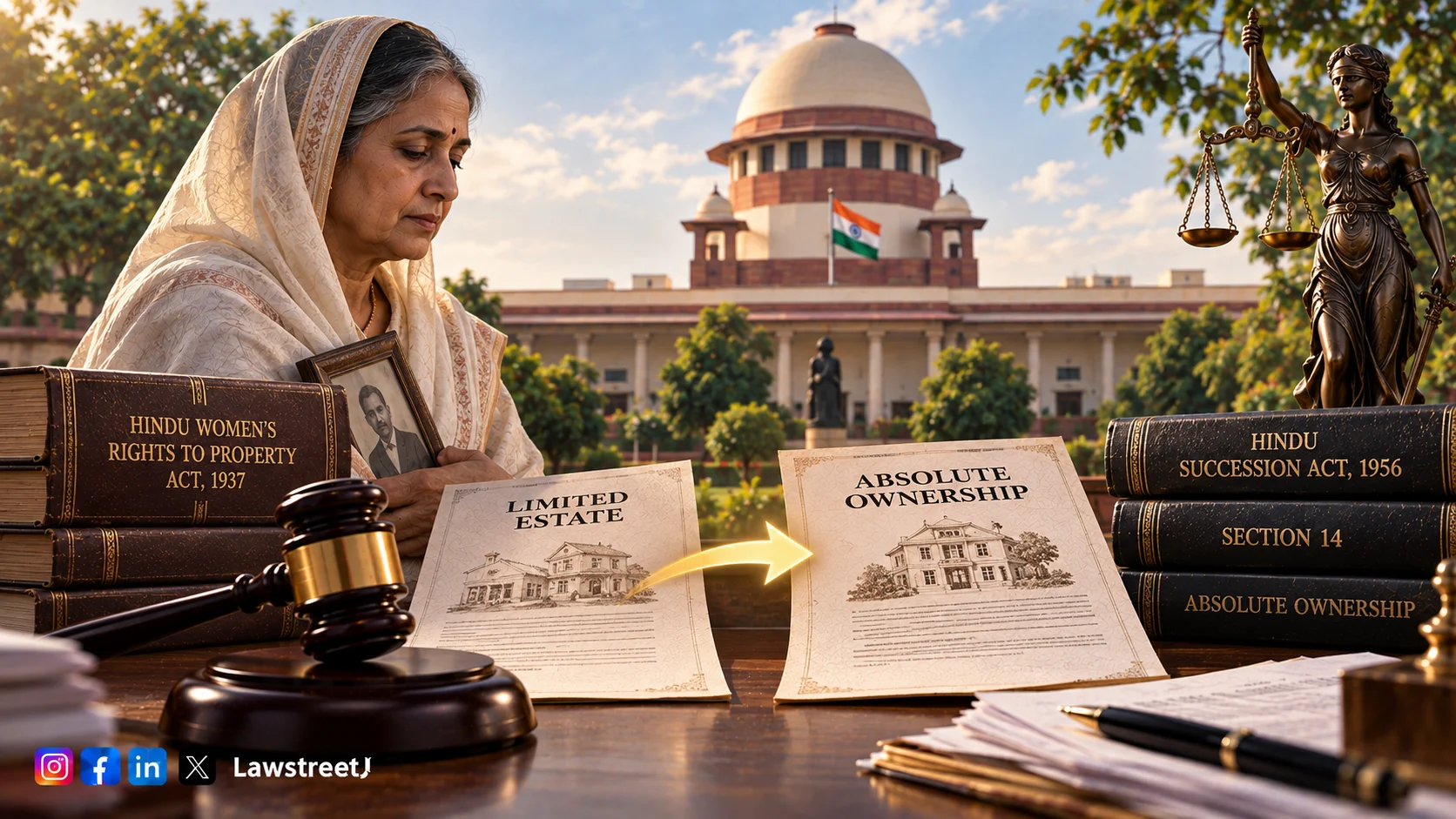
New Delhi: The Supreme Court has dismissed an appeal by the legal representatives of a son who claimed exclusive succession to his deceased father's estate, holding that his stepmother's limited interest in the property under Section 3(2) of the Hindu Women's Rights to Property Act, 1937, ripened into full and absolute ownership under Section 14(1) of the Hindu Succession Act, 1956, entitling her to bequeath the property by will, without any requirement that she first effect a partition to claim that right.
A Bench of Justices S.V.N. Bhatti and N.V. Anjaria was hearing Civil Appeal No. 660 of 2019, filed by Ganapati (since deceased, through his legal representatives) against Prabhakar and others, challenging a judgment dated 19.07.2012 passed by the High Court of Karnataka, Circuit Bench at Dharwad, in R.S.A. No. 551 of 2007.
The propositus, Gangaram, died intestate in 1949, survived by his son Ganapati (the plaintiff) through his first wife, and by his second wife Kashibai, who had two daughters, Defendant Nos. 1 and 2. The plaintiff claimed that on Gangaram's death he became the sole absolute owner of the suit properties, two houses at Terdal, Bagalkot District, Karnataka, to the exclusion of Kashibai and her daughters. After Kashibai's death in 1986, Defendant No. 1 got the properties mutated in her name based on a registered Will dated 13.10.1984 executed by Kashibai, prompting the plaintiff to file a suit for declaration and injunction; Defendant No. 1 also sold one of the two houses to Defendant No. 3 during the pendency of the suit. Defendant Nos. 1 and 2 defended the suit on the ground of an oral partition allegedly allotting the suit properties to Kashibai. The Trial Court and the First Appellate Court both held that no oral partition had been proved, that Kashibai's limited interest under the 1937 Act never ripened into an absolute right since she never claimed partition, and that her Will was accordingly void, decreeing the suit in the plaintiff's favour and directing delivery of possession. On second appeal, however, the High Court reversed these concurrent findings, holding that Kashibai and the plaintiff took equal shares in Gangaram's estate under Section 3(2) of the 1937 Act, that this share automatically became Kashibai's absolute property under Section 14(1) of the 1956 Act without any requirement of partition, and that her Will in favour of Defendant No. 1 was accordingly valid, leading to the present appeal by the plaintiff's legal representatives.
Counsel for the appellants, Mr. Anil Katarki, submitted that the High Court committed a serious error of law in confirming Kashibai's limited right and then expanding it into an absolute right under Section 14(1) of the 1956 Act, when the Respondents' entire case rested on an oral partition that both the Trial Court and the First Appellate Court had concurrently found not to be established. It was submitted that Kashibai could not be said to have enjoyed the suit properties in her own independent right between 1949 and 1956 so as to convert any such enjoyment into absolute ownership, and that the decisions relied upon by the High Court were factually distinguishable from the present case. The appellants accordingly contended that the Respondents' claim to title over the plaint schedule properties was legally unfounded, and primarily relied on the concurrent factual findings of the Trial and First Appellate Courts rejecting the plea of oral partition to assail the High Court's judgment.
Senior Counsel for the respondents, Mr. Shanthkumar V. Mahale, submitted that the relationship between the parties being admitted, the death of Gangaram in 1949 was the crucial factor determining devolution of rights, since under Section 3 of the 1937 Act, both the plaintiff and Kashibai became entitled to one-half share each in Gangaram's estate, with the plaintiff merely stepping into the shoes of the propositus as to his own share. It was argued that there is no requirement in law that transformation of Kashibai's interest into an absolute right could occur only upon an actual partition between her and the plaintiff, relying on Potti Lakshmi Perumallu v. Potti Krishnavenamma to submit that the quantum of a widow's interest is determined as of the date she seeks to enforce partition rather than the date of her husband's death, and on V. Tulasamma v. Sesha Reddy and Raghubar Singh v. Gulab Singh to submit that a Hindu widow's right, being a pre-existing right rooted in Shastric Hindu law and merely recognised by statute, automatically blossoms into full ownership under Section 14(1) once she is found to be "possessed" of the property, a term of the widest amplitude.
The Court held that the settled position, following V. Tulasamma and Raghubar Singh, is that a Hindu widow's right to maintenance and to a share in her husband's estate is a pre-existing legal right under Shastric Hindu law, not one newly created by the 1937 or 1956 Acts, and that an instrument or entitlement merely recognising this pre-existing right attracts Section 14(1), converting her limited interest into absolute ownership, rather than being restricted as a new grant under Section 14(2). It held that the expression "possessed by" in Section 14(1) has the widest amplitude, covering constructive as well as actual possession, so long as it is backed by some vestige of title and not merely that of a trespasser.
Applying these principles, the Court held that even assuming the Defendants had failed to prove the oral partition they pleaded, this did not affect the independent operation of Section 3(2) of the 1937 Act read with Section 14(1) of the 1956 Act, since Kashibai's right under Section 3(2) was a legislative confirmation of a pre-existing entitlement to her husband's estate on his death, and this right ripened into absolute ownership under Section 14(1) without any requirement that she first effect or formally claim a partition. It held that Section 14(1) takes away the effect of the limitation contained in Section 3(2) of the 1937 Act, and that fluctuation in coparcenary shares pending partition does not amount to denial of the underlying right.
Accordingly, the Court held that the High Court had correctly applied the admitted facts to the governing precedents and had properly exercised its jurisdiction under Section 100 of the CPC, and found no infirmity warranting interference with the impugned judgment upholding Kashibai's Will and Defendant No. 1's consequent title to convey the property to Defendant No. 3.
The civil appeal was accordingly dismissed, with no order as to costs, and any pending application was disposed of accordingly.
Appearances:
For the Appellants: Mr. Anil Katarki, Advocate.
For the Respondents: Mr. Shanthkumar V. Mahale, Senior Advocate.
Case Title: Ganapati (Dead) by His LRs vs. Prabhakar & Others, Civil Appeal No. 660 of 2019