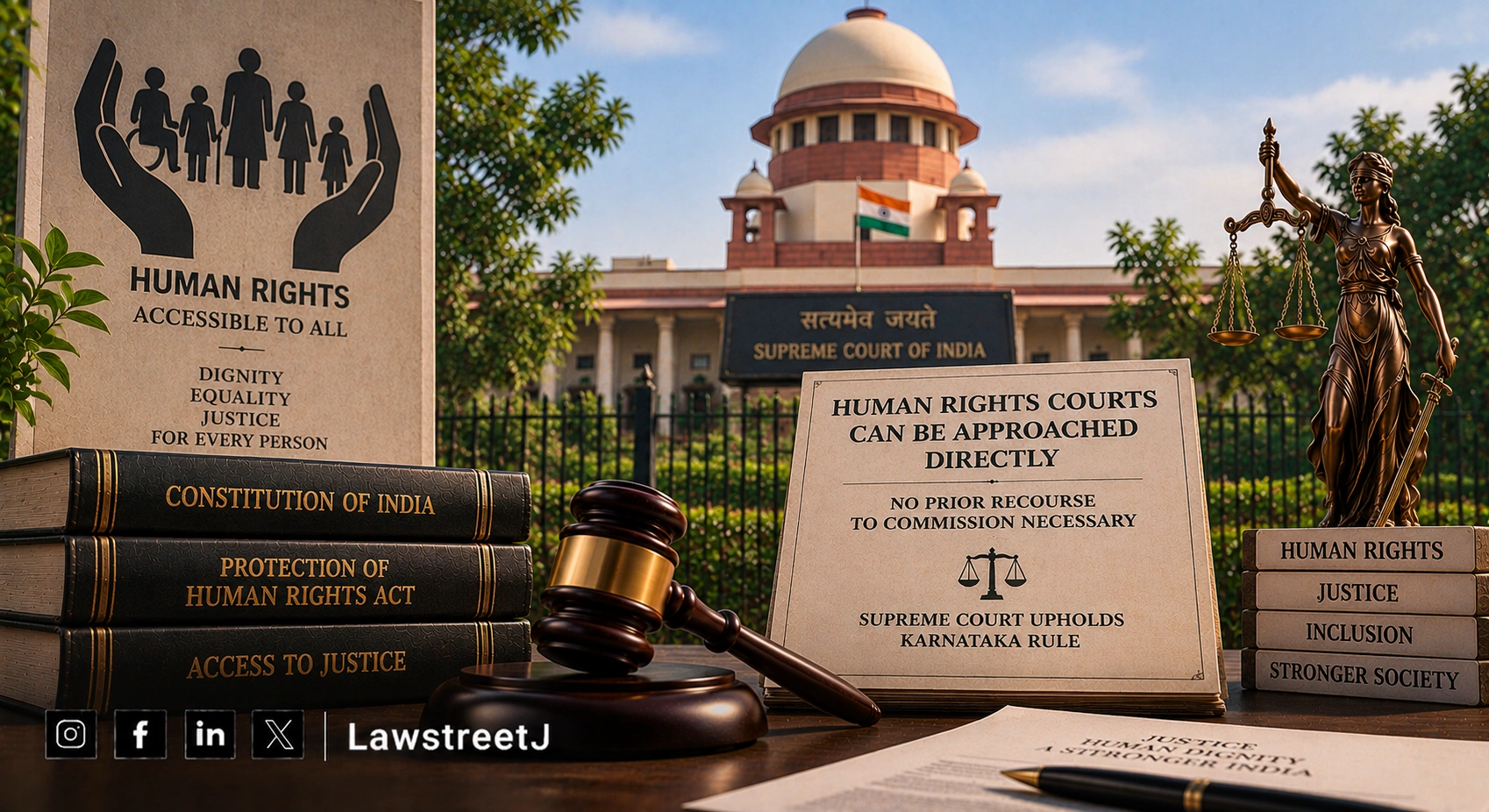
New Delhi: The Supreme Court has set aside a judgment of the Karnataka High Court that had struck down Rule 6 of the Karnataka State Human Rights Courts Rules, 2006 as unconstitutional, holding that the provision is procedural in character, consistent with the Protection of Human Rights Act, 1993, and within the rule-making power conferred on the State Government under Section 41 of the Act.
A Bench comprising Justices Vikram Nath and Sandeep Mehta was hearing connected appeals arising from the judgment dated 17.07.2025 passed by the Karnataka High Court in Writ Petition No. 200873 of 2024, whereby the High Court had also quashed Crime No. 15 of 2024 registered at Jalanagar Police Station, Vijayapura, and held that the order directing investigation in PCR No. 1 of 2024 did not survive for consideration. One appeal was preferred by Sayad Asifulla, the original complainant, and the other by the State of Karnataka, both assailing the High Court's judgment.
The dispute traced back to a private complaint filed by the appellant before the Human Rights Court, Vijayapura, alleging violation of his human rights by police officials in connection with his custody in a separate criminal case. Invoking Rule 6 of the 2006 Rules, the Sessions Judge had directed investigation under Section 156(3) of the Code of Criminal Procedure, leading to registration of Crime No. 15 of 2024. The concerned police officials challenged this before the High Court, contending that Rule 6 was ultra vires the 1993 Act since it allowed a victim to approach the Human Rights Court directly, bypassing the inquiry mechanism of the Human Rights Commission under Sections 12 to 18 of the Act. The High Court accepted this contention and struck down the Rule.
Examining the statutory scheme, the Supreme Court held that the 1993 Act contemplates two distinct institutional mechanisms the Human Rights Commissions, which perform an inquisitorial and recommendatory role under Sections 12 to 18, and the Human Rights Courts constituted under Section 30, which exercise judicial power to try offences arising out of violations of human rights. The Court found nothing in the Act making a Commission inquiry or recommendation a condition precedent to invoking the jurisdiction of a Human Rights Court, and observed that reading such a limitation into the statute would amount to supplying a condition Parliament itself had not enacted.
The Court further held that Rule 6 does not create any new offence or enlarge the meaning of human rights under the Act; it merely supplies the procedural machinery for exercising jurisdiction already conferred by Section 30, and therefore supplements rather than supplants the parent enactment. It also rejected the argument that the general rule-making power under Section 41(1) of the Act is confined to the illustrative matters listed in Section 41(2), and found support for its construction in the decision in Paramvir Singh Saini v. Baljit Singh, which recognised that recourse to a Human Rights Court is independent of proceedings before the Human Rights Commission. Holding that there was no inconsistency between Rule 6 and the 1993 Act, the Court concluded that “Rule 6 of the 2006 Rules is therefore intra vires the 1993 Act and is valid.”
Setting aside the High Court's judgment, the Supreme Court restored Crime No. 15 of 2024 and the order dated 20.01.2024 passed in PCR No. 1 of 2024, directing that the proceedings continue from the stage at which they stood, in accordance with law. The Court clarified that it had expressed no opinion on the merits of the underlying allegations, leaving all contentions and defences open to be urged before the competent trial court.
The appeals were accordingly allowed.
Case Title: Sayad Asifulla vs. State of Karnataka & Ors., Criminal Appeal No. 4075 of 2026 [@SLP(Crl.) No.16453 of 2025] with Criminal Appeal No. 4076 of 2026 [@SLP(Crl.) No.872 of 2026]