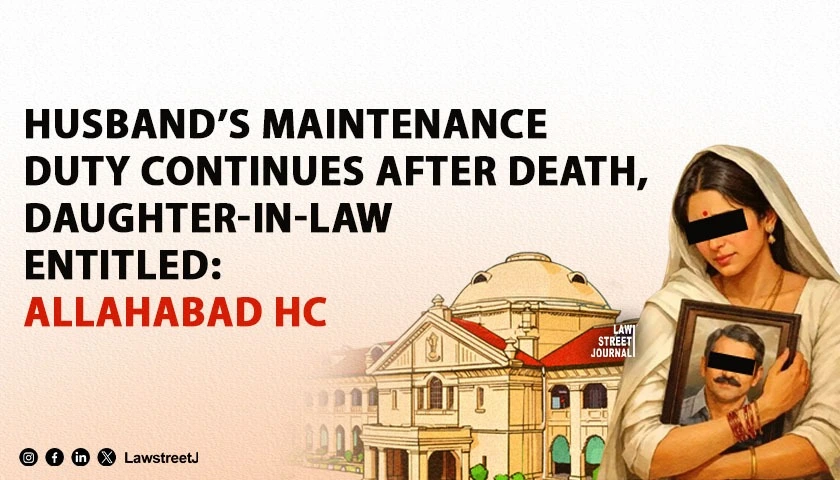
Prayagraj: The Allahabad High Court has affirmed that the legal obligation to maintain a wife does not extinguish upon the death of her husband, ruling that a widowed daughter-in-law is entitled to seek maintenance from her father-in-law under specific conditions.
The observation was made by a Division Bench of Justice Arindam Sinha and Justice Satya Veer Singh while hearing a first appeal filed by the appellant-husband, challenging a judgment dated February 6, 2026, of the Family Court, which had rejected his application seeking leave to prosecute the respondent-wife for perjury in connection with her claim for maintenance.
The appellant contended before the High Court that his wife had made several false statements in her pleadings in the maintenance proceedings. He alleged, firstly, that she had concealed the fact that she was a working woman and had instead represented herself as a housewife. Secondly, he pointed to documents on record demonstrating that she held fixed deposit receipts aggregating in excess of ₹20 lakhs in Bank of Baroda and HDFC Bank. He further submitted that those deposits had since been largely encashed, with only approximately ₹4 lakhs remaining, and that his wife had also suppressed other financial details in her affidavit filed pursuant to the guidelines issued by the Supreme Court in Rajnesh v. Neha, reported in (2021) 2 SCC 324.
At the outset of its analysis, the High Court situated the matter within the well-settled legal framework governing a husband’s obligation of maintenance. The Court observed that this obligation has consistently arisen in situations where spouses have separated and the wife has sought maintenance, whether under criminal law or the maintenance provisions of Hindu law. Crucially, the Court noted that this obligation is so robust that it does not dissolve upon the husband’s death; the law expressly extends it by entitling a widowed daughter-in-law to claim maintenance from her father-in-law.
Turning to the allegations of perjury, the Court examined the impugned judgment of the Family Court and found its reasoning to be sound. On the question of employment, the Court noted that the appellant had produced no documentary evidence whatsoever to demonstrate that the respondent-wife was employed. The Court held that a wife who claims she is not employed cannot be compelled to prove a negative; the onus lay squarely on the appellant to establish otherwise, which he failed to discharge.
As regards the fixed deposits, the Court observed that these had been made by the respondent’s father in her favour — a fact not disputed by the appellant, as it had been stated in her pleadings in the domestic violence proceedings as well. The Court held that a father bears no legal obligation to maintain his daughter after her marriage, except in the event of her being widowed. Accordingly, the deposits could not be treated as resources available to her by virtue of any enforceable entitlement. The fact that she had encashed most of the deposits over time, leaving only ₹4 lakhs, was characterised not as suppression of wealth but as evidence of her financial need in the absence of maintenance from the appellant.
The Court also drew a critical distinction between suppression of information and making a false statement. It held that suppression of financial details in an affidavit, even if established, does not amount to a false statement before the court. Since the application for leave to prosecute for perjury was founded on allegations of false statements, and the appellant had produced no cogent evidence to substantiate such claims, the Court declined to admit the appeal.
The Court further reiterated a foundational principle of evidence law: when a party relies on a document, the document must be considered in its entirety. A party cannot selectively rely on portions of a document while disregarding the remainder.
Exercising its power under Rule 11 of Order XLI of the Code of Civil Procedure, which permits dismissal of an appeal at the admission stage without issuing notice, the Division Bench dismissed the appeal in limine. The Registry was directed to communicate the order to the Family Court that had passed the impugned judgment.
Case Title: Akul Rastogi v. Shubhangi Rastogi, First Appeal Defective No. 212 of 2026


!["No Loudspeakers For Azan, No Fundamental Right To Create Noise," Says Allahabad HC To Two Mosques [Read Judgment]](/secure/uploads/2020/01/lj_4995_Allahabad_HC_AZAN.jpg)