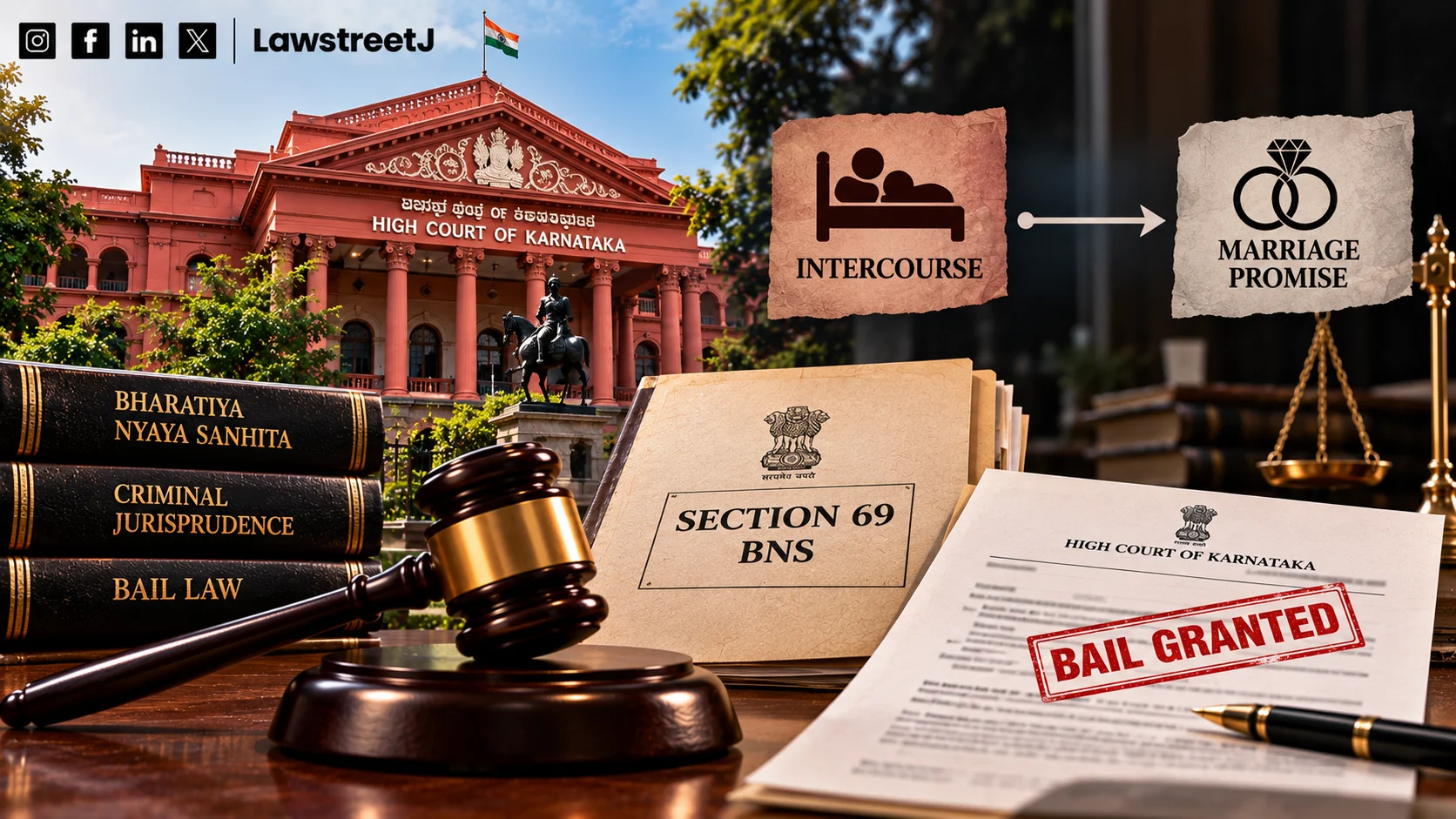
Bengaluru: The Karnataka High Court has quashed an FIR registered against a woman alleged to be the paramour of a married man, in so far as it concerned her, holding that a paramour cannot be construed as a "relative" of the husband and, therefore, cannot be prosecuted for offences that require the accused to be a relative connected with harassment over an unfulfilled dowry demand.
Justice M. Nagaprasanna was hearing a criminal petition filed under Section 482 CrPC (Section 528 BNSS) by Tanushree M., arrayed as accused No.4, seeking quashing of FIR Crime No. 22/2026 registered at the Central Women Police Station, Bengaluru, for offences under Sections 74, 85, 352 and 351(2) read with Section 3(5) of the Bharatiya Nyaya Sanhita, 2023 and Sections 3 and 4 of the Dowry Prohibition Act, 1961, pending before the 6th Additional Chief Judicial Magistrate Court, Bengaluru, in so far as it concerned the petitioner.
As per the facts, accused No.1 and respondent No.2 are husband and wife between whom a matrimonial dispute had arisen, in the course of which the petitioner came to be implicated on the allegation that she was the paramour of the husband and was responsible for the breakdown of the marriage. Learned counsel for the petitioner submitted, on a reading of the complaint, that the only allegation against her was that she was the husband's paramour and had criminally intimidated the wife, and that she could not be roped into the proceedings under Section 85 of the BNS since a paramour cannot, as a matter of settled law, be treated as a member of the family for the purpose of being tried for such an offence.
The Court held that the issue stood squarely covered by the decision of the Supreme Court in Dechamma I.M. @ Dechamma Koushik v. State of Karnataka and Another, (2024 SCC OnLine SC 3853), which, following the earlier decision in U. Suvetha, had held that a girlfriend or a woman with whom a man has had a romantic or sexual relationship outside marriage cannot be regarded as a "relative", since the status of a relative can only be conferred by blood, marriage or adoption, and that in the absence of a marriage, no such relationship could arise. The Supreme Court had further held that unless the material on record showed harassment connected with non-fulfilment of a dowry demand, meted out by the husband or a relative, continuation of such proceedings would amount to an abuse of the process of law.
Applying this principle, the Court observed: “a paramour of the husband - accused No.1 cannot be termed as a relative of the husband.”
The Court further held that even examining the other offences alleged in the complaint, none of their ingredients could be made out against the petitioner.
Accordingly, the criminal petition was allowed, and the impugned crime, in so far as it concerned the petitioner, was quashed.
Appearances:
For the Petitioner: Mr. Gagandeep E. for Mr. Ajit P.B., Advocates.
For Respondent No.1: Smt. Rashmi Patel, High Court Government Pleader.
For Respondent No.2: Mr. P.M. Gopi, Advocate.
Case Title: Tanushree M. vs. State of Karnataka and Another, Criminal Petition No. 9264 of 2026


![Karnataka High Court: Cabinet Rank Status Not Equivalent to Ministerial Position [Read Order]](/secure/uploads/2023/09/lj_2318_fc1b99b7-aeed-472b-836e-33750bedb394.jpg)


![Woman living in adultery cannot claim maintenance: Karnataka High Court [Read Order]](/secure/uploads/2023/10/lj_3083_Women_living.jpg)