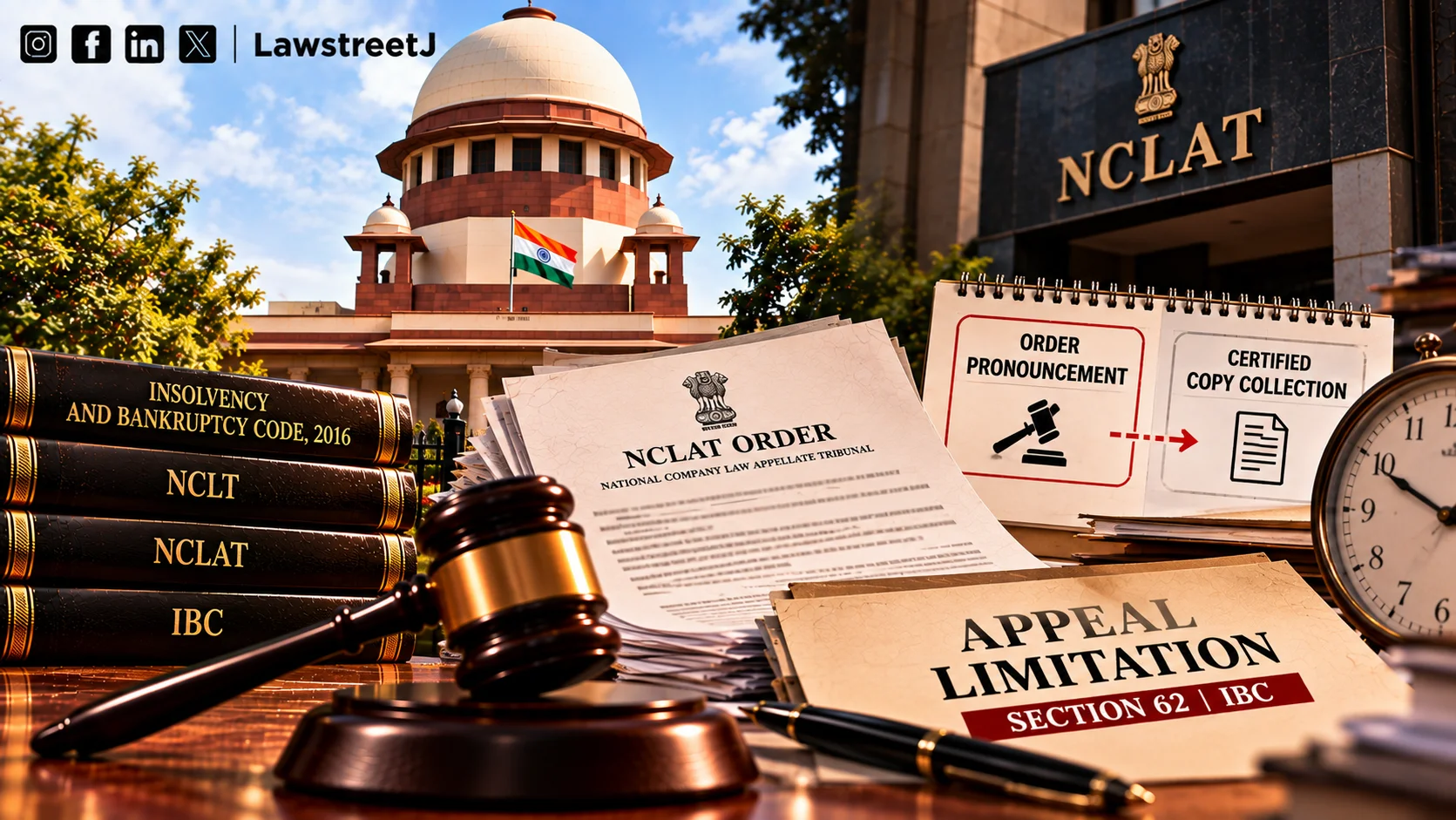
New Delhi: The Supreme Court has held that the limitation for an appeal under Section 62 of the Insolvency and Bankruptcy Code, 2016 begins on the date the NCLAT pronounces its order and not on the date the appellant chooses to apply for and receive a certified copy, and has dismissed an appeal by the tax department as barred by limitation.
A Bench of Justice S.V.N. Bhatti and Justice N.V. Anjaria decided a preliminary objection on limitation in Civil Appeal No. 7882 of 2023, The Assistant Commissioner of Central Tax, CGST Division v. Sreenivasa Rao Ravinuthala and Another. The judgment was authored by Justice Bhatti.
The appeal challenged an order dated 02.08.2023 of the NCLAT, Chennai, which confirmed a Resolution Plan approved on 13.08.2021 by the NCLT, Hyderabad, for the corporate debtor, Samyu Glass Private Limited. The Revenue had submitted a claim of Rs. 22,60,32,948 and, under the approved plan, was to receive Rs. 1,34,657 towards excise arrears. The Revenue filed its appeal on 21.11.2023.
Respondent No. 2, through Senior Advocate Ritin Rai, argued that the IBC is a complete Code and that Section 62 allows 45 days, extendable by a condonable period of 15 days, making 60 days the outer limit, which expired on 01.10.2023. He submitted that, at best, only the time spent in obtaining the certified copy could be excluded, and even then the appeal ought to have been filed by 05.11.2023.
For the appellant, Advocate Saurav Roy argued that Section 62(1) allows 45 days "from the date of receipt of such order", that Section 61 uses different wording, and that time must therefore run from receipt of the certified copy on 11.10.2023, making the appeal filed after 41 days within time.
The Bench examined its earlier decisions in Sagufa Ahmed v. Upper Assam Plywood Products, V. Nagarajan v. SKS Ispat and Power, and CA Ramchandra Dallaram Choudhary v. Adani Infrastructure and Developers, and noted that the IBC is a self-contained code with a strict, time-bound limitation scheme. Under Section 62, it said, the absolute outer limit is 60 days, and once that and the window under the Supreme Court Rules, 2013 lapse, the right of appeal is extinguished.
The Court drew a clear distinction between exclusion of time under Section 12 of the Limitation Act, 1963 and condonation of delay under Section 62(2) of the IBC. It held that the words "from the date of receipt of the order" in Section 62(1) cannot be read as the date on which a party chooses to apply for and collect a certified copy. If that were so, "the limitation period would then become fluctuating and indefinite", and Section 12(2), which excludes only the time requisite for obtaining a copy, would be rendered redundant.
The Bench distinguished Sagufa Ahmed, which concerned the Companies Act, 2013 and a statutory right to a free certified copy. For a Section 62 appeal, it said, Order XIX Rule 3(2)(i) read with Rule 40 of the Supreme Court Rules, 2013 imposes an obligation on the appellant to proactively apply for and produce a certified copy, so a litigant cannot keep limitation suspended while awaiting one. Relying on Rule 91 of the NCLAT Rules, 2016, which treats reading the operative portion in open court as pronouncement, it held that limitation commences on the date of pronouncement.
Applying this, the Court noted that the NCLAT pronounced its judgment on 02.08.2023 and the appellant applied for a certified copy only on 06.09.2023, on the 35th day. These 35 days of inaction could not be excluded. The period from 06.09.2023 to delivery of the copy on 11.10.2023, another 35 days, was the time requisite and was excluded. The appellant then took 41 more days to file after receiving the copy.
Adding the actionable periods, the Court arrived at 76 days against the statutory ceiling of 60 days, holding that, even after excluding the time taken to prepare the certified copy, the appeal was filed 16 days beyond the absolute outer limit within which delay can be condoned. Accepting the appellant's argument, it added, would nullify both the limitation period and the condonable period and make the right of appeal subject to an indefinite period.
The preliminary objection was sustained and the Civil Appeal was dismissed as barred by limitation, with no order as to costs. The Court did not examine the merits of the dispute over the Resolution Plan, and pending applications were disposed of.
Appearances:
For the Appellant: Mr. Saurav Roy, Advocate.
For Respondent No. 2: Mr. Ritin Rai, Senior Advocate.
Case Title: The Assistant Commissioner of Central Tax, CGST Division vs. Sreenivasa Rao Ravinuthala and Another, Civil Appeal No. 7882 of 2023


.jpeg)