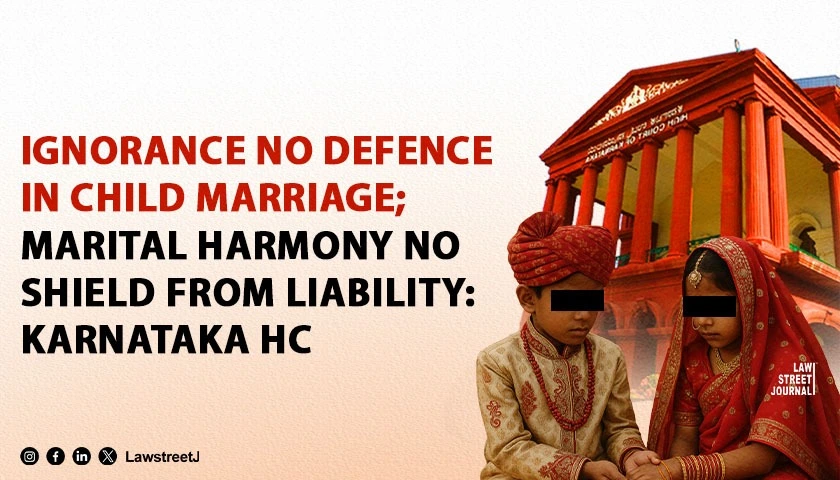
Karnataka: The Karnataka High Court has firmly held that ignorance of law is no excuse when it comes to offences under the Prohibition of Child Marriage Act, 2006, and that the fact of a couple subsequently living in harmony cannot neutralise the criminal liability that arose at the time the marriage was solemnised.
The Court held that criminal liability is measured at the moment of commission and not retrospectively erased by domestic peace.
Refusing to quash the proceedings, the Court declared that it would not extend its protective arm to those who indulge in child marriage, and directed that temples, marriage halls, and similar venues must display notices warning that the marriage of a person below 18 years is prohibited by law and attracts criminal consequences.
The Bench of Justice M. Nagaprasanna rejected a petition filed under Section 482 CrPC seeking to quash all proceedings arising out of Crime No. 61 of 2021 registered by Channarayapatna Police Station, Devanahalli Taluk.
The case arose from a marriage solemnised on August 30, 2021, at Sri Thabblingeshwara Temple, Bullahalli Village, Devanahalli Taluk, between petitioner No. 1, Manjunatha N., who was 27 years old at the time, and a minor girl, Rakshitha, who was 16 years old. The girl was the daughter of petitioners 4 and 5, namely Manjunatha B.S. and Smt. Manjula. The other accused were family members of both the groom and the minor girl who participated in the marriage. A suo motu complaint was filed by the Child Development Project Officer, Devanahalli Taluk, on August 9, 2021. Following investigation, a charge sheet was filed, and the Court took cognizance, registering Criminal Case No. 4782 of 2022 for offences punishable under Sections 9, 10, and 11 of the Prohibition of Child Marriage Act, 2006. The matter was at the stage of hearing before charge when the petitioners approached the High Court seeking quashment.
The petitioners’ counsel argued that the parents of both the accused and the victim were ignorant of the law and its consequences. It was contended that the marriage was performed during the COVID-19 pandemic, when the family feared that the pandemic might claim lives. The counsel further submitted that the husband and wife were currently living happily together, that the marriage had been registered after the girl turned 18, and that no overt acts had been committed by any of the accused. On this basis, it was urged that continuing the trial for an eventual acquittal would serve no purpose and that the proceedings should be quashed.
The State, through the Additional State Public Prosecutor, opposed the petition by pointing out that the girl’s age of 16 years at the time of marriage was an admitted fact, and that the admitted facts themselves constituted sufficient material to proceed against the accused. It was further submitted that since the matter was at the stage of hearing before charge, the High Court should not exercise its jurisdiction under Section 528 of the BNSS to interfere.
Justice Nagaprasanna examined Sections 9, 10, and 11 of the Act in detail. The Court held that these provisions are not merely penal in character but are legislative declarations that childhood shall not be prematurely surrendered at the altar of matrimony.
Section 9, the Court held, addresses the adult male who marries a child, and the offence is complete upon the act of contracting such marriage, with culpability not conditioned upon any intention beyond knowledge of age. Additionally, Section 10, the Court noted, widens the net of liability to anyone who performs, conducts, directs, or abets a child marriage, including the priest who solemnises the ceremony, the relative who arranges it, and the organiser who facilitates it. The only statutory defence available under Section 10 is a demonstrable and reasonable belief that the marriage was not a child marriage, and this must be established by evidence and not presumed through sympathy. Section 11 was described by the Court as the statute’s vigilant sentinel, casting a wide net that encompasses parents, guardians, and any person who promotes, permits, or negligently fails to prevent the solemnisation of a child marriage.
The Court further noted that Section 11(2) raises a statutory presumption that where a minor has been married, the person having charge of the child is deemed to have negligently failed to prevent the marriage, placing a reverse burden that reflects Parliament’s serious view of the protection of minors.
Relying on the Supreme Court’s three-judge Bench decision in Society for Enlightenment and Voluntary Action v. Union of India, 2024 SCC OnLine 2922, the Court observed that even temple authorities and the management of marriage venues can attract liability under Section 11. The Court also placed reliance on the Kerala High Court’s decision in Moidutty Musliyar v. Sub-Inspector, Vadakkencherry Police Station, 2024 SCC OnLine Ker 4188, where identical arguments of ignorance of law and religious sanction had been rejected.
The Court observed a disturbing pattern of litigation under both POCSO and the Child Marriage Act, where parents of both parties, acting under a mistaken sense of social propriety, solemnise marriages of girls below 18 years.
The Court held that what is presented as familial consent is, in truth, a surrender of childhood. A girl married before the age of 18, the Court noted, does not merely enter matrimony; she exits opportunity. Her promise of education and professional advancement remains a dream.
The Court held that if such conduct were to receive judicial indulgence, the eradication of child marriage would remain an elusive aspiration.
Accordingly, the petition was rejected, and the trial was directed to proceed. The Court further directed Child Development Project Officers to ensure that notices about the criminal consequences of child marriage are displayed at every venue where marriages are ordinarily performed.
Appearance:
For the Petitioners: Sri Sadakath U., Advocate
For the Respondent (State): Sri B. N. Jagadeesha, Addl. SPP
Case Title: Sri Manjunatha N. & Ors. v. State of Karnataka (Criminal Petition No. 1605 of 2026)


![Karnataka High Court: Cabinet Rank Status Not Equivalent to Ministerial Position [Read Order]](/secure/uploads/2023/09/lj_2318_fc1b99b7-aeed-472b-836e-33750bedb394.jpg)


![Woman living in adultery cannot claim maintenance: Karnataka High Court [Read Order]](/secure/uploads/2023/10/lj_3083_Women_living.jpg)