New Delhi: The Supreme Court has set aside the deputation and absorption of four officers of the Development and Panchayat Department, Government of Haryana, in the Public Works (Buildings and Roads) Department in the cadre of Assistant Engineer (Civil)/Sub-Divisional Engineer, holding the absorption to be illegal, non est and void, and has directed their repatriation to their parent department.
A Bench of Justice Manoj Misra and Justice Ujjal Bhuyan was hearing a batch of civil appeals arising out of a common judgment of the Punjab and Haryana High Court dated 15.03.2023, which had disposed of nine writ petitions concerning the legality of the deputation and absorption of Shri Pradeep Atri, Shri Praveen Chaudhary, Shri Pankaj Gaur and Shri Arun Bhatia, and the seniority assigned to them upon absorption.
The four officers, who belonged to the Development and Panchayat Department in the cadre of Sub-Divisional Officer, were sent on deputation to the PW(B&R) Department and later absorbed there as Assistant Engineer (Civil), in some instances against vacancies earmarked for direct recruitment. Their absorption was challenged before the High Court by direct recruits, who contended that the officers had failed to qualify in the direct recruitment process and had achieved indirectly, through deputation and absorption, what they could not achieve directly, and that the entire exercise amounted to a backdoor entry engineered through political influence.
The High Court had held that the absorption of the four officers was bad in law and was the product of political machination, but declined to disturb their continuance in the PW(B&R) Department on the ground that they no longer held a lien in their parent department and had already rendered over eighteen years of service. The High Court instead denied them seniority over direct recruits appointed on 07.12.2007 or 2009, and over persons promoted against vacancies arising before 01.07.2006 or 2009.
Examining the concept of deputation with reference to its earlier decisions in State of Punjab v. Inder Singh, Umapati Choudhary v. State of Bihar, Kunal Nanda v. Union of India and CBI v. Ramesh Chander Diwan, the Court held that deputation is by its nature a temporary, consensual arrangement between the lending department, the borrowing department and the officer concerned, that a deputationist has no right to claim absorption unless the rules of the borrowing department so provide, and that on cessation of the exigency for deputation, the officer must be repatriated without any requirement of his consent.
The Court held that under the Punjab Service of Engineers, Class II, P.W.D. (Buildings and Roads Branch) Rules, 1965, recruitment could only be made by direct recruitment or promotion in equal proportion, and that appointment by transfer under Rule 10 could be resorted to only in ‘special circumstances’ with the approval of the Haryana Public Service Commission. Rejecting the plea that shortage of engineers or pendency of litigation constituted such special circumstances, the Court held that accrual of vacancies was a routine phenomenon and that the reliance placed on Chief Engineering v. K.S. Brar was misplaced, since that decision had not examined the validity of an appointment by transfer under Rule 10 but had proceeded on a concession.
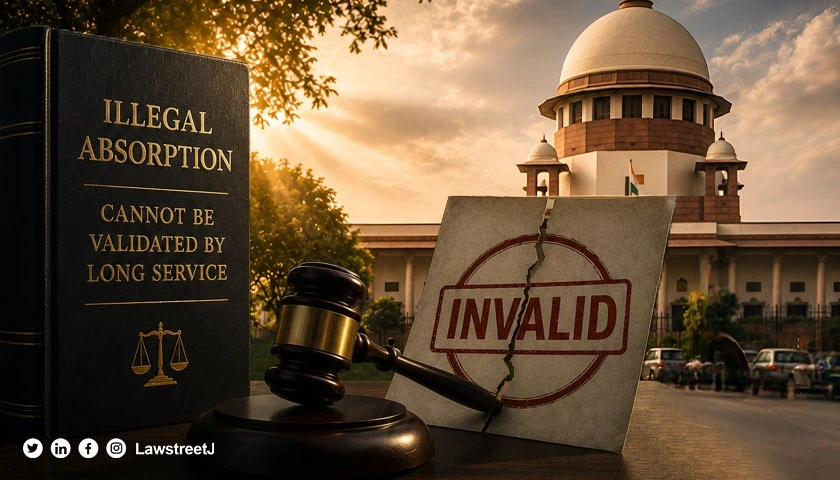
The Court observed that illegality, being void ab initio, cannot be cured merely by the passage of time or continuance in service, holding:
“Illegality means something which is contrary to law; something which is wrong right from the inception. It is void ab initio. Illegality cannot be cured and made legal and valid by lapse of time. Illegality, which is distinct and different from irregularity, cannot be regularized by taking a sympathetic view on the ground of long continuance in service.”
Relying on the Constitution Bench decision in Secretary, State of Karnataka v. Umadevi, the Court held that the High Court erred in allowing the four officers to continue in the PW(B&R) Department even after finding their absorption illegal, and that the correct consequence of an illegal absorption was repatriation rather than a sympathetic continuance coupled with denial of seniority. The Court held that the deputation of Shri Pradeep Atri and Shri Praveen Chaudhary was illegal, while the deputation of Shri Pankaj Gaur and Shri Arun Bhatia was irregular, and that the absorption of all four officers as Assistant Engineer (Civil)/Sub-Divisional Engineer in the PW(B&R) Department was illegal, non est and void.
Setting aside the High Court's judgment to the extent it declined to disturb the officers' continuance in the PW(B&R) Department, the Court directed that the four officers be repatriated to the Development and Panchayat Department, Government of Haryana, where their cadre and seniority will be determined by placing them immediately above the candidates who were junior to them in the cadre of Sub-Divisional Officer (Panchayati Raj). The civil appeals were accordingly disposed of.
Appearances:
For the Appellants (Direct Recruits): Mr. Ranjeet Kumar, Senior Advocate; Mr. V. Giri, Senior Advocate.
For the Deputationist Officers: Mr. Patwalia, Senior Advocate (for Shri Pradeep Atri); Mr. Nidhesh Gupta, Senior Advocate (for Shri Praveen Chaudhary); Mr. Guru Krishna Kumar, Senior Advocate (for Shri Pankaj Gaur and Shri Arun Bhatia).
For the State of Haryana: Mr. Bijender Chahar, Additional Solicitor General.
Case Title: Hemant Kumar & Ors. vs. State of Haryana & Ors., Civil Appeal (@ SLP(C) Nos. 12017-12018 of 2023) with connected appeals