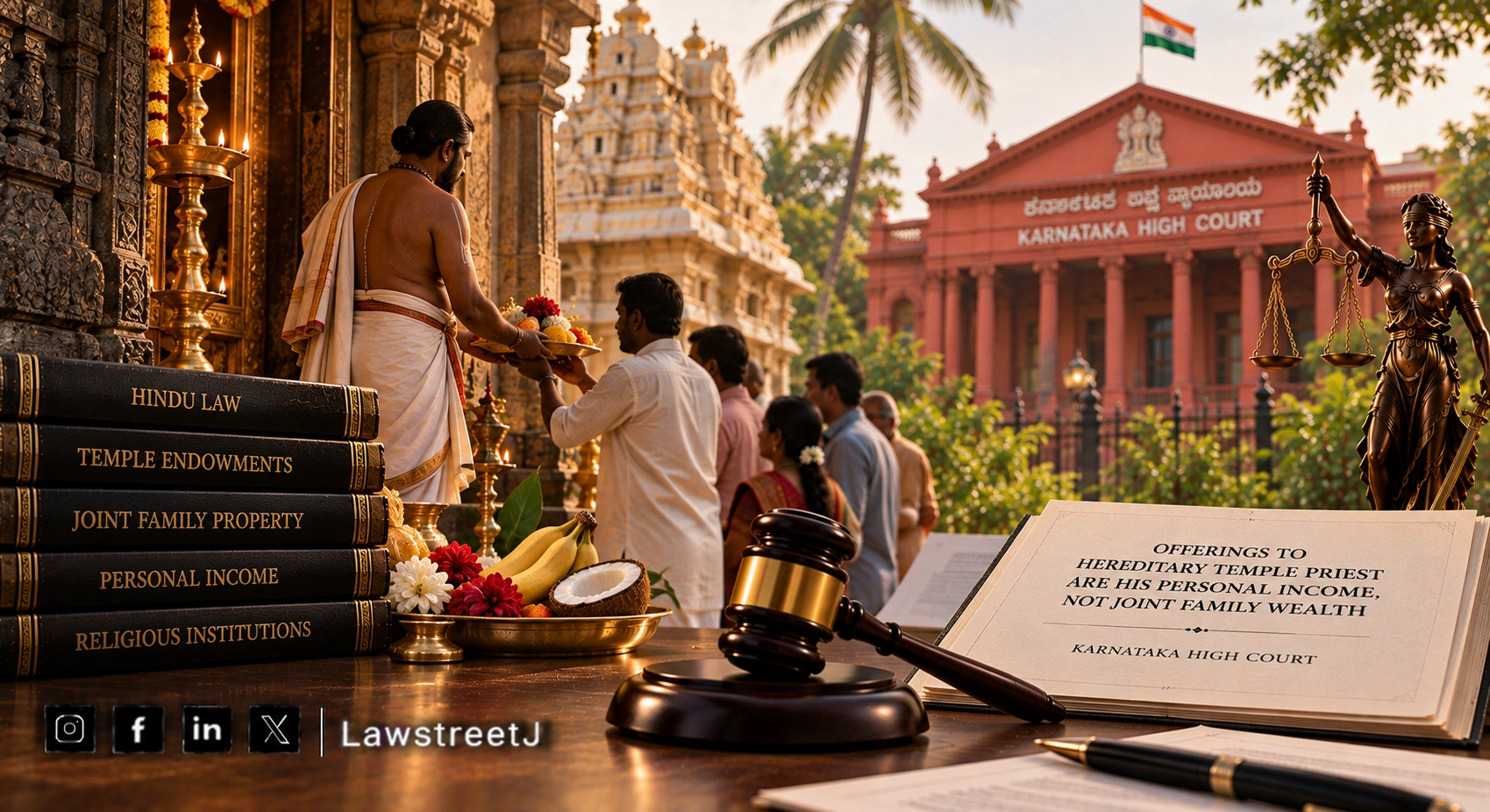
Kalaburagi: The Karnataka High Court has held that income earned by a hereditary temple archak from devotee offerings is his individual and personal income, and not the income of the joint family, even where the tradition of performing the priestly duties is itself inherited within the family.
The appeal arose out of a partition suit filed by the daughters and grandchildren of one Sri. Kasturichand, who claimed a 2/3rd share in several properties, including land on which the Goddess Padmavathi Jain Mandir at Hunsi Hadgil stood, contending that the priesthood at the temple was held hereditarily by their forefathers and that Sri. Kasturichand, who performed the duties of archak, had used the substantial income generated from devotee offerings valued at ₹8,00,000 per year along with income from agricultural lands, to purchase several properties in the names of his son Sri. Chamalrao and his daughter-in-law, defendant No.1, for the benefit of the joint family. The Trial Court had partly decreed the suit, holding the plaintiffs entitled to 1/3rd share each in the properties, including those standing in the names of Sri. Chamalrao and the daughter-in-law.
Appearing for the appellants (defendants before the Trial Court), Sri. B.D. Hangarki, Advocate, submitted that the plaintiffs had failed to prove the existence of a joint family possessing sufficient properties capable of generating income, without which no presumption could arise that properties purchased in the names of family members were joint family properties. It was contended that any income Sri. Kasturichand earned as an archak was his independent income, and that if he chose to apply it towards purchasing properties in the names of his son and daughter-in-law, the plaintiffs could claim no share therein, relying on Bhagwat Sharan (Dead Through LRs) vs. Purushottam and Others, reported in AIR 2020 SC 2361, and Sangappa Ramappa Jambur vs. Honnappa Jambur and Others, reported in 2013 (1) AKR 332.
Opposing the appeal, counsel for the respondents (plaintiffs) submitted that the hereditary right to perform archakship, having been inherited by Sri. Kasturichand from his ancestors, enured to all members of the joint family and constituted property in itself, so that any income generated from it should likewise enure to the family, entitling the plaintiffs to a share in the properties purchased in the names of Sri. Chamalrao and the daughter-in-law, relying on Hanso Patak vs. Harmandil Patak and Another, reported in AIR 1934 All 851, and Vineeta Sharma vs. Rakesh Sharma and Others, reported in (2020) 9 SCC 1.
The Division Bench of Justice R. Nataraj and Justice Tyagaraja N. Inavally framed the central question as whether income earned by Sri. Kasturichand as a hereditary archak could be treated as income of the joint family, and consequently, whether properties purchased in the names of Sri. Chamalrao and the daughter-in-law could be regarded as joint family acquisitions.
The Bench noted that a Trust administered the temple and accounted for devotee offerings, and that the only offering an archak was personally entitled to retain was that made in the mangalarathi plate during worship.
The Court held:
"A member of a family, for whatever reason, may or may not undertake the duties of a hereditary archak... If such person, in deference to the traditions in the family, endows himself in the service of the deity and devotees show obeisance to him by offering cash or in kind, then such offerings would be in recognition of the man's service and hence, should be construed as his individual income."
Tracing the law on gains from a hereditary profession, the Bench relied on the Madras High Court's decision in Ramakrishna Mardi and Others vs. Vishnumoorthi Mardi and Others, reported in (1956) 2 MLJ 550, and the Allahabad High Court's ruling in Hanso Patak vs. Harmandil Patak, both holding that income from personal services rendered by a priest, received at the discretion of devotees, cannot be claimed as of right and does not amount to family property, being in the nature of "Vidyadhana" or gains of learning saved under Section 3 of the Hindu Gains of Learning Act, 1930. The Bench further applied the Supreme Court's decision in Lakshmi Chand Khajuria and Others vs. Ishroo Devi, reported in (1977) 2 SCC 501, which affirmed that although hereditary priesthood itself may be immovable property, the income derived from practising a hereditary profession does not become joint family property.
On the facts, the Bench found no evidence that Sri. Kasturichand possessed any ancestral nucleus capable of generating income to purchase the properties, and that the plaintiffs had themselves admitted in the plaint that two of the properties were his self-acquisition. It held that the properties purchased in the names of Sri. Chamalrao and the daughter-in-law who were shown to have no independent income of their own at the relevant time were acquired out of Sri. Kasturichand's personal income as archak and were therefore his son's and daughter-in-law's self-acquisitions, in which the plaintiffs had no share.
The Bench also noted that the plaintiffs had not asserted any claim to the properties for decades following Sri. Kasturichand's death in 1982 and Sri. Chamalrao's death in 1986, observing that this supported the inference that the properties were understood by the family to be independently held. It further held that, in any event, the properties purchased in the daughter-in-law's name would have vested absolutely in her under Section 14 of the Hindu Succession Act, 1956.
The Court, however, upheld the plaintiffs' entitlement to 1/3rd share each in the land at Sy.No.94/3 of Nellur village, which stood directly in the name of Sri. Kasturichand, who died intestate, applying Section 8 of the Hindu Succession Act, 1956. It held that the plaintiffs were not entitled to any share in Sy.No.90, sold by Sri. Kasturichand to meet his medical expenses, in House No.1-84, which no longer existed, having been demolished by the Trust, or in Sy.No.6, on which the temple stood, for so long as the temple continued to exist.
The Bench also clarified that it had not returned any finding on whether the daughter-in-law was entitled to perform archak duties through her son-in-law, leaving that question open for consideration in appropriate proceedings involving the male members of the family.
The appeal was accordingly allowed in part, modifying the judgment and decree of the III Additional Senior Civil Judge, Gulbarga, dated 28.04.2014, with parties directed to bear their own costs.
Appearances: Sri. B.D. Hangarki, Advocate, appeared for the appellants, while Sri. D.P. Ambekar, Advocate, appeared for respondent Nos.1, 2(a) and 2(c) to 2(e).
Case Title: Rajamati & Others vs. Leelavathi & Others [Regular First Appeal No. 200037 of 2014]


![Karnataka High Court: Cabinet Rank Status Not Equivalent to Ministerial Position [Read Order]](/secure/uploads/2023/09/lj_2318_fc1b99b7-aeed-472b-836e-33750bedb394.jpg)

![Woman living in adultery cannot claim maintenance: Karnataka High Court [Read Order]](/secure/uploads/2023/10/lj_3083_Women_living.jpg)