New Delhi: The Supreme Court has directed the FSSAI to rework the nutrient-of-concern thresholds and the design of the proposed front-of-pack warning labels on packaged foods, holding that the right to make an informed choice is part of the rights to health and to food under Article 21, and that “The label is the only witness at the point of sale”. A Bench of Justice J.B. Pardiwala and Justice K. Vinod Chandran delivered the reportable judgment on 26 November 2026 (2026 INSC 1275) in Miscellaneous Application No. 1177 of 2025 in W.P.(C) No. 437 of 2024, filed by 3S and Our Health Society.
The original petition sought a clear front-of-package nutrition labelling (FoPNL) that warns consumers of high saturated fat, sugar and salt in packaged foods, and was disposed of in 2024 with a direction to the FSSAI’s Expert Committee to consider the 14,000 comments received on its 2022 draft amendment, which proposed a star-rating format. The FSSAI’s reconstituted Expert Committee, in its report of 08.10.2025, recorded no consensus on that format, recommended against the industry’s “facts-up-front” approach, and favoured an interpretive, warning-style label. The Court then examined the FSSAI’s proposal, with the Union’s and FSSAI’s affidavits and the petitioner’s objections.
The Court began with the public health crisis, noting that non-communicable diseases account for roughly 63% of deaths annually in India and are projected to reach about 75% by 2030, citing the ICMR-INDIAB study and NFHS-6 figures, and that children face a “double burden” of malnutrition and NCD risk. It said that, while smoking and alcohol are personal choices, consumption of high-fat, sugar and salt foods and ultra-processed foods is driven by visual appeal and advertising, so a label is a reasonable State measure to realise fundamental rights.
The Court accepted that the Union and the FSSAI themselves recognise an interpretive FoPNL as a reasonable measure, but found certain aspects of the proposal deficient and issued directions. On nutrients and thresholds, the FSSAI must treat “total sugars” and “saturated fat”, rather than “added sugar” and “added fat”, as nutrients of concern, alongside salt, and must revisit and reformulate the threshold levels, since those in Table 15.1 of the Dietary Guidelines for Indians, 2024 were calculated for added sugar and added fat.
The Court said that the thresholds must be fixed on evidence and be neither too low nor too high. Thresholds set too low would put a warning on almost all packaged foods and cause “label fatigue”, which it said the thresholds on record would do, while thresholds set too high would let most products escape the label and leave consumers exposed to harmful levels.
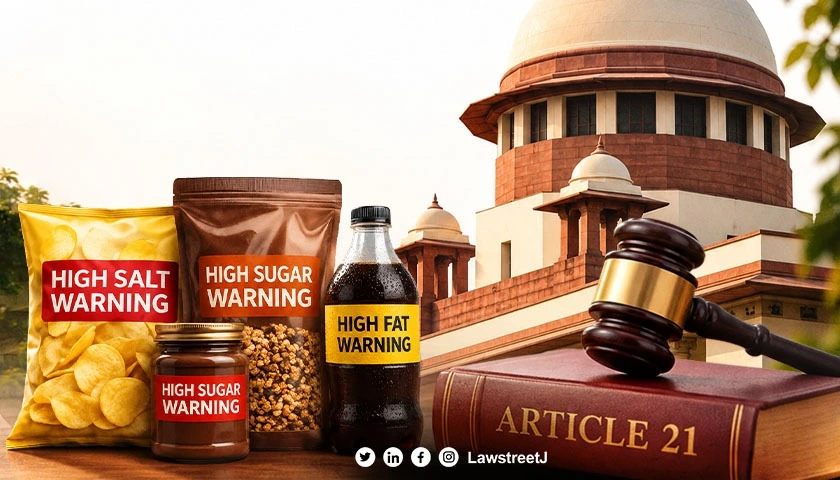
On format, the Court directed that each hexagon carry a standardised pictorial representation of the nutrient with the words “High Fat”, “High Sugar” or “High Salt”, with a separate hexagon for each nutrient and not a single combined hexagon. Each hexagon must occupy not less than 4% or 5% of the principal display panel, unless explicit reasons exist to the contrary, and the FSSAI must prescribe a font size that is prominent and readily legible. Beverages that do not exceed the thresholds must not carry a label identical or deceptively similar to the warning label, for denoting their category.
The Court further directed that the FSSAI provide a robust and exhaustive list of exempted foods, solid and liquid, with reasons, while ensuring that products that must be covered do not escape the label, and that it monitor reformulation after the label’s introduction, so that artificial preservatives and other additives are not used to offset the objective, revising the regulations through the statutory process where necessary.
On timelines, the FSSAI had said that about four months would be needed to notify the draft amendment for 60 days of comments, examine them and obtain final approval. The Court found this reasonable, directed that the regulations be brought into force within that timeline, and stressed that the FSSAI must avoid deadlock in seeking absolute consensus from industry and public health advocates, and prioritise the approach consistent with public health and consumer interest.
The FSSAI’s proposed 365-day voluntary implementation period for food business operators after notification was accepted by the Court, rejecting the petitioner’s plea for the label to be mandatory from the start, since the Act requires commercial interests to be balanced with public health and measures to be proportionate. The Court directed the FSSAI to prevent misuse of this period and to monitor compliance, said that no further extension shall ordinarily be granted, and that non-compliant operators must be dealt with strictly.
On nutritional literacy, the Union must ensure strict implementation of the Food Safety and Standards (Safe food and balanced diets for children in school) Regulations, 2020, and that school pedagogy gives children opportunities to practise nutritional literacy through workshops and co-curricular activities. The Registry must list the matter after ten weeks for the FSSAI to file an affidavit on the progress of the draft regulations, and the matter is part-heard for this limited purpose.
Case Title: 3S and Our Health Society v. Union of India and Others, Miscellaneous Application No. 1177 of 2025 in Writ Petition (Civil) No. 437 of 2024