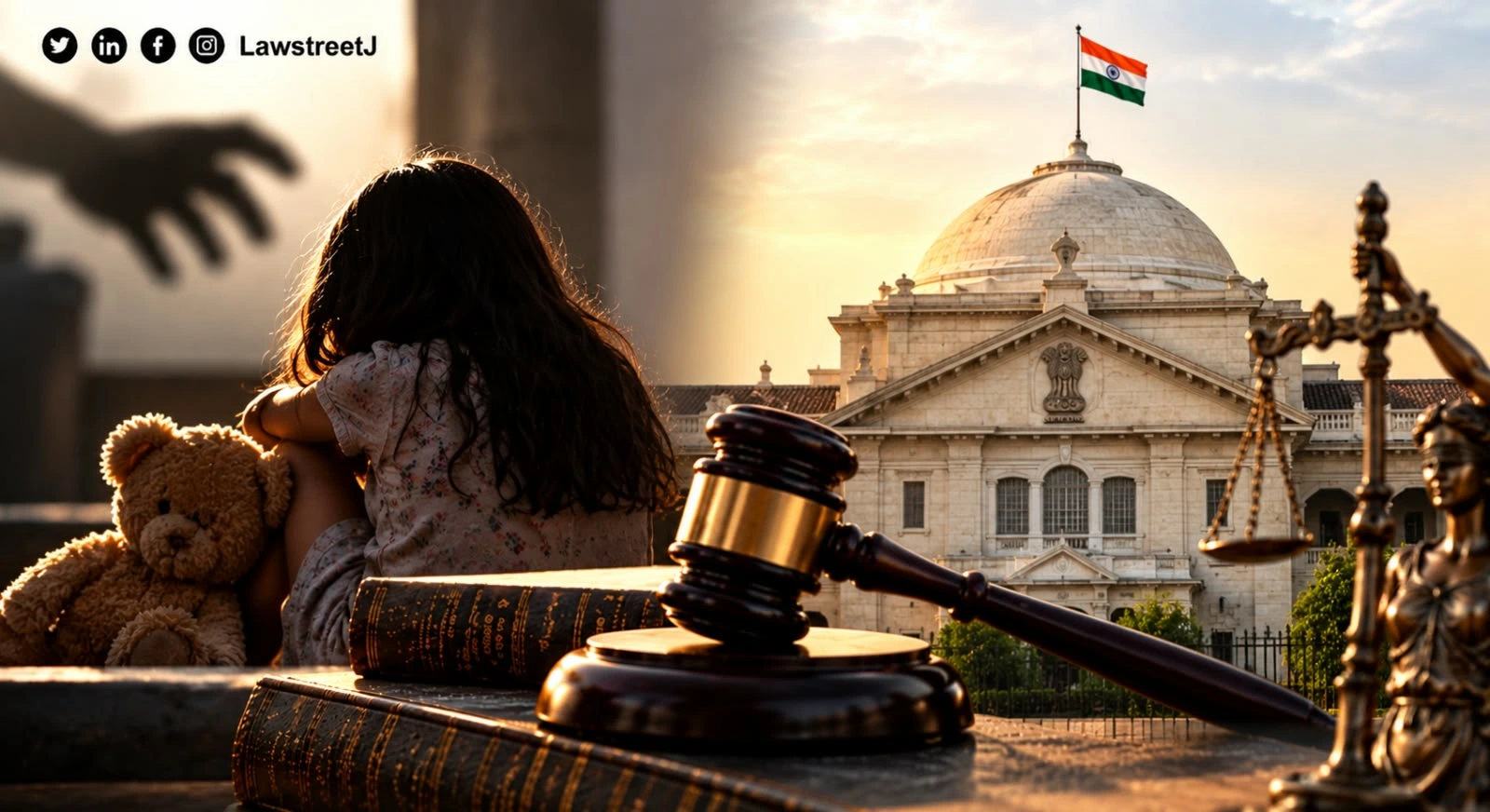
Prayagraj: The Allahabad High Court has struck down, as manifestly arbitrary and violative of Article 14, the requirement of an “injury report indicating penetrative sexual assault” as a pre-requisite for financial assistance under Entry 7 of Annexure 1 to the Uttar Pradesh Rani Lakshmi Bai Mahila Evam Bal Samman Kosh Rules, 2015.
A Division Bench held that the condition has no rational nexus with the rehabilitative object of the Scheme and cannot be used to deny relief to a child victim whose examination for penetrative assault could not be conducted for want of consent. It directed the State to release Rs. 3,00,000 within ten days.
The Bench of Justice Saral Srivastava and Justice Garima Prashad, was hearing a writ petition, filed through her mother as next friend by a minor who was eight years old at the time of the alleged incident in January 2024. The FIR invoked Sections 376-AB, 120-B, 504 and 506 IPC and Sections 5(m) and 6 of the POCSO Act, and a charge-sheet was filed under the same provisions. At her medical examination, consent was not given for the examination relating to penetrative sexual assault, so no injury report of the kind Entry 7 contemplates was prepared. The District Steering Committee rejected her claim on that ground.
The petitioner relied on a coordinate Bench’s decision of 14.01.2026 in Victim X in FIR No. 048 of 2025 v. State of U.P. Additional Advocate General Manish Goyal, for the State, argued that the Scheme is an independent welfare measure to be applied strictly, that the injury report is as essential as the FIR and charge-sheet, and that, since the petition did not seek a declaration against the condition, the Court should not strike it down.
The Court began with Rule 4(a), which shows the Scheme to be a social-welfare measure meant to ensure “immediate” monetary and medical relief and to support the maintenance, education and rehabilitation of victims. Every condition in Annexure 1 must therefore further that purpose.
The Bench observed that none of the three documents is a judicial determination, and that even at trial an accused cannot be acquitted merely because an injury report is absent. Relying on Dalip Kumar v. State of Uttaranchal (2025), where the Supreme Court said that “Bodily injuries are not necessary to prove sexual assault”, and Lok Mal v. State of U.P. (2025), it held that penetrative sexual assault under Section 3 of the POCSO Act does not depend on a demonstrable bodily injury. An injury report “may be relevant without being conclusive”.
On consent, the Court relied on Section 27(1) of the POCSO Act, which applies Section 164-A CrPC, sub-section (7) of which provides that nothing renders lawful an examination without consent. It noted that Section 184(7) of the BNSS preserves the same protection, and drew on Lillu v. State of Haryana (2013) 14 SCC 643. From these it reasoned:
“A mandatory injury-report condition places the victim in an impermissible dilemma: either submit to the particular examination or lose the financial assistance intended for her rehabilitation… A welfare scheme cannot indirectly compel what the governing statute prohibits from being done without consent.”
Testing the condition under Article 14, with Kulsum Nisha v. State of U.P., 2026 INSC 617, the Court held that it divides victims of the same offence into those with and those without an injury report, though the report “does not determine the seriousness of the allegation, the credibility of the victim or her need for monetary relief.” It held the condition manifestly arbitrary because it excludes otherwise eligible victims for reasons unrelated to their need, penalises the exercise of a choice protected by law, and makes relief depend on a document that may not lawfully or practically be available. Citing Animal Welfare Board of India v. Union of India, 2023 INSC 524, it added that a procedural condition cannot become “more important than the substantive benefit which it was meant to facilitate.”
The Court held the injury-report requirement severable, so that Entry 7 remains workable on the FIR and charge-sheet, and that an available medical report may still be considered but its absence cannot bar relief. On the objection that no declaration was sought, it held that, under Article 226, it may mould relief; the rejection rested entirely on the condition, the State had defended it, and no evidence was needed. Quoting Nur Islam v. State of Assam, 2025 INSC 1506, it said “justice cannot be forsaken on the altar of technicalities”, noting that a mere direction to reconsider would leave the cause of rejection untouched.
The Court quashed the Steering Committee’s decision of 02.01.2025 (communicated on 27.04.2026), allowed the petition and directed release of Rs. 3,00,000 within ten days, to be deposited in the protected account of the victim or dealt with as the competent court may lawfully arrange.
Appearances:
For the Petitioner: Mr. Pankaj Kumar Shukla and Mr. Satish Kumar, Advocates.
For the Respondents (State of U.P.): Mr. Manish Goyal, Additional Advocate General, assisted by Mr. Sandeep Kumar Singh, Additional Chief Standing Counsel.
Case Title: Victim X vs. State of U.P. & 2 Others, Writ-C No. 16193 of 2026