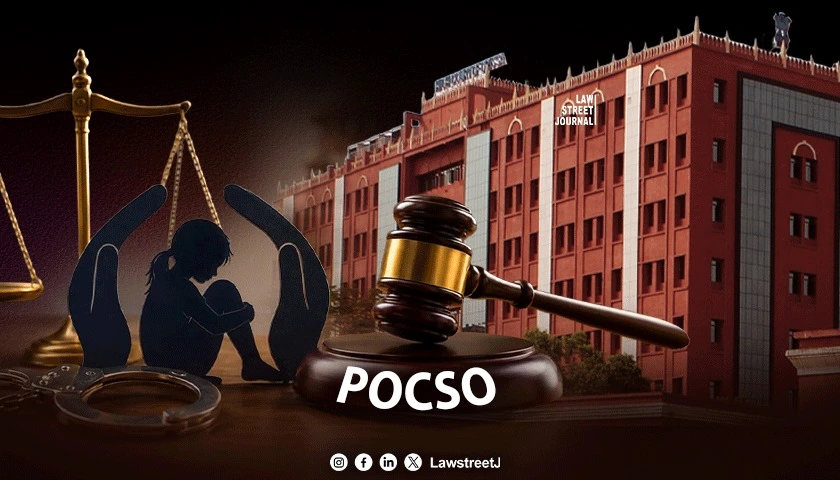
The Orissa High Court has held that inserting a hand inside the clothing of a minor victim, even without proof of digital penetration, constitutes 'sexual assault' under Section 7 of the Protection of Children from Sexual Offences Act, 2012, and invites the aggravated punishment under Section 10 of the Act where the victim is below twelve years of age.
The accused who works as a grinder mechanic came to repair an appliance. While the householder stepped into the kitchen to prepare tea, the accused entered the room where an eight-year-old girl was present, forcibly kissed her and inserted his hand inside her pant. The victim escaped and hid herself; the accused however fled.
The ADJ-cum-Special Court under the POCSO Act, Cuttack convicted the accused under Sections 452, 354 and 354-A of the Indian Penal Code and Sections 10 and 12 of the POCSO Act, sentencing him to seven years' rigorous imprisonment.
The trial court acquitted him of the graver charge of aggravated penetrative sexual assault under Section 376(AB) IPC and Section 6 of the POCSO Act, since the allegation of digital penetration was absent from the victim's Section 164 CrPC statement and was not supported by medical evidence. Compensation of Rs. 2,00,000 was also awarded to the victim under Section 357-A CrPC.
Before the High Court, the accused challenged the conviction on grounds of contradictions in the prosecution evidence. It was argued that the victim's court deposition differed from her Section 164 statement on peripheral details, that the evidence of PW-3 was self-contradictory, that no Test Identification Parade was conducted, and that the investigation was tainted by a prior acquaintance between the victim's father and the Investigating Officer.
Justice Dr. Sanjeeb K. Panigrahi dismissed the appeal.
On the question of identity, the Court noted that the victim had consistently referred to the accused as 'Bablu uncle' and that PW-3 had deposed that he was a regular visitor to her house as a grinder mechanic. A Test Identification Parade, the Court held, was unnecessary where witnesses were already acquainted with the accused.
On the alleged contradictions, the Court held that the discrepancy between the victim saying she was watching television in court and saying she was going to the swing in her Section 164 statement was a minor variation that did not touch the core of the prosecution case. The core allegations of dragging, kissing and inserting his hand inside her pant remained consistent throughout.
On the central legal question, the Court affirmed that even though penetrative sexual assault was not made out, the act of inserting a hand inside the victim's clothing with sexual intent squarely attracted Section 7 of the POCSO Act. The Court observed:
"The conduct of the accused, namely dragging the victim, kissing her and inserting his hand inside her pant, clearly constitutes physical contact with sexual intent and squarely falls within the ambit of 'sexual assault' as defined under Section 7 of the POCSO Act. Considering the age of the victim, this Court finds no infirmity in the conclusion arrived at by the learned trial court in holding the appellant guilty for the offence punishable under Section 10 of the POCSO Act."
The conviction under Section 452 IPC for house-trespass was also upheld.
The Court held that although the accused had initially entered the premises with permission to repair the grinder in the verandah, his subsequent entry into the room to commit sexual assault was unauthorized and constituted criminal trespass with preparation to commit an offence.
The sentence of seven years was found neither excessive nor disproportionate.
Case: Bablu Verma v. State of Odisha (CRLA No. 508 of 2025)


![Orissa HC awards Rs 10 lakh to father who lost child to stray dog attack [Read Judgment]](/secure/uploads/2023/12/lj_3371_Stray_dog_menace.jpg)
![Orissa HC rules in favour of BJDs Lok Sabha MP Anubhav Mohanty in divorce plea [Read Judgment]](/secure/uploads/2024/01/lj_2524_Anubhav_Mohanty.jpg)
![Indian Courts this Week: Law Street Journal's Weekly Round-Up of SC & HCs [Jan 1 - Jan 6]](/secure/uploads/2024/01/lj_9050_WhatsApp_Image_2024-01-06_at_12.07.10_PM.jpeg)