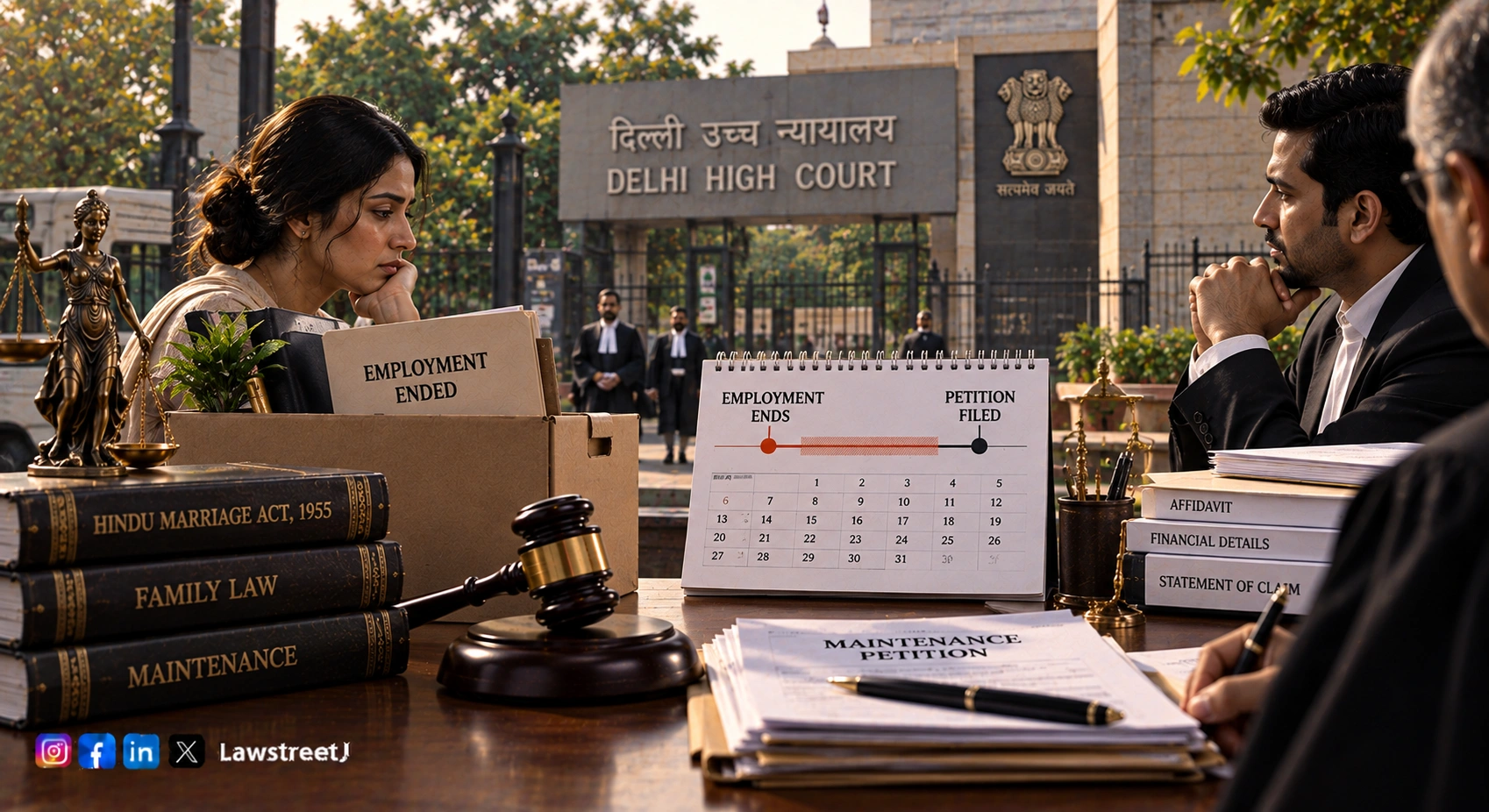
New Delhi: The Delhi High Court has upheld a Family Court's order directing a husband to pay Rs. 5,000 per month as interim maintenance to his wife under Section 24 of the Hindu Marriage Act, 1955, but modified the effective date of payment, holding that since the wife was admittedly employed and earning until June 2024, she was not entitled to maintenance from the date of filing her application in 2021, but only from 01.07.2024, when she actually became unemployed.
A Division Bench of Justices Vivek Chaudhary and Renu Bhatnagar was hearing an appeal filed by the husband under Section 19(1) of the Family Courts Act, 1984 read with Section 28 of the Hindu Marriage Act, challenging an order dated 12.11.2024 passed by the Principal Judge, Family Courts, Shahdara, Karkardooma Courts, Delhi, in the wife's HMA petition.
The parties married in 2015, and a daughter was born to them in 2016. Following marital discord, they began living separately from 11.11.2020, after which the wife filed a divorce petition on the ground of cruelty along with an application under Section 24 of the HMA seeking interim maintenance. The Family Court, assessing the husband's income at Rs. 22,000 per month based on a Delhi minimum wages notification and the wife's income at Rs. 7,000 per month from part-time work at a Bata showroom, directed the husband to pay Rs. 5,000 per month as interim maintenance from the date of filing the application, 08.01.2021, till disposal of the divorce petition. The husband challenged this order, while the wife neither appeared nor filed a reply despite opportunity.
Counsel for the appellant-husband submitted that the impugned order was erroneous since the wife was financially stable, as admitted by her in a custody petition under the Guardians and Wards Act and in a complaint under the Domestic Violence Act, and since she had admittedly worked at a Bata showroom from March 2020 to June 2024. It was submitted that the Family Court wrongly assessed the husband's income at Rs. 22,000 solely on the basis of a Delhi minimum wages notification, when he neither resided nor worked in Delhi but in Jagadhari, Haryana, and was in fact financially dependent on his father, earning only Rs. 16,500 per month as an operator at his father's photostat shop, being merely a matriculate without professional qualifications who ought to have been treated as an unskilled worker. It was further submitted that the husband bore sole responsibility for their daughter, in his custody, whose monthly expenses of Rs. 8,000 to Rs. 10,000 he alone met, and that the Family Court overlooked an inconsistency in the wife's own pleadings, where she claimed to earn only Rs. 7,000 monthly from weekend work while simultaneously asserting monthly expenses of Rs. 39,500 in her Section 24 application.
Since the respondent-wife neither appeared nor filed any reply despite being granted opportunity, no submissions were advanced on her behalf before the Court.
The Court reiterated the settled principles governing interim maintenance, noting that proceedings under Section 24 HMA are summary in nature requiring only a prima facie assessment of income, and that parties frequently do not truthfully disclose their income, permitting an element of guesswork, as recognised in Jasbir Kaur Sehgal v. District Judge, Dehradun and Rajnesh v. Neha, which endorsed the factors laid down in Bharat Hegde v. Saroj Hegde for assessing maintenance, including status of the parties, reasonable wants, independent income, liabilities, and payment capacity, without requiring mathematical precision.
On the challenge to the husband's income assessment, the Court held that although he resided and worked in Haryana rather than Delhi, the prevailing minimum wages in Haryana were broadly similar to those in Delhi, and in the absence of credible evidence establishing a lower income, the assessment of Rs. 22,000 per month did not warrant interference. It found that the salary certificate issued by the husband's own father, showing Rs. 16,500 per month, could not by itself be treated as conclusive proof in the absence of other supporting documentary evidence, and upheld the quantum of Rs. 5,000 per month as just, fair and reasonable.
However, the Court found merit in the husband's challenge to the effective date of maintenance. It noted that the wife had, in her own petition under the Guardians and Wards Act as well as in her affidavit dated 05.11.2024 before the Family Court, admitted that she was employed as a sales helper at a Bata showroom earning Rs. 7,000 per month until she was let go in June 2024, meaning she was admittedly employed and earning at the time she filed the maintenance application in January 2021. The Court accordingly held that she was not entitled to maintenance for the period she remained employed, from January 2021 till June 2024.
Accordingly, the Court allowed the appeal to the limited extent that maintenance would be payable from 01.07.2024, the date the wife became unemployed, rather than from the date of filing the application, while directing the husband to continue paying Rs. 5,000 per month from that date onward, with all other terms of the Family Court's order continuing unchanged.
The appeal, along with pending applications, was disposed of in these terms.
Case Title: Husband vs. Wife, MAT.APP.(F.C.) 439/2024 & CM APPL. 75595/2024 (Delhi High Court)


![Delhi High Court Sets Aside Arbitral Tribunal's Award Against NHAI in Highway Project Delay Case [Read Judgment]](/secure/uploads/2023/07/lj_9605_23374c2e-392c-4491-a2fe-f2f12fc5272f.jpg)
![Delhi Court Rejects Stay Request in Defamation Case Against Rajasthan CM Ashok Gehlot [Read Order]](/secure/uploads/2023/08/lj_5208_80de1ddc-d76a-4f7f-b180-408e3ae14fb4.jpg)