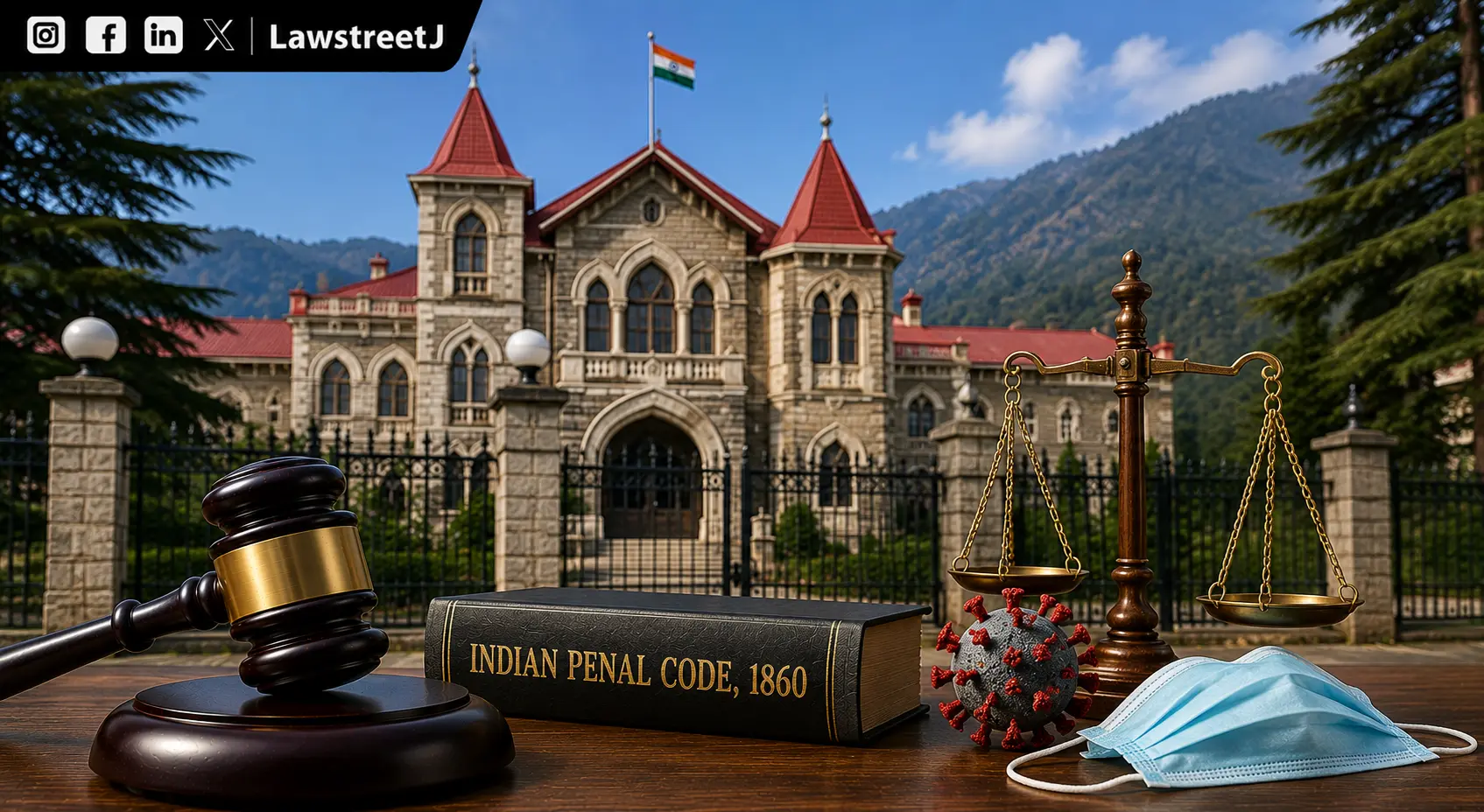
Jammu: The High Court of Jammu & Kashmir and Ladakh at Jammu has quashed a five-year-old FIR registered against a man for allegedly circulating a WhatsApp message in March 2020 claiming that two Covid-19 positive cases had been detected in a migrant colony in Nagrota, Jammu, holding that the allegations, even if accepted in their entirety, did not disclose the essential ingredients of the offence under Section 505(2) of the Indian Penal Code.
A Single Judge Bench of Justice M A Chowdhary was hearing a petition filed under Section 528 of the Bharatiya Nagarik Suraksha Sanhita, 2023, seeking quashment of FIR No. 146 of 2020 registered at Police Station Nagrota. The prosecution's case was that the petitioner had circulated a message in a WhatsApp group on March 28, 2020, stating that two Covid-19 positive cases had been found at Migrant Colony, Jagti, Nagrota, which allegedly created panic in society.
It was the petitioner's case that the accusation, even taken at face value, did not make out an offence under Section 505(2) IPC, since there was no allegation that the message was circulated with the intent, or likelihood, of creating enmity, hatred or ill-will between groups, as the provision requires. It was further submitted that the investigation, though pending for nearly five years, had not established any such intent, nor had it been shown that the information circulated was false. The petitioner also contended that the offence, being punishable with imprisonment up to three years, was barred by the three-year limitation period prescribed under Section 468 of the CrPC, and that continued investigation beyond that period amounted to an abuse of the process of law.
The Union Territory of Jammu & Kashmir, in its status report, opposed the petition, asserting that the inherent jurisdiction under Section 482 CrPC could be invoked only if the tests laid down under that provision were satisfied, and that the instant case did not fall within its sweep. It was further submitted that courts ought to be discouraged from embarking on a roving enquiry into the reliability of allegations at the quashing stage.
The Court noted that despite registration of the FIR in 2020, the investigation had not culminated in a final report even after nearly five years, with the latest status report dated February 11, 2025 merely stating that the investigation was almost complete and that a challan would be presented shortly.
Examining the scope of Section 505(2) IPC, the Court observed that the provision is attracted only when a person makes, publishes, or circulates a statement, rumour, or report with intent to create, or which is likely to create or promote, feelings of enmity, hatred, or ill-will between different groups on grounds such as religion, race, caste, community, or language.
"A plain reading of the allegations contained in the impugned FIR does not disclose the essential ingredients of the aforesaid offence. The allegation against the petitioner is only that he circulated a message regarding detection of two Covid-19 positive cases in a particular locality, which allegedly created panic. There is no allegation that the message was intended to create, or was likely to create, feelings of enmity, hatred or ill-will between any two groups based on religion, caste, community, language or any other ground contemplated under Section 505(2) IPC. The creation of panic or fear, by itself, does not satisfy the ingredients of the offence under Section 505(2) IPC."
The Court further noted that even after almost five years of investigation, the Union Territory had failed to place any material to demonstrate that the petitioner possessed the requisite intention, or that the message was likely to promote enmity between groups. It was also not shown that the information circulated by the petitioner was false or fabricated.
Reiterating the settled position that continuation of criminal proceedings amounts to an abuse of the process of law where the allegations, even if accepted in their entirety, do not constitute the offence alleged, the Court held that exercise of its inherent jurisdiction was warranted to secure the ends of justice.
On the question of limitation, the Court observed that the offence under Section 505(2) IPC, being punishable with imprisonment up to three years, attracted the three-year limitation period under Section 468 CrPC for taking cognizance. Since the FIR was registered in March 2020 and no final report had been presented even after more than five years, without any satisfactory explanation for the delay, permitting the investigation to continue indefinitely, in the absence of material disclosing commission of the alleged offence, would itself amount to an abuse of the process of law.
Accordingly, the Court allowed the petition and quashed FIR No. 146 of 2020 registered at Police Station Nagrota, along with all consequential proceedings arising therefrom.
Appearances:
For the Petitioner: Mr. Ayushman Kotwal, Advocate.
For the Respondent: Ms. Shazia Asaf, Advocate, vice Mr. P.D. Singh, Deputy Advocate General.
Case Title: Sandeep Kumar Bhat v. UT of J&K, CRM(M) No. 118/2025


![J&K and Ladakh HC upholds preventive detention, confirms validity beyond criminal proceedings [Read Order]](/secure/uploads/2024/09/lj_7116_WhatsApp_Image_2024-09-11_at_11.36.56_AM.webp)
![High Court of J&K and Ladakh clarifies dress code rules for Advocates, dismisses domestic violence petition [Read Order]](/secure/uploads/2024/12/lj_1748_Women_lawyers_cant_appear_before_court_with_face_covered.jpg)
![Jammu & Kashmir High Court limits scope of Judicial Review in Tender disputes [Read Judgment]](/secure/uploads/2025/01/lj_8309_0f418c46-349d-4866-907b-bcd34c9236a3.jpg)
![Jammu & Kashmir and Ladakh High Court rules Section 27 statements insufficient to prove knowledge in NDPS cases [Read Order]](/secure/uploads/2025/02/lj_9406_Jammu_&_Kashmir_and_Ladakh.webp)