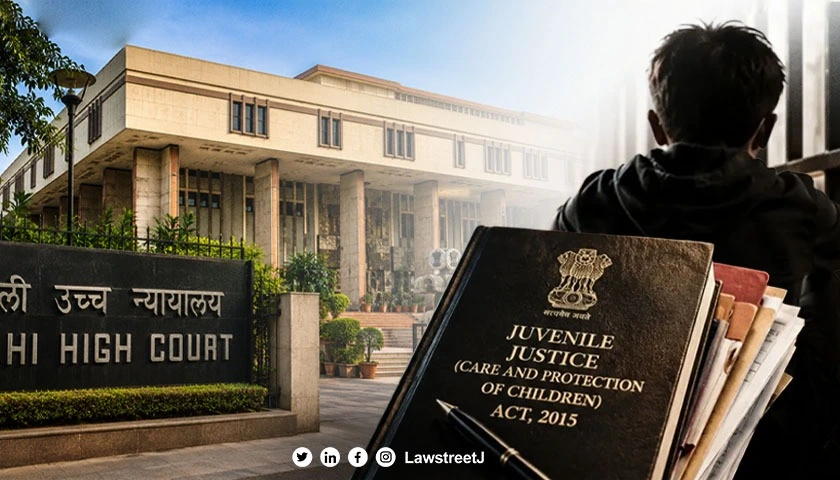
New Delhi: The Delhi High Court has held that Section 86(4) of the Juvenile Justice Act, 2015, as amended in 2021, has retrospective effect, so that even trials pending before a Judicial Magistrate of the First Class under the unamended Act must be transferred to the Children’s Court, but that general offences under the BNS or IPC, even where one of the victims is a minor, are not exclusively triable by the Children’s Court. A Division Bench of Justice Navin Chawla and Justice Arun Bhardwaj answered the two questions in Crl. Ref. 1/2026 on 23 November 2026, in a reference made under Section 436 of the BNSS by the Additional Sessions Judge-06 (POCSO), Saket Court.
The reference arose from a POCSO case (SC 741/2025, FIR No. 479/2021, Police Station Lajpat Nagar), and asked whether Section 86(4) of the 2015 Act has retrospective or prospective effect, and whether general offences under the BNS or IPC in which one victim is a minor are ‘offences against children’ under Sections 2(b) and 25 of the Commissions for Protection of Child Rights Act, 2005 (CPCR) triable by the Children’s Court.
The Court explained that, before the Juvenile Justice Amendment Act, 2021, offences under the JJ Act punishable with more than seven years were triable by a Children’s Court, those of three to seven years by a Magistrate of the First Class and the rest by any Magistrate. By the amendment, effective from 01.09.2022, all offences under the Act are triable by the Children’s Court, notwithstanding the Cr.P.C., the CPCR Act or the POCSO Act, and the Children’s Court in Delhi, notified in 2010, is the Court of the Additional Sessions Judge-01 in each police district.
The referring judge had asked whether transferring pending trials would adversely affect the accused’s and the State’s right of first appeal, since an appeal from a Magistrate lay to the Sessions Court, but from a Children’s Court would lie before the High Court. The Bench said that the answer lies in the principle that a “change in the forum of a trial is a procedural matter”, which is presumed to be retrospective unless a contrary intention appears, subject to the exception where a vested right of appeal is also changed.
Applying Hitendra Vishnu Thakur v. State of Maharashtra and the other decisions cited, the Court held that, under Section 101(5) of the JJ Act and Section 415 of the BNSS, there is no curtailment of the accused’s right of appeal, as only the forum changes and the appeal now lies before the High Court instead of the Sessions Court. On the State’s appeal against an acquittal, which now lies before the High Court with leave under Section 419(3) of the BNSS, the Court found this not sufficient to disregard the legislature’s intent that all offences under the Act be tried by the Children’s Court.
The Court relied on Ramesh Kumar Soni v. State of M.P., where the Supreme Court held that an amendment shifting the forum of trial is retrospective, and a litigant has no vested right to a forum, and noted that the Kerala High Court had taken the same view in Vaheeda v. State of Kerala and Mini Mathew v. State of Kerala. It answered Question 1 by holding that Section 86(4) has retrospective effect and that pending trials before the Magistrate must go to the Children’s Court.
On Question 2, the Court answered in the negative. It held that Section 86(4) applies only to “offences under this Act”, that nothing in it requires the transfer of general offences even if one victim is a minor, and that Section 25 of the CPCR Act does not create an exclusive forum to try offences against children, as the Act does not even define such offences. It relied on the Madhya Pradesh High Court’s ruling in Presiding Officer, Children’s Court v. Vinod that a contrary reading would lead to absurdity, flooding the Sessions Court with minor cases in which a child is a victim.
The Court accordingly held that general offences under the BNS or IPC, even where one victim is a minor, unless otherwise provided by any other statute, are not exclusively triable only by a Children’s Court under Section 25 of the CPCR Act, and sent its answers to the referring court.
Appearances: Amicus Curiae: Mr. Jai Sahai Endlaw, with Ms. Shambhavi Kala, Mr. Ishaan Saraswat and Ms. Rukmini Rajagopal, Advocates. For the State (GNCTD): Mr. Amol Sinha, ASC (Criminal), with Mr. Kshitiz Garg, Advocate. For the Union of India: Mr. Rohan Jaitley, CGSC, with Mr. Akshay Sharma, Mr. Dev Pratap Shahi, Mr. Varun Pratap Singh and Mr. Yogya Bhatia, Advocates.
Case Title: Court on its Own Motion v. State Govt. of NCT of Delhi, Crl. Ref. 1/2026