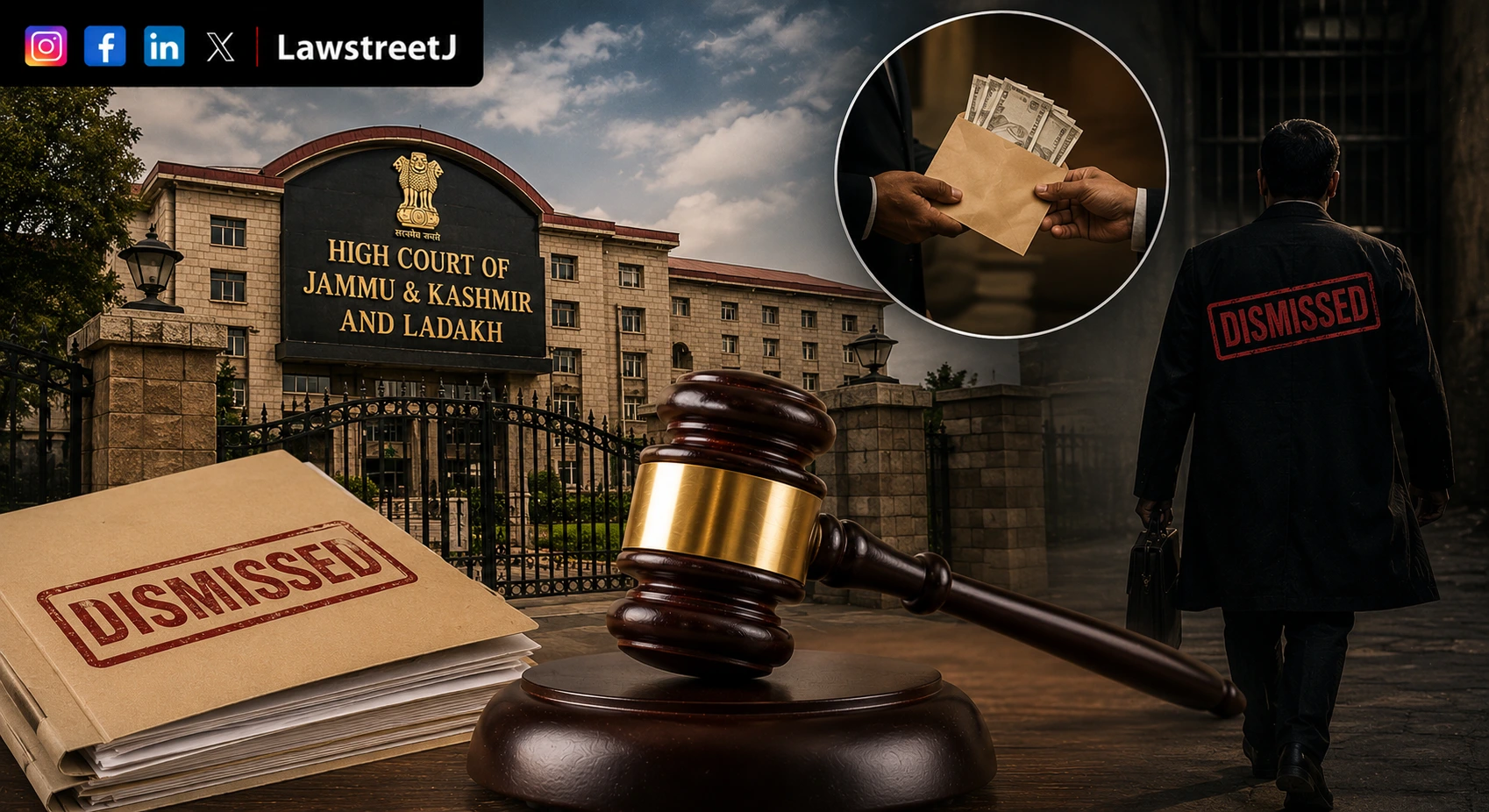
Jammu: The High Court of Jammu & Kashmir and Ladakh has upheld the removal from service of a Judicial Officer who was found guilty, in a departmental inquiry, of accepting Rs.2.50 lakh each from three unemployed persons on the false assurance of securing them Class IV appointments in the District Judiciary, and of thereafter refusing to acknowledge or refund the money.
A Division Bench of Justice Rajnesh Oswal and Justice Sanjay Parihar was hearing a writ petition filed by Naveen Jamwal, a Civil Judge (Junior Division)/Munsiff, challenging Government Order No.2704-JK(LD) of 2022 dated 20.05.2022, by which he was removed from service pursuant to a Full Court resolution, and seeking a consequential direction for his reinstatement.
The petitioner had been appointed Civil Judge (Junior Division)/Munsiff on 16.03.2013 and posted as Munsiff/Additional Special Mobile Magistrate (Traffic), Doda. It was alleged that, during this posting, he induced three residents of erstwhile District Doda to pay him Rs.2.50 lakh each on the assurance that he would secure their appointment in the Judicial Department by influencing senior officers and members of the Selection Committee for Class IV posts.
Although the amounts were paid, none of the complainants was appointed, nor was the money refunded; the petitioner allegedly abused and threatened them and, on one occasion, drove them away from his residence with a threat of having them arrested.
The complainants addressed a written complaint to the then Acting Chief Justice on 31.03.2018, upon which the Court directed the Registrar Vigilance to hold a preliminary inquiry. The inquiry found the allegations prima facie supported by the complainants' statements and by a compact disc containing a recorded conversation between one complainant and the petitioner, and recommended a regular departmental inquiry. Pursuant to a Full Court resolution dated 27.12.2018, Justice Sanjeev Kumar was appointed Enquiry Officer, with the Registrar Vigilance acting as Presenting Officer.
The petitioner, despite service of notices including a charge-sheet served through the Process Server on 17.04.2019 while he was posted at Mahore, and subsequent notices served through the Principal District Judge, Kulgam, one of which he acknowledged on 18.09.2019 did not file any reply and remained absent on the dates fixed for his appearance.
The Enquiry Officer accordingly proceeded ex parte and recorded the evidence of the three complainants, who deposed consistently regarding the payments made and the petitioner's subsequent refusal to refund the amounts. In his report dated 24.08.2021, the Enquiry Officer held that the charges stood proved and that the petitioner was guilty of grave misconduct unbecoming of a Judicial Officer.
The Full Court accepted the findings and resolved to propose the major penalty of dismissal, following which show-cause notices were issued to the petitioner. No response was received despite repeated opportunities, including an additional notice issued on the directions of the Chief Justice. The Full Court thereafter resolved, on 12.04.2022, to recommend the petitioner's removal from service, and the Government issued the impugned order on 20.05.2022 accordingly.
Before the High Court, the petitioner contended that neither the charge-sheet nor any notice was ever served upon him, that he learnt of the proceedings only upon accessing the Government order on the Law Department's website, and that the entire inquiry was conducted ex parte in violation of Rule 33 of the Jammu and Kashmir Civil Services (Classification, Control and Appeal) Rules, 1956, the principles of natural justice, and Article 311 of the Constitution.
He argued that the compact disc relied upon lacked the certificate mandated under Section 65-B of the Indian Evidence Act, that there was no evidence of demand or recovery of money, that he had continued to draw his salary and had even been considered for promotion during the pendency of the proceedings, and that the charges were framed nearly one-and-a-half years after the complaint, contrary to Rule 31 of the Rules of 1956.
The respondents maintained that the disciplinary proceedings were conducted strictly in accordance with Rules 33 and 34 of the Rules of 1956, that all notices, including both show-cause notices, were duly served upon the petitioner, and that he had deliberately abstained from participating despite repeated opportunities, leaving the Enquiry Officer with no option but to proceed ex parte.
The Bench examined the constitutional scheme under Article 235, noting that disciplinary control over the District Judiciary vests comprehensively in the High Court, subject only to the Governor's powers of appointment, posting and promotion under Articles 233 and 234, and that the High Court is competent to conduct disciplinary proceedings and recommend punishment, though the formal order is passed by the Governor. Reference was made to the Supreme Court's decisions in Union of India v. K.K. Dhawan, R.R. Parekh v. High Court of Gujarat, B.C. Chaturvedi v. Union of India, State of U.P. v. Saroj Kumar Sinha, Chairman-cum-MD, Coal India Ltd. v. Ananta Saha and Pravin Kumar v. Union of India, on the scope of disciplinary action against judicial officers and the limited scope of judicial review over departmental findings.
On facts, the Court held that the original record unmistakably established due service of the charge-sheet as well as every subsequent notice, including communication of hearing dates through telephone, WhatsApp and e-mail, and that the petitioner had produced no material to rebut this documentary record. Having voluntarily abstained from the inquiry despite due notice, he could not invoke the principles of natural justice to assail proceedings he had chosen not to participate in, nor could he complain of having lost the opportunity to cross-examine witnesses whose testimony remained wholly uncontroverted. The Court further noted that the writ petition did not contain even a plea that the allegations were false, fabricated or actuated by mala fides, and that the challenge rested almost entirely on procedural grounds that were found, on scrutiny of the record, to be non-existent.
Rejecting the contention regarding the absence of a certificate under Section 65-B of the Evidence Act, the Bench observed that the Enquiry Officer had not relied upon the compact disc to determine culpability at all, having based his findings solely on the consistent, unrebutted oral testimony of the three complainants. The Court also held that suspension is not a condition precedent for initiation or continuation of disciplinary proceedings, and that the absence of suspension did not affect the legality of the inquiry or the penalty imposed.
Observing that a Judicial Officer's office demands unimpeachable integrity and that allegations of accepting money on the promise of securing public employment strike at the root of judicial probity, the Bench held that the High Court, in exercise of its constitutional control under Article 235, was duty-bound to maintain the purity of judicial service once such misconduct stood established in a duly conducted inquiry. Finding that the disciplinary proceedings suffered from neither procedural infirmity nor legal perversity, and that the penalty of removal was not disproportionate on the facts, the Court dismissed the writ petition and upheld Government Order No.2704-JK(LD) of 2022 dated 20.05.2022, with no order as to costs.
Appearances:
For the Petitioner: Ms. Surinder Kour, Sr. Advocate with Ms. Manpreet Kour, Advocate.
For Respondent No.1: Mr. Aditya Gupta, Advocate.
For Respondent Nos.2 & 3: Ms. Monika Kohli, Sr. Advocate (Sr. AAG).
Case Title: Naveen Jamwal vs. High Court of Jammu & Kashmir and Ladakh and Others, WP(C) No. 2510/2022, CM No. 6864/2022


![J&K and Ladakh HC upholds preventive detention, confirms validity beyond criminal proceedings [Read Order]](/secure/uploads/2024/09/lj_7116_WhatsApp_Image_2024-09-11_at_11.36.56_AM.webp)
![High Court of J&K and Ladakh clarifies dress code rules for Advocates, dismisses domestic violence petition [Read Order]](/secure/uploads/2024/12/lj_1748_Women_lawyers_cant_appear_before_court_with_face_covered.jpg)
![Jammu & Kashmir High Court limits scope of Judicial Review in Tender disputes [Read Judgment]](/secure/uploads/2025/01/lj_8309_0f418c46-349d-4866-907b-bcd34c9236a3.jpg)
![Jammu & Kashmir and Ladakh High Court rules Section 27 statements insufficient to prove knowledge in NDPS cases [Read Order]](/secure/uploads/2025/02/lj_9406_Jammu_&_Kashmir_and_Ladakh.webp)