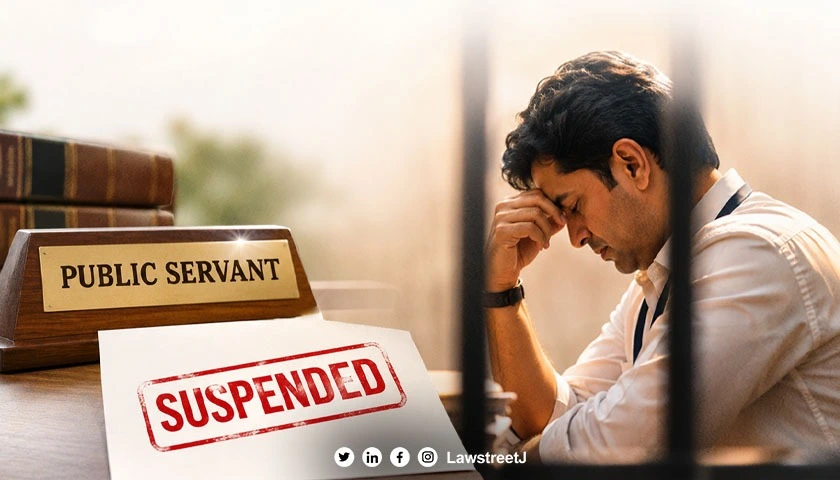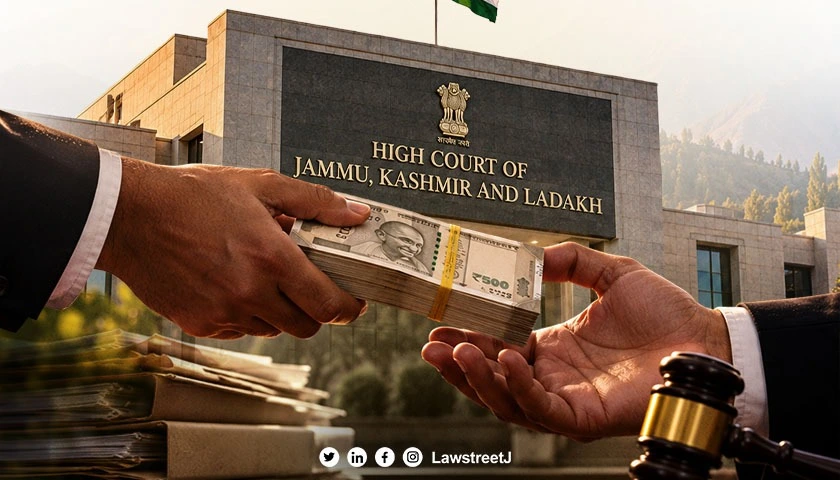
Jammu: The High Court of Jammu & Kashmir and Ladakh has upheld the conviction of a bank manager caught in a vigilance trap for accepting ₹5,000 as illegal gratification for releasing a loan instalment, holding that there is “no abstract rule” that the uncorroborated testimony of a bribe-giver cannot be accepted, and that a hostile shadow witness had in any case corroborated the demand and acceptance. It reduced the sentence from two years to one year in view of the long pendency.
Justice Sanjay Dhar dismissed the appeal of Daleep Kumar Bhat against the judgment of 18.02.2017 of the Special Judge, Anti-Corruption, Jammu, which convicted him under Section 5(1)(d) read with Section 5(2) of the J&K Prevention of Corruption Act and Section 161 RPC, and sentenced him to two years’ simple imprisonment and ₹10,000 fine for each offence, to run concurrently.
The prosecution case was that the complainant, Parmanand, had a loan of ₹1 lakh sanctioned by J&K Grameen Bank, Pargwal, and received ₹35,000 as the first instalment. For releasing the second instalment of ₹65,000, the appellant, then the branch Manager, allegedly demanded ₹7,000 and later agreed to take ₹5,000. On the complaint of 14.06.2010, a vigilance trap was laid at the complainant’s shop at Pargwal. According to the trap team, the appellant accepted the money, tried to throw it away when the trap officer introduced himself, and the hand-wash and the right back-pocket wash of his pant turned pink in sodium carbonate solution.
The appellant said the complainant had not installed the machinery or produced purchase bills, and falsely implicated him after he refused to release the amount. He claimed that the complainant tried to thrust the money into his pocket and that it fell on the ground. Appearing for him, Senior Advocate P.N. Raina argued that the sanction was granted without application of mind, that there was no verification before the trap, that the shadow witness, PW Madan Singh, turned hostile, and that the uncorroborated word of the complainant, who is in the nature of an accomplice, could not support a conviction.
On sanction, the Court noted that the Chairman of the bank, PW Raja Abdul Latief, had admitted the sanction order of 03.03.2011 and his signatures, and said that he had examined the loan’s terms, subsidy and scheme, so that the non-forwarding of the seized loan file did not show non-application of mind. The order, running into sixteen paragraphs, reflected such application. On the defence that the complainant had not completed formalities, the Court held that this was “not of much relevance”, since the appellant had authority to release the instalment, and demanding a bribe to release it even without completed formalities would be misuse of official position.
On the corroboration question, the Court surveyed the law, including Prakash Chand v. State (Delhi Administration) (1979), M.O. Shamsudhin v. State of Kerala (1995), and the Constitution Bench in Neeraj Dutta v. State (NCT of Delhi), which held that demand can be proved by other witnesses or circumstantial evidence when the complainant turns hostile or is unavailable. It concluded that a bribe-giver is a partisan witness to be scrutinised like any other, but that there is no rule against accepting his uncorroborated testimony, and corroboration may be direct or circumstantial.
“There is no abstract rule that uncorroborated testimony of a bribe giver should not be accepted.”
Applying this, the Court found that the complainant’s account was corroborated. Even the hostile PW Madan Singh stated that the demand emanated from the appellant and that the complainant handed over the money, resiling only on the recovery from his pocket, and the other trap team members and the independent witness, PW Sanjeev Gupta, consistently deposed to the recovery from the appellant’s back pocket. The Court also drew an inference under Section 114 of the Evidence Act from the pink wash and recovery that the appellant had willingly received the notes, which triggered the presumption under Section 4 of the J&K P.C. Act.
It rejected the defence as improbable. If the complainant had produced no purchase bills, the appellant had no occasion to visit his shop to verify the machinery, so his visit pointed to collecting the bribe. The defence witnesses reached the spot only after the appellant had been apprehended, and the verification objection had no substance, as the trap team questioned the complainant about the allegations and any grudge.
Upholding the conviction, the Court reduced the imprisonment from two years to one year for each offence, the fine of ₹10,000 each remaining, since the appellant had faced trial for about six years and the appeal had been pending for nine. He was directed to surrender within one month.
Appearances:
For the Appellant: Mr. P.N. Raina, Senior Advocate, with Mr. J.A. Hamal, Advocate.
For the State: Mr. Raman Sharma, Senior Advocate, with Ms. Saliqa Sheikh, Ms. Jagmeet Kour and Mr. Kartikay Sharma, Advocates.
Case Title: Daleep Kumar Bhat vs. State of J&K, CRA No. 5/2017