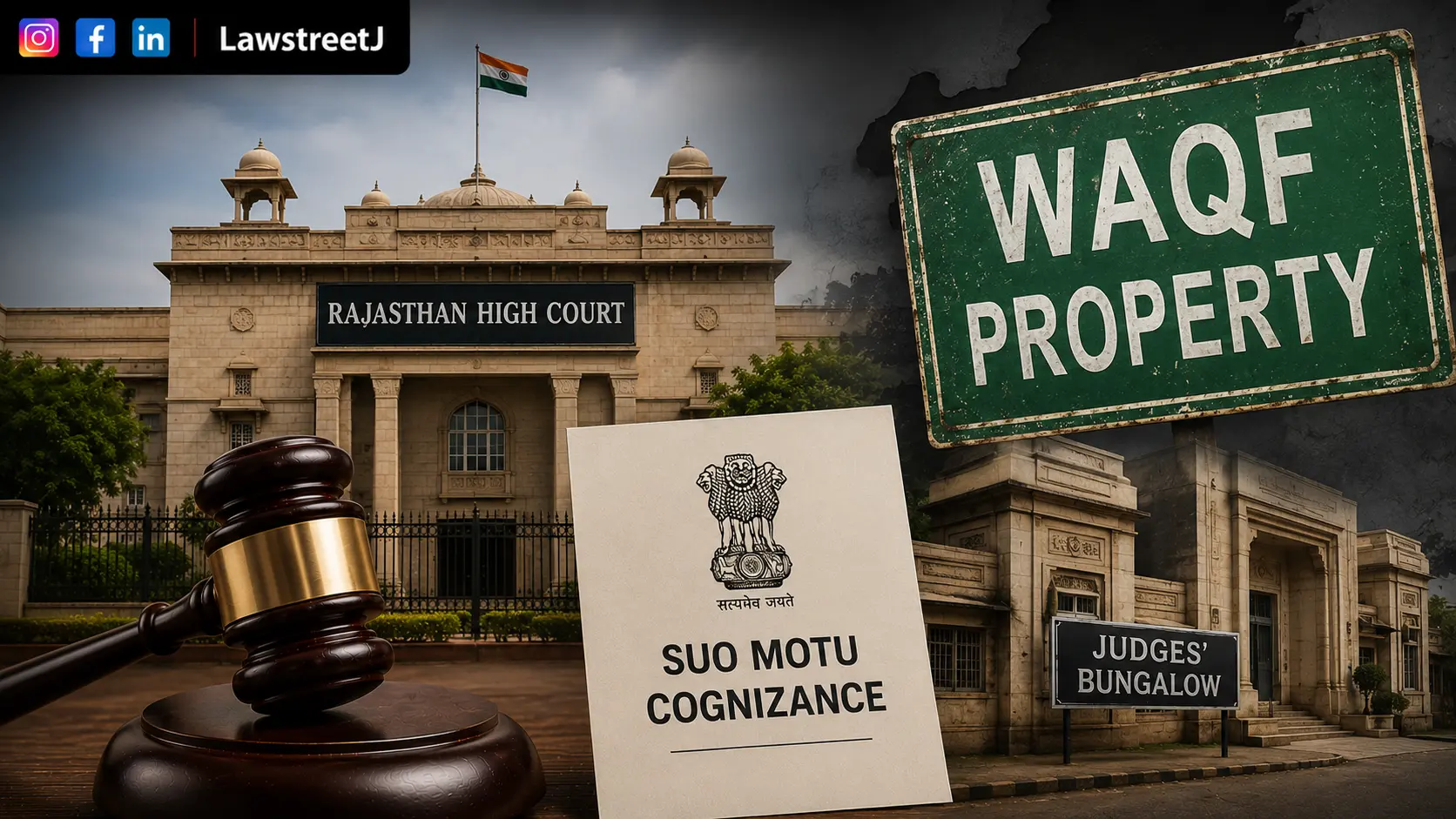
Jodhpur: The Rajasthan High Court has taken suo motu cognizance of alleged large-scale irregularities in the registration of public, educational, religious and residential properties in Jodhpur as Waqf assets, including the official residences of two sitting and former Judges of the Court, and has directed that status quo be maintained over the properties in question pending further orders.
A Division Bench comprising Dr. Justice Pushpendra Singh Bhati and Justice Praveer Bhatnagar was acting on a news report published in Dainik Bhaskar (Jodhpur Edition) dated 27.07.2026, which, relying on revenue records, Waqf Gazette entries and the Umeed Portal, disclosed what the Court described as "grave and shocking irregularities" in the recording of large tracts of land and numerous properties as Waqf property.
The material before the Court showed, prima facie, that Khasra Nos. 482, 485 and 490 of Jodhpur Rural, together measuring over 147 bigha and recorded in revenue records in the name of the concerned revenue authority, had been entered, in whole or substantial part, in the Waqf Gazette and uploaded on the Umeed Portal as Waqf property.
The properties said to be affected included several schools and colleges, multiple temples and community properties, residential and commercial properties, and notably the official bungalows of Justice Vinit Kumar Mathur, a sitting Judge of the Rajasthan High Court, and Justice Prakash, a former Judge of the Court and former Chief Justice of the Jharkhand High Court, as well as Geeta Bhawan, described as a major religious institution of the Hindu community.
The Court noted that the entries had apparently been made without the appointment of a Mutawalli, in violation of the statutory scheme under the Waqf Act, 1995, and that the process of uploading, checking and approval appeared to have been carried out in a mechanical and opaque manner, including alleged data entry conducted under the guise of "training" at the premises of the Marwar Muslim Educational Society. The report also flagged a historical structure, Tunwarji ka Jhalra, built roughly 250 years ago, which had been recorded as "Jhalra for Taziya" in Waqf records as far back as 1965, without any evidence of a contemporaneous dedication as Waqf.
Addressing the constitutional dimension of the issue, the Court observed:
"Any unilateral declaration or entry affecting the legal character of such properties, if found to have been made without adherence to the statutory requirements, including those contemplated under Sections 36, 40, 54 and other relevant provisions of the Waqf Act, 1995, and without notice or opportunity to the recorded owner or other affected persons wherever required by law, would raise serious concerns of arbitrariness, procedural illegality and deprivation of property otherwise than by authority of law, engaging the constitutional guarantees under Articles 14, 25 and 300-A of the Constitution of India."
Holding that the nature and magnitude of the properties involved disclosed questions of substantial public importance, the Court directed that the proceedings be registered as a Suo Motu Public Interest Litigation under Article 226 of the Constitution, arraying the Union of India, the State of Rajasthan, the District Collector, Jodhpur, and the Jodhpur Municipal Corporation as respondents. Notice was issued to all four respondents, which was accepted on the spot by counsel appearing for each of them.
Without expressing any opinion on the rights, title or character of the properties at this stage, the Court directed that status quo be maintained over the ownership and legal status of the properties in question, with no mutation, transfer, lease, licence, construction or demolition to be carried out on the basis of the disputed entries until further orders. The District Collector, Jodhpur was directed to preserve the existing revenue records and to place before the Court authenticated copies of the current Jamabandi, Record of Rights, mutation registers and revenue maps, and to conduct a physical verification of the three Khasras with photographs and GPS particulars.
The Chief Executive Officer, Rajasthan Board of Muslim Waqf was directed to produce the complete original record relating to the inclusion of the properties in the Waqf Gazette and on the Umeed Portal, and to file an affidavit explaining the statutory basis and procedure followed, including the position regarding appointment of a Mutawalli. The District Minority Welfare Officer, Jodhpur was similarly directed to file an affidavit on the circumstances of the data-entry exercise said to have taken place at the Marwar Muslim Educational Society premises. All concerned authorities were directed to preserve the relevant original physical and electronic records pending further orders.
The Court appointed Mr. Moti Singh and Mr. Abhishek Mehta, Advocates, as Amicus Curiae to assist in the matter, directed that the newspaper report be treated as part of the record, and listed the matter for further hearing on 11.08.2026.
Appearances: Mr. Shyam Sunder Paliwal, Deputy Government Counsel, accepted notice for Respondent No. 1; Mr. B.L. Bhati, Additional Advocate General, assisted by Mr. Deepak Chandak, accepted notice for Respondents No. 2 and 3; Mr. Rajesh Panwar, Senior Counsel and Additional Advocate General, assisted by Mr. Ayush Gehlot, accepted notice for Respondent No. 4.
Case Title: Suo Motu: In Re Illegal Registration of Municipal Properties (incl. Judges' Bungalows, Geeta Bhawan, Schools, Colleges & Temples as well as Khasra 482/485/490) as Waqf Assets in Jodhpur v. Union of India & Ors.


![Collegium Recommends Chief Justices of Delhi, Rajasthan, and Gauhati High Courts for Elevation to Supreme Court [Read Order]](/secure/uploads/2023/11/lj_9736_933a94de-bdaf-43de-944b-b0e58e17edb5.jpg)
![Rajasthan HC directs police to consider protection for couple in live-in relationship outside marriage [Read Order]](/secure/uploads/2024/08/lj_9448_Live-In_relation_protection.webp)
!['Tears have to be understood for what they are worth,' SC sets aside HC's judgment in child sexual assault case [Read Judgment]](/secure/uploads/2025/03/lj_9096_Tears_have_to_be_understood_for.webp)