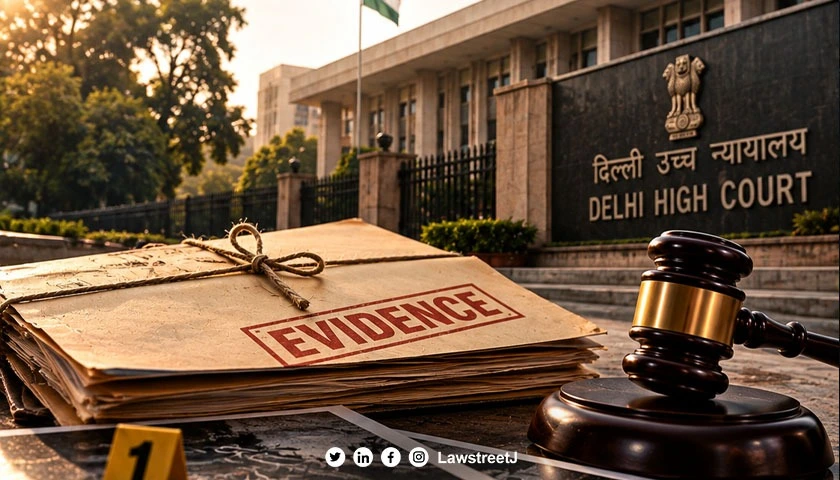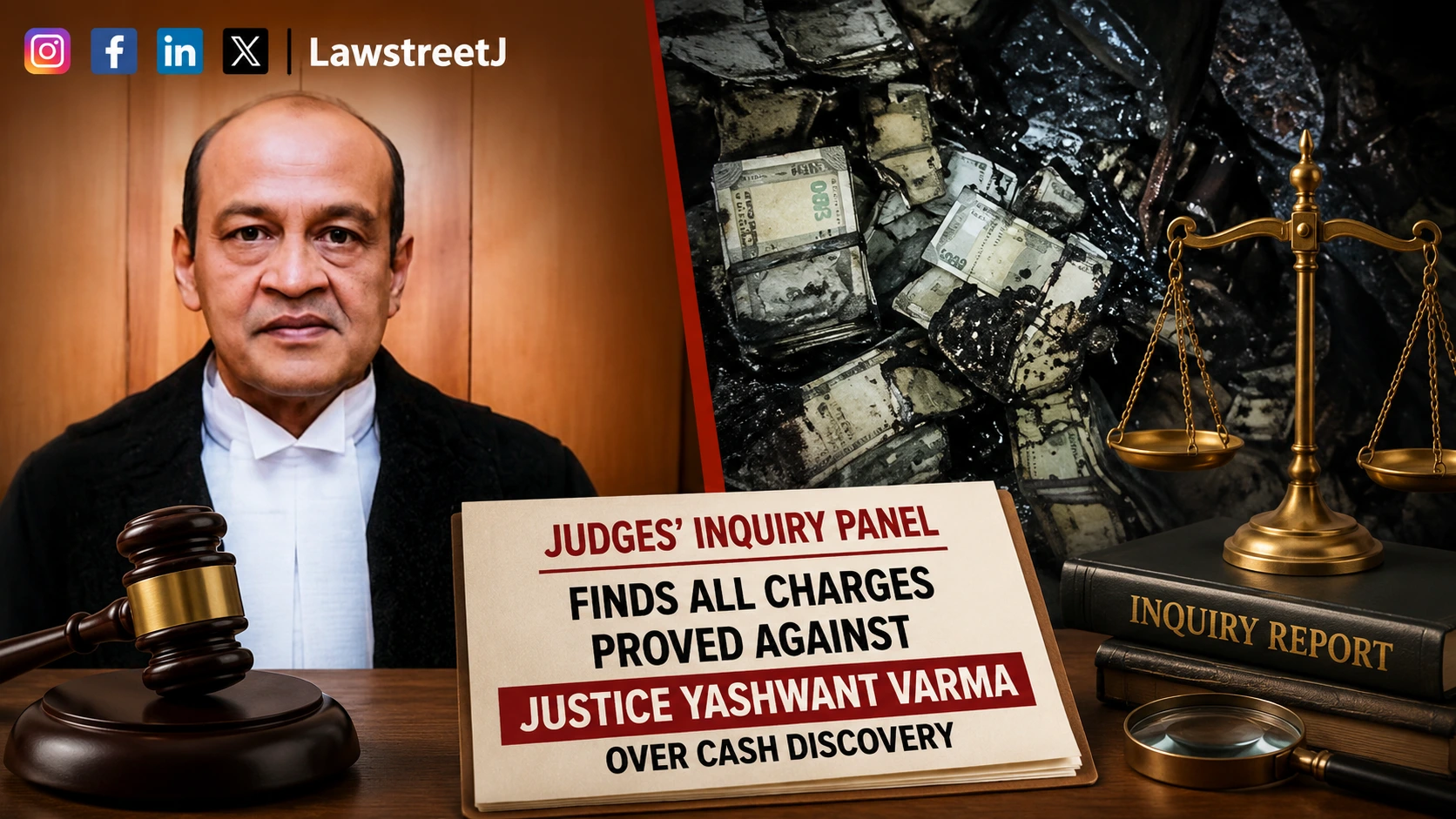
New Delhi: A high-powered statutory panel headed by Supreme Court Judge Justice Aravind Kumar has submitted its 123-page investigation report to the Speaker of the Lok Sabha, finding that massive stacks of Rs.500 currency notes were discovered during a fire at the Judge's official Delhi residence, that material evidence was interfered with by household staff under his instructions, and that the Judge offered contradictory explanations before unilaterally abandoning the inquiry.

The Statutory Inquiry Committee, constituted under Section 3(2) of the Judges (Inquiry) Act, 1968, has formally submitted its comprehensive investigation report (Volume 1) to the Hon'ble Speaker of the Lok Sabha. The Committee has unanimously concluded that all three Articles of Charge framed against Hon'ble Mr. Justice Yashwant Varma, former Judge of the High Court of Delhi and Judge of the High Court of Judicature at Allahabad, stand fully proved. The findings provide the factual foundation for Parliament to consider presenting an address to the President of India praying for the Judge's removal under Articles 124(4) and 218 of the Constitution.
The Three-Member Statutory Committee was presided over by Mr. Justice Aravind Kumar, Judge, Supreme Court of India, alongside Mr. Justice Shree Chandrashekhar, Chief Justice of the Bombay High Court, who was inducted following the superannuation of Justice Maninder Mohan Shrivastava on 05.03.2026, and Shri B.V. Acharya, Senior Advocate. Smt. Aishwarya Bhati, Additional Solicitor General of India, along with Senior Advocate Shri Raja Thakare, appeared as designated counsel under Section 3(9) of the Act to present the case against the Judge.
The proceedings trace back to the intervening night of 14–15.03.2025, when a fire broke out at Bungalow No. 30, Tughlaq Crescent, New Delhi, the official residence allotted to the Judge during his tenure at the Delhi High Court. While dousing the flames in a corner storeroom, firefighters and police personnel discovered vast quantities of currency notes, predominantly of Rs.500 denomination, in burnt, wet and disintegrated condition. Forensic analysis by CFSL Chandigarh authenticated mobile videos of the scene, confirming they were captured in real time between 11:45 PM and 1:30 AM without any tampering.
Following administrative reports from Delhi Fire Services and Delhi Police, the Chief Justice of the Delhi High Court informed the Chief Justice of India, who constituted an In-House Fact-Finding Committee on 22.03.2025. On receiving its report on 04.05.2025, the CJI advised the Judge to resign or seek voluntary retirement; on his declining, the report was forwarded to the President and Prime Minister. The Judge's challenge to the In-House proceedings, by way of Writ Petition (Civil) No. 699 of 2025, was dismissed by the Supreme Court on 07.08.2025. Thereafter, following notices of motion moved in the Lok Sabha on 21.07.2025 and admitted by the Speaker on 12.08.2025, the Three-Member Judges (Inquiry) Committee was constituted under Section 3(2) of the 1968 Act.
Three definite Articles of Charge were framed on 23.11.2025. After examining nine witnesses, adjudicating eleven interlocutory applications and evaluating 221 marked exhibits, the Committee returned unanimous findings of "Proved" on all three charges: unexplained possession of substantial currency within premises under the Judge's effective control (Article I); failure to secure and preserve material evidence, and acquiescence in its disturbance before it could be lawfully sealed (Article II); and furnishing evasive, incomplete and misleading explanations to constitutional authorities (Article III).
Article | Statement of Charge | Committee Finding |
| Article I | Discovery and possession of substantial unexplained Indian currency notes within official residential premises under effective control; failure to disclose or explain the lawful source or ownership thereof. | PROVED |
| Article II | Failure to secure and preserve material evidence, causing interference with the scene of occurrence, and acquiescing in the disturbance or removal of evidence before lawful sealing by authorities. | PROVED |
| Article III | Furnishing evasive, incomplete, and misleading explanations when called upon by constitutional authorities, failing to exhibit candour, transparency, and institutional responsibility. | PROVED |
On Article I, the Judge had contended that the storeroom was an unlocked outhouse accessible to household staff, security personnel and workers, and thus outside his exclusive control. The Committee rejected this, holding that exclusive physical occupation is not required to establish institutional control over official premises, and relied on the Judge's own admission that he kept a locked personal liquor cabinet in the very same storeroom.
On the quantum of cash, the Committee relied on the depositions of Delhi Fire Services and Delhi Police personnel. A Head Constable who was cross-examined described the amount found as far exceeding five lakh rupees, while a Fire Operator testified that he had never witnessed such a volume of cash in twenty years of service. The Committee held that the absence of a panchanama or preserved sample notes did not dilute the core finding of a conspicuous, massive volume of currency having been present.
On Article II, the Committee found that after fire tenders left the premises around 2:00 AM, the Judge's Private Secretary and an attendant were engaged in clearing debris and cleaning the storeroom, as deposed by a security guard on duty. Call detail records established continuous telephonic contact between the Judge and his staff through the night, yet no steps were taken to seal the premises or seek police protection, amounting to acquiescence in the disappearance of material evidence.
On Article III, the report documented how the Judge's explanations shifted across four stages, from an initial factual denial to raising conspiracy and staff-involvement pleas, and finally suggesting fake currency or theft by first responders during cross-examination. When called upon to lead defence evidence after the presenting side closed its case on 17.03.2026, the Judge produced no witness and did not enter the witness box, instead announcing his unilateral withdrawal from the proceedings on 09.04.2026.
"A statutory proceeding of this nature cannot be entered into in stages and judged in fragments... To disengage at such a stage, after invoking the process, testing it through applications and cross-examination, and thereafter characterising that very process as fundamentally infirm, presented a dissonance which the Committee could not ignore."
In its concluding observations, the Committee held that judicial office rests on public trust, integrity and unblemished probity, and that the discovery of unexplained cash at the Judge's official residence, followed by the cleaning of the site under his staff's supervision and his evasive explanations, constituted misbehaviour of a grave and dishonourable character. It held that a judge cannot take refuge in technical pleas of non-seizure or shared access when the surrounding facts point squarely to institutional accountability.
With the submission of the report under Section 4(2) of the Judges (Inquiry) Act, 1968, the matter now moves from the statutory investigative stage to the Parliamentary domain, providing both Houses with the evidentiary basis to deliberate upon an address to the President under Article 124(4) read with Article 218 of the Constitution for the Judge's removal.
Committee Composition:
Presiding Officer: Hon'ble Mr. Justice Aravind Kumar, Judge, Supreme Court of India.
Members: Hon'ble Mr. Justice Shree Chandrashekhar, Chief Justice, Bombay High Court; Shri B.V. Acharya, Senior Advocate.
Assisting Counsel: Smt. Aishwarya Bhati, Additional Solicitor General of India; Shri Raja Thakare, Senior Advocate.
Matter Reference: Motion for Removal of Justice Yashwant Varma, Judge, High Court of Judicature at Allahabad (Formerly Delhi High Court) — Judges (Inquiry) Committee Report under Section 4(2) of the Judges (Inquiry) Act, 1968


![Number of Constitution bench matters reduced drastically over decades, Lok Sabha informed [Read Statement]](/secure/uploads/2023/08/lj_1613_Constitution_bench_cases_sc.jpg)
![Amicus curiae supports plea for permanent disqualification of convicted lawmakers [Read Report]](/secure/uploads/2023/09/lj_2142_39a30518-7616-4c47-8f64-5f81898860ae.jpg)