

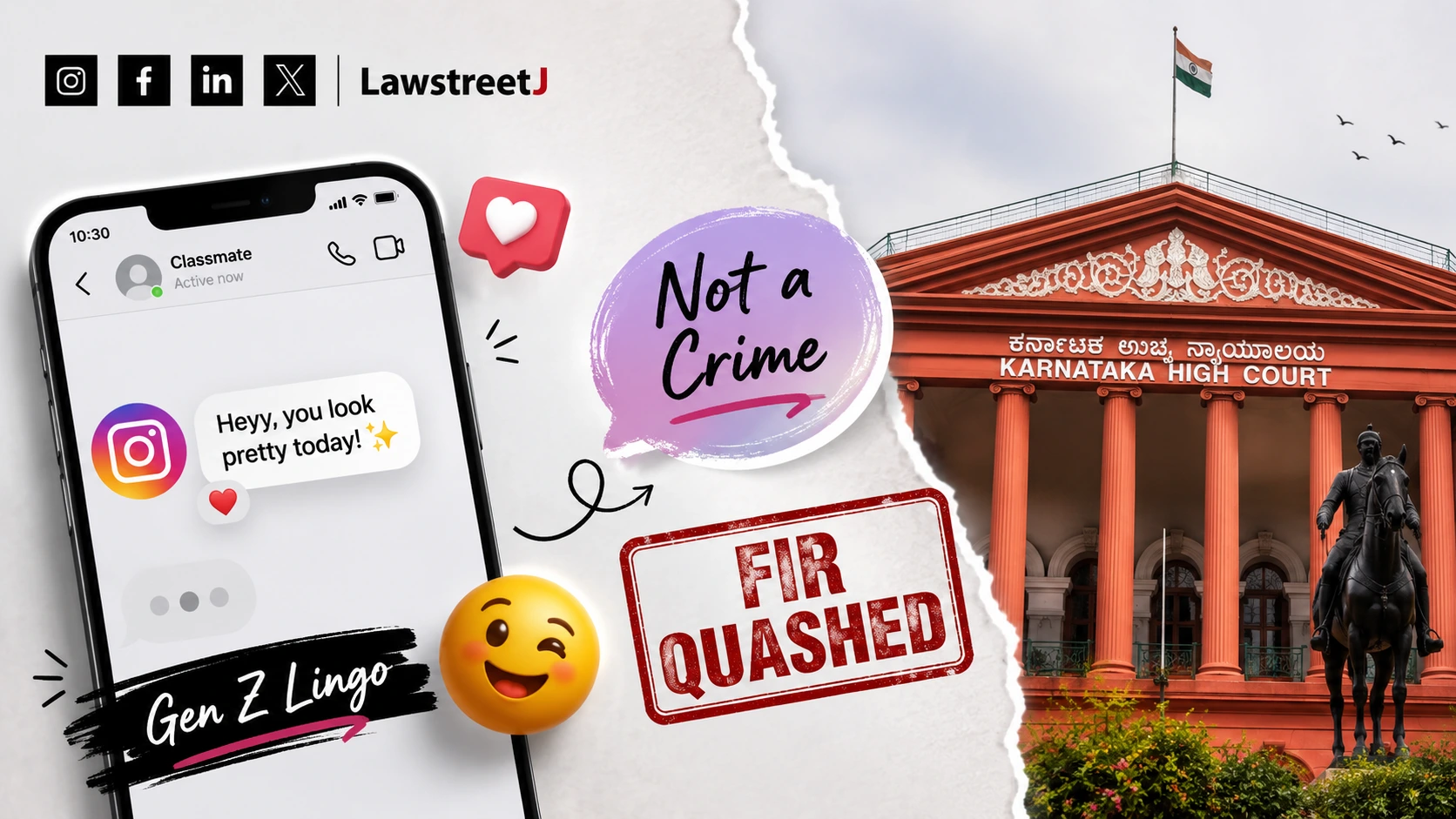
Karnataka: The Karnataka High Court recently delivered a significant ruling regarding digital interactions among youth, holding that complimenting a classmate in a private message does not constitute a criminal offence.
Justice M. Nagaprasanna quashed an FIR registered against a 20-year-old college student who had been booked for stalking, voyeurism, and outraging the modesty of a woman after he sent a private Instagram direct message (DM) calling his female classmate "pretty". The court observed that such personal exchanges, often characterized by "Gen Z lingo," are common among students and should not be criminalised.
The case originated from a private conversation on Instagram between the petitioner and his 21-year-old classmate, who were reportedly friends and students at the same college. The student had messaged the complainant, describing her as "pretty" and "beautiful" in response to a picture she had posted. Records indicated that the woman initially responded to the compliment by writing "thanks". However, the situation escalated after the private message was shown to the complainant's father, a senior IPS officer of the Karnataka cadre, leading to the registration of an FIR against the student,,.
The student faced serious legal charges under various provisions of the Bharatiya Nyaya Sanhita (BNS) and the Information Technology Act, including Section 66E for violation of privacy and Section 66A. The police specifically booked him for offences including voyeurism, stalking, and outraging the modesty of a woman. During the investigation, which lasted nearly two years, the police seized the student’s laptop and mobile phone,.
In its ruling, the High Court emphasized that the conversation was strictly private and not intended for the public domain. Justice Nagaprasanna noted that the chat was a one-to-one exchange between two individuals and reflected the communication style prevalent among modern students,. The Court remarked that the language deployed is typical of the current generation and stated, "The chat is not a public chat. It is a chat between two individuals... The language used is the one students of this day use. That cannot become a crime".
The Court further scrutinized the legal ingredients of the alleged offences, finding that a compliment in a private message could not, by itself, fulfill the requirements for stalking or voyeurism. Justice Nagaprasanna highlighted that there was no evidence of criminal behavior, noting that the complainant’s initial "thanks" suggested the message was not perceived as harassment at the time,. The court further observed, "It's a DM on Instagram, a direct message. What's wrong with it? She must be happy. That's why I said Gen Z lingo".
Advocate Nidhishree B.V., representing the petitioner, argued that the entire prosecution was born from an innocuous conversation between classmates. She pointed out that the case had severely jeopardised the young man’s future, noting that he was a State-level cricketer who was slated to represent the Under-19 team in Tamil Nadu at the time of the incident. The defence contended that keeping the petitioner's electronic devices in police custody for two years without following proper procedure was an additional hardship,.
Opposing the petition, the High Court Government Pleader argued that merely being classmates did not entitle the petitioner to comment on the complainant’s appearance. The prosecution urged the Court to allow the investigation to continue. However, the Court rejected this stance, holding that an isolated exchange of this nature could not make out the offences of stalking or outraging modesty,.
The High Court warned that invoking criminal law for such trivial matters could have a lasting, negative impact on the lives of young individuals. The Court concluded that allowing the investigation and criminal proceedings to continue would amount to a miscarriage of justice and an abuse of the process of law.
Consequently, the Court quashed the FIR and all related proceedings. To ensure the student could resume his life, the Court directed the investigating officer to immediately return all seized materials, including his mobile phone and laptop,,.
Case title: Mr. Thomas Jadan Paldano G v. State of Karnataka & Another


![Karnataka High Court: Cabinet Rank Status Not Equivalent to Ministerial Position [Read Order]](/secure/uploads/2023/09/lj_2318_fc1b99b7-aeed-472b-836e-33750bedb394.jpg)


![Woman living in adultery cannot claim maintenance: Karnataka High Court [Read Order]](/secure/uploads/2023/10/lj_3083_Women_living.jpg)