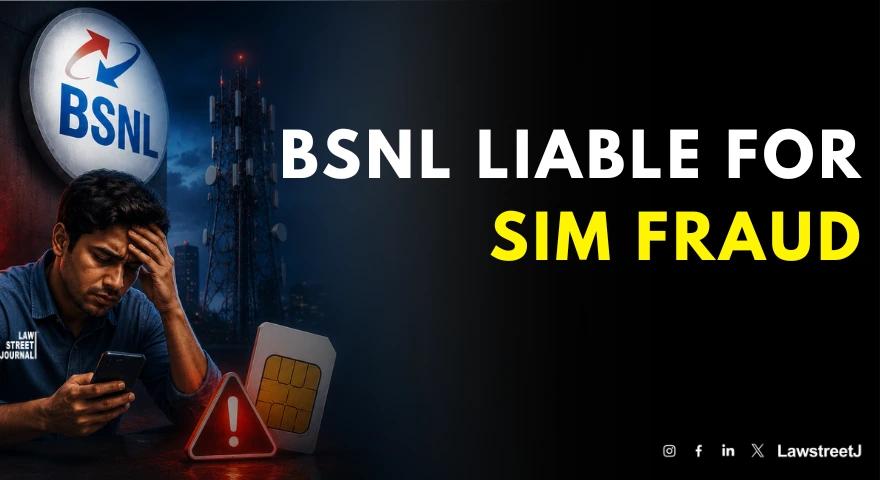
Karnataka: The Karnataka High Court has held that a telecom service provider that negligently issues a duplicate SIM card can be held fully liable for losses caused by the resulting SIM swap fraud. Accordingly, the Court directed Bharat Sanchar Nigam Limited (BSNL) to pay Rs. 50.50 lakh with 9% annual interest, along with Rs. 5 lakh as consequential damages, to a co-operative bank that lost over Rs. 87 lakh through unauthorised online transactions in February 2019.
The judgment was delivered on 1 June 2026 by Justice Suraj Govindaraj in two connected writ petitions filed by Basaveshwara Pattana Sahakara Bank Niyamitha and BSNL. The petitions challenged an August 2024 award of the Permanent Lok Adalat, Dakshina Kannada, which had directed BSNL to pay only Rs. 5 lakh as compensation to the bank.
The dispute arose after a co-operative bank discovered that seven unauthorised RTGS and NEFT transactions worth Rs. 87.70 lakh had been carried out from its Canara Bank account between 6 and 7 February 2019. The fraud was traced to the issuance of a duplicate SIM card for the mobile number linked to the bank’s internet banking account, enabling fraudsters to receive OTPs and authorise the transfers. While Rs. 30 lakh was credited back and another Rs. 7.12 lakh was later recovered, the bank ultimately suffered an unrecovered loss of Rs. 50.50 lakh.
After issuing legal notices to BSNL and Canara Bank, the co-operative bank approached the Permanent Lok Adalat. The Lok Adalat found BSNL negligent, exonerated Canara Bank, and awarded Rs. 5 lakh in compensation with 6% interest. Both parties challenged the award before the High Court.
The High Court rejected BSNL’s arguments that the fraud resulted from lapses within the bank or that the pending criminal case barred civil proceedings. It upheld the finding that BSNL’s official had negligently issued the duplicate SIM without proper verification and held BSNL vicariously liable for the resulting loss. The Court further reiterated that civil proceedings can continue independently of criminal proceedings, with liability being determined on the basis of the preponderance of probabilities.
Dismissing BSNL’s petition and partly allowing the bank’s challenge, the High Court significantly enhanced the compensation awarded by the Permanent Lok Adalat. It directed BSNL to pay Rs. 50.50 lakh towards the bank’s unrecovered financial loss, along with interest at 9% per annum from 7 February 2019 until realisation. The Court also awarded Rs. 5 lakh as consequential damages for reputational harm, loss of public confidence, operational disruption, and related losses. If the amount is not paid within three months, the outstanding sum will carry interest at 12% per annum. The Court upheld the exoneration of Canara Bank and granted no relief against it.
On the broader legal framework governing SIM swap fraud, the Court laid down several principles of general application. It characterised telecom service providers as critical infrastructure in the digital financial system, holding that the duty of care in issuing duplicate SIMs extends beyond the individual subscriber to the banking and financial system as a whole. Where the negligent issuance of a duplicate SIM directly enables financial fraud, the telecom provider bears full civil liability for the resulting loss. On the treatment of recoveries, the Court held that while direct recoveries of stolen funds reduce the net compensable loss, collateral insurance proceeds do not diminish the tortfeasor’s liability, a distinction it described as a principle of general application in digital fraud compensation.
On the obligations of banks, the Court observed that banking institutions must take proactive steps to protect themselves from SIM swap fraud, including registering multiple OTP delivery channels, implementing time delays between SIM swap notifications and the processing of high-value transactions, sending transaction alerts through alternate communication channels, and educating customers about the risks involved. The Court clarified that these measures are an additional layer of protection and not a substitute for the telecom provider’s independent duty of care.
The Court also noted the importance of effective regulatory oversight of SIM swap procedures by the Department of Telecommunications and the Telecom Regulatory Authority of India, observing that prescribed verification procedures must be enforced in practice, that penalties for non-compliance must carry genuine deterrent force, and that subscribers must receive prompt notification whenever a SIM swap is requested for their mobile numbers. While declining to issue formal directions to the regulators as being outside the scope of the writ proceedings, the Court described effective oversight of SIM management practices as a matter of urgent public importance in the digital economy.
Case Title: Basaveshwara Pattana Sahakara Bank Niyamitha v. Canara Bank and Others, WP No. 16104 of 2025 C/W WP No. 4674 of 2025


![Karnataka High Court: Cabinet Rank Status Not Equivalent to Ministerial Position [Read Order]](/secure/uploads/2023/09/lj_2318_fc1b99b7-aeed-472b-836e-33750bedb394.jpg)


![Woman living in adultery cannot claim maintenance: Karnataka High Court [Read Order]](/secure/uploads/2023/10/lj_3083_Women_living.jpg)