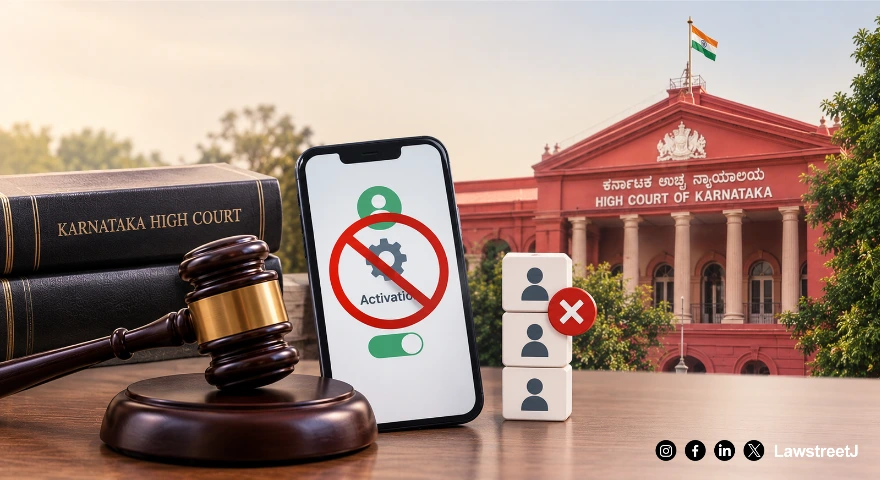
Bengaluru: The Karnataka High Court has declined to quash criminal proceedings against Mallikarjuna, a promoter of Reliance Jio, accused of possessing 75 SIM cards that were allegedly activated in the names of other persons using their Aadhaar particulars and of attempting to sell them.
Justice Suraj Govindaraj held that the circumstances raise questions that cannot be resolved without evidence, and in the same order issued a series of preventive directions to the Director General of Police, Cyber Command, concerning unauthorised activation and circulation of SIM cards by operators and their intermediaries.
In Criminal Petition No. 303 of 2025, filed under Section 482 CrPC (Section 528 BNSS), the petitioner sought to quash C.C. No. 26756/2024 pending before the III ACJM, Bengaluru, for offences under Sections 406, 419 and 420 IPC. The case arose from a suo motu FIR, Crime No. 247/2022, registered by HAL Police Station on 08.09.2022. The prosecution alleges that he obtained customers’ Aadhaar numbers and photographs, used them to procure unauthorised activation of SIM cards, and held 55 Jio and 20 Vodafone cards which he allegedly tried to sell at higher than the normal price.
Counsel for the petitioner, Vijay Kumar T., argued that the petitioner was a Jio employee entrusted with the SIM cards in the ordinary course of business, that the Area Manager (CW-8) had stated that promoters are given only non-activated cards, that he had not activated or procured the cards, and that no sale was completed or misuse shown. HCGP Ranjith Kumar N. filed a memo giving particulars of persons in whose names the cards had been activated and argued that possession of 75 activated cards cannot be reconciled with a promoter’s role.
The Court framed the question as whether the allegations, read with the investigation material, show that no offence is made out. It held that the petitioner’s employment with Jio “at first blush” explained his possession of Jio cards but did not explain the 20 Vodafone cards, a company with which he had no relationship. It further held that the CW-8 statement, read with the allegation that the cards were already activated in others’ names, raised “a material question as to how such SIM cards came into the possession of the petitioner.” The authority to sell non-activated cards, it said, “does not, by itself, confer authority to possess or distribute SIM cards activated in the names of third parties outside the prescribed procedure.”
The Court also rejected the plea that he did not personally activate the cards, observing that this cannot in isolation justify quashing. Whether he knew of the activations, his dealings with those who supplied or received the cards, and whether he tried to sell them are matters for trial.
At the same time, the Court was careful to clarify that mere possession of a SIM card, even one activated in another’s name, does not “automatically establish the commission of every offence alleged”. Each offence must satisfy its own ingredients, including dishonest or fraudulent intention, entrustment and dishonest misappropriation, and impersonation or cheating.
On the scope of the inherent power, the Court held that the jurisdiction to quash is not ordinarily exercised to appreciate disputed evidence or weigh credibility, and that where the material discloses a prima facie case, proceedings should not end merely because the accused offers an alternative explanation. It dismissed the petition, noting that nothing in its order expresses an opinion on guilt.
Turning to the larger issue, the Court observed that a SIM card is “also capable of being used as an instrument for establishing digital identity, receiving one-time passwords, registering online accounts, communicating with financial institutions”, so that unauthorised activation in the names of unsuspecting persons may expose them to identity misuse and financial fraud. It added that no finding of cyber fraud or specific misuse was being recorded, the concern being confined to systemic risks.
“The mere issuance of instructions to such intermediaries may not, by itself, be sufficient unless supported by appropriate record-keeping, supervision, verification and mechanisms for detecting deviations from the prescribed process.”
The Court directed the DGP, Cyber Command, Karnataka, to examine the issue and consider issuing instructions to jurisdictional police for prompt examination of credible information about unauthorised activation, and to examine whether multiple SIM cards activated through third-party particulars disclose a wider pattern. It also directed the DGP to issue directions to the operators, including Jio and Vodafone, to review procedures for authorising and supervising promoters and distributors, to reconcile SIM cards supplied to intermediaries against those sold or returned, to detect unusual activation patterns, to strengthen customer verification, to provide an accessible mechanism for customers to report unauthorised activation, and to train intermediaries on the limits of their authority.
All measures must remain consistent with telecommunications law and the law on customer identification data, and the Court clarified that its directions do not authorise indiscriminate surveillance or unrestricted access to customer data, and are not a finding of guilt against the petitioner. The petition was dismissed, and the matter was listed on 27.11.2026 for the DGP’s compliance report.
Appearances:
For the Petitioner: Mr. Vijay Kumar T., Advocate.
For the Respondent (State of Karnataka): Mr. Ranjith Kumar N., HCGP.
Case Title: Mallikarjuna vs. State of Karnataka, Criminal Petition No. 303 of 2025, 2026:KHC:54091