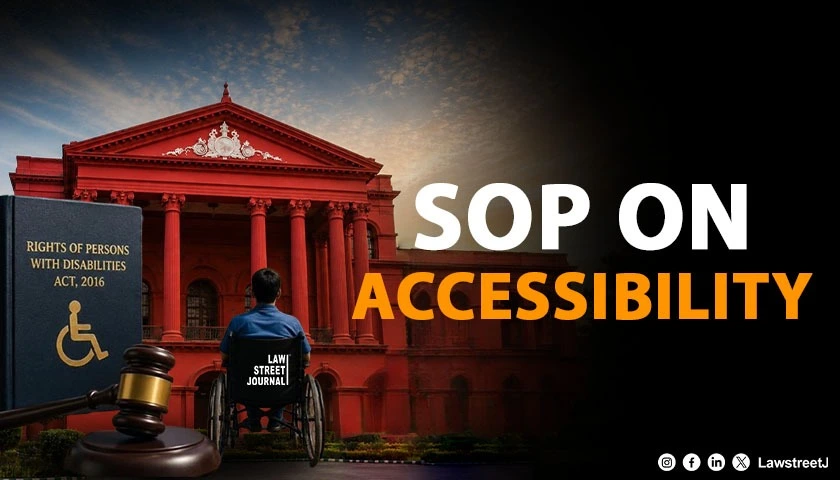
Karnataka: The Karnataka High Court has issued a comprehensive Standard Operating Procedure for Universal Accessibility, directing that all government buildings and a wide range of private establishments, including schools, hospitals, malls, transport hubs, and digital platforms, must be made fully accessible to persons with disabilities across the State of Karnataka.
The SOP, issued as part of the judgment in Writ Petition No. 11351 of 2020, was pronounced by Justice Suraj Govindaraj on June 1, 2026. While the petition was filed by PSBB Learning Leadership Academy, Bengaluru, challenging an order of the State Commissioner for Persons with Disabilities directing it to reinstate and compensate a teacher who had acquired a ninety percent locomotor disability after attempting to rescue a student, the judgment traversed far beyond the immediate dispute and issued sweeping directions for the implementation of the Rights of Persons with Disabilities Act, 2016, across Karnataka.
The SOP, issued under Articles 226 and 227 of the Constitution, is described as transitional in character and shall function as binding directions of the Court until the State Government frames comprehensive accessibility rules under Sections 40 and 45 of the Rights of Persons with Disabilities Act, 2016. The Court grounded the SOP in Articles 14, 15, 19, 21, 38, 41, and 46 of the Constitution, affirming that accessibility for persons with disabilities is a fundamental right and not a welfare concession or charity.
The SOP adopts a framework of universal design, a barrier-free environment, reasonable accommodation, and inclusion by design. It also recognises intersectionality, acknowledging that disability intersects with gender, age, caste, religion, economic status, and geographic location, and that policies must address compounded disadvantages. The Court emphasised that the RPwD Act, 2016, has been accorded quasi-constitutional status as a super-statute by the Supreme Court and must be interpreted purposively to advance the rights of persons with disabilities.
The SOP applies across Karnataka to all categories of establishments, public buildings, specified disabilities, and persons without distinction of age or gender. It covers government offices, courts, tribunals, police stations, panchayat offices, prisons, hospitals, and schools, along with private establishments such as malls, commercial complexes, cinemas, hotels, restaurants, banks, ATMs, fuel stations, and healthcare facilities. Educational institutions, including schools, colleges, universities, coaching centres, libraries, and examination centres, are also included.
The SOP also covers transport infrastructure such as bus terminals, railway and metro stations, airports, ferry terminals, transport hubs, taxi stands, parking areas, footpaths, and pedestrian crossings. It includes religious, cultural, and recreational places like temples, mosques, churches, museums, heritage sites, parks, and sports complexes. Residential facilities, including apartment complexes, gated communities, housing projects, senior living facilities, and student hostels, are also covered.
Regarding digital and virtual platforms, the SOP mandates that all government websites, mobile applications, e-governance portals, court filing and case management systems, online grievance systems, and smart-city platforms must comply with digital accessibility standards. Private establishments providing digital services to the public, including banking portals, e-commerce platforms, health portals, and educational platforms, are strongly directed to adopt digital accessibility standards and will be required to comply fully once regulations are framed under the Act.
The SOP classifies buildings into categories for the purpose of compliance timelines. All new constructions, whether government or private, must comply with accessibility requirements from the inception stage. Existing public buildings must be made fully accessible within five years of the notification of accessibility rules. Private establishments providing services to the public, including schools, hospitals, and malls, must make their services accessible within two years of the notification of accessibility rules. High-footfall public utility buildings, specifically airports, railway stations, metro stations, bus terminals, malls, and shopping complexes, are accorded priority status and must achieve full accessibility compliance within one year from the date of the order.
The Court directed the Karnataka Government to establish a State Accessibility Authority within six months. Until its formation, the State Commissioner for Persons with Disabilities will perform its functions. The Authority will monitor accessibility compliance, issue certifications, empanel auditors, update accessibility standards, develop digital monitoring systems, and publish an annual State Accessibility Report with district-wise rankings.
The Court also directed the establishment of District Accessibility Committees in every district within six months, chaired by the respective Deputy Commissioner and comprising the Chief Executive Officer of the Zilla Panchayat, the Municipal Commissioner, a representative of the State Commissioner for Persons with Disabilities, and a district engineer from the Public Works Department, among others.
On the question of whether the Rights of Persons with Disabilities Act, 2016, applies to private institutions, the Court held emphatically that it does. Distinguishing the position under the 1995 Act, which had been interpreted by the Supreme Court in Dalco Engineering Private Limited v. Union of India to exclude private sector companies, the Court noted that the 2016 Act made a decisive departure by defining “establishment” under Section 2(i) to expressly include both government and private establishments. The Court further held that Section 2(v) of the 2016 Act defines “private establishment” to include companies, firms, societies, trusts, agencies, institutions, and organisations, and that the petitioner school fell squarely within this definition.
The Court addressed thirteen points for determination, covering the applicability of the Act to private institutions; the duties of educational institutions under Sections 16 and 17; the scope of non-discrimination in employment under Section 20; the obligation to frame equal opportunity policies under Section 21; the meaning of “public building” under Section 2(w) of the Act; the obligation of private employers to provide reasonable accommodation; and the question of whether the State Commissioner possessed jurisdiction to issue binding corrective directions against a private establishment.
On the specific facts of the dispute, the petitioner-school had challenged the order of the State Commissioner dated June 12, 2020, which had directed it to pay Rs. 10,00,000 towards medical expenses to Respondent No. 1, a primary teacher who had sustained a ninety percent permanent locomotor disability on August 22, 2013, after she fell while attempting to prevent a student from jumping off a window of the school building. The school had contended, inter alia, that the teacher had acted contrary to the Standard Operating Procedure, that the Commissioner lacked jurisdiction under the 2016 Act to pass binding orders, and that the complaint was barred by limitation.
The Court addressed in detail the competing lines of Supreme Court decisions on the powers of the Commissioner, reconciling the view in State Bank of Patiala v. Vinesh Kumar Bhasin, which had held that the Commissioner under the 1995 Act could not issue mandatory directions, with the later developments under the 2016 Act and the ruling in Geetaben Ratilal Patel v. District Primary Education Officer, which had affirmed the Commissioner’s power to take effective remedial action. The Court ultimately held that, under the 2016 Act, the Commissioner possesses powers going beyond mere recommendation and can issue corrective directions where the rights of persons with disabilities have been violated.
Mr. B.K. Sampath Kumar, Senior Advocate, appeared for the petitioner-school, with Mr. Suraj Sampath, Advocate. Ms. Jayna Kothari, Senior Advocate, appeared for Respondent No. 1, with Mr. Rohan Kothari as co-counsel. Mr. Mahantesh Shettar, Additional Government Advocate, appeared for Respondent No. 2.
Case Title: PSBB Learning Leadership Academy v. Mrs. Barnali Rout & The State Commissioner for Persons with Disabilities, Karnataka, Writ Petition No. 11351 of 2020.


![Karnataka High Court: Cabinet Rank Status Not Equivalent to Ministerial Position [Read Order]](/secure/uploads/2023/09/lj_2318_fc1b99b7-aeed-472b-836e-33750bedb394.jpg)


![Woman living in adultery cannot claim maintenance: Karnataka High Court [Read Order]](/secure/uploads/2023/10/lj_3083_Women_living.jpg)