

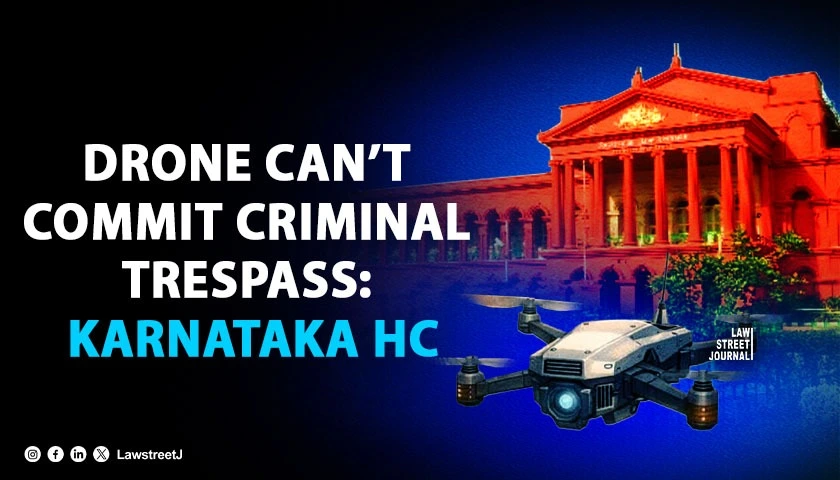
Karnataka: The High Court of Karnataka has quashed a First Information Report registered against M/s NewSpace Research and Technologies Private Limited, a company engaged in research and development of unmanned aerial systems, holding that the essential ingredients of criminal trespass and endangerment of life under the Bharatiya Nyaya Sanhita, 2023 were conspicuously absent, and that the criminal justice system cannot be invoked on the basis of speculative or mechanical attribution of a rash or negligent human act to an inanimate object.
Justice M. Nagaprasanna delivered the order on 24 February 2026 in Writ Petition No. 3862 of 2026 (GM-RES), filed by the petitioner under Article 226 of the Constitution of India read with Section 528 of the Bharatiya Nagarik Suraksha Sanhita, 2023.
The petitioner, M/s NewSpace Research and Technologies Private Limited, is a centrally regulated entity holding a valid authorization certificate issued by the Directorate General of Civil Aviation, recognizing it as a research and development organization under the unmanned aircraft system regulatory framework. It also holds an industrial and defence licence granted by the Department for Promotion of Industry and Internal Trade, authorizing it to manufacture and develop autonomous systems and unmanned aerial vehicles. The petitioner has been in lawful possession of approximately 48 acres of land at Doddaballapura, Bengaluru Rural District, under a subsisting lease agreement, and has been using the said land for the last five years for research, development, and testing of drones and unmanned systems as part of routine operations.
On 29 January 2026, a team of flight operators employed by the petitioner was conducting routine drone testing at the leased premises. The drone involved on the said day was a lightweight research prototype made primarily of thermocol, fitted with a commercially available battery, weighing approximately seven kilograms and capable of flying at an altitude of 100 to 150 feet. The testing was carried out within a green zone classification area. During the course of testing, one of the drones suffered a battery malfunction, as a result of which it glided beyond the boundary of the leased land and landed smoothly into a neighbouring property. Owing to poor lighting conditions and lack of GPS signal, the drone could not be located immediately, and the petitioner’s team began a search the following day.
On the same day, a Police Constable attached to Doddaballapura Rural Police Station, while on routine rounds, received information through the 112 helpline regarding the presence of a drone in Palanayogahalli village, Doddaballapura Taluk. The Constable proceeded to the spot and conducted a check. This resulted in the registration of a suo motu crime against unknown persons, alleging that the drone had been placed on private land and that its presence was endangering the life and physical safety of the owner of the land. The same was registered as Crime No. 24 of 2026 for offences punishable under Sections 125 and 329(3) of the Bharatiya Nyaya Sanhita, 2023. The crime did not name or identify any individual, company, operator, or pilot as an accused.
When the petitioner’s officials visited the jurisdictional Police Station the following day and disclosed that the drone belonged to the petitioner and was being used for research and testing purposes, the Officer-in-charge directed that the Managing Director of the company be physically present before the contents of the FIR were revealed. Despite the petitioner informing the Police that Rule 42 of the Drone Rules, 2021 exempts research and development organizations from obtaining permission and approval for such operations, a copy of the FIR was not furnished to the petitioner. Apprehending coercive action, the petitioner approached the High Court.
The petitioner’s counsel argued that the ingredients of neither offence were satisfied even at the threshold. It was contended that the allegation under Section 329 of the BNS cannot be attributed to an inanimate object, and that even if attribution were attempted to some operator, the FIR did not mention any culpable human entry with the requisite intention of trespass. On Section 125, it was submitted that the FIR contained no allegation of any rash or negligent human act and no specific endangerment to any identified person. The petitioner further relied upon the doctrine of triviality, noting that the incident caused only slight or negligible harm, with no bodily injury, property damage, or private complaint. The denial of the FIR copy despite repeated requests was also strongly assailed.
The Additional State Public Prosecutor countered that the allegation was not that the drone itself had committed trespass but that it was planted by the petitioner. He argued that a drone landing in one’s neighbourhood is undoubtedly an object of fear in today’s world, justifying registration of the crime. He conceded, however, that a copy of the FIR ought to have been furnished to the petitioner and sought dismissal of the petition on the ground that the matter should be permitted to be investigated.
Examining Section 329(3) of the BNS, the Court noted that criminal trespass predicates liability upon entry into property with intent to commit an offence or to intimidate, insult, or annoy the owner of the said property. The sine qua non of the provision is the existence of mens rea. The Court observed that the FIR was conspicuously devoid of any allegation of intentional human entry or any discernible ingredient of the statute, and that the recovery of a drone, without anything more, cannot by any stretch of imagination satisfy the ingredients of the offence. The Court held that Section 329 of the BNS was loosely laid against the petitioner.
On Section 125 of the BNS, which contemplates a rash or negligent human act endangering life or personal safety, the Court found that the FIR did not attribute any such negligent human act to any individual, nor did it identify any specific victim. The Court held that criminal jurisprudence continues to rest upon the bedrock of mens rea and that the criminal justice system cannot be invoked on the basis of speculative or mechanical attribution of the ingredients of the offence of a rash and negligent human act to an inanimate object. The Police, the Court held, cannot convert a mechanical event into an offence involving mens rea by a bald assertion in the complaint.
The Court further held that even assuming the widest latitude in favour of the prosecution, the incident at its highest constituted a case of negligible harm, squarely attracting the doctrine of triviality under Section 33 of the BNS, which corresponds to Section 95 of the Indian Penal Code. Relying on the Supreme Court’s decision in Mrs. Veeda Menezes v. Yusuf Khan (AIR 1966 SC 1772), the Court noted that Section 95 is intended to prevent penalisation of negligible wrongs or offences of a trivial character, and that whether an act amounts to a trivial offence depends upon the nature of the injury, the position of the parties, the knowledge or intention with which the offending act is done, and other related circumstances. With no bodily injury, property damage, or aggrieved private complainant, and a suo motu FIR whose fulcrum was nothing more than a drone trespassing into a neighbouring property, the case squarely attracted this principle.
The Court applied the well-established categories set out by the Supreme Court in State of Haryana v. Bhajan Lal (1992 Supp (1) SCC 335), particularly the category that the allegations in the FIR, even if taken at face value and accepted in their entirety, do not prima facie constitute any offence or make out a case against the accused. The Court held that when the essential ingredients are absent, quashing becomes axiomatic. Since neither Section 329 nor Section 125 of the BNS was made out even in the remotest sense, the inevitable conclusion was obliteration of the crime.
Before concluding, the Court took the opportunity to address the recurring failure of investigating agencies to furnish copies of FIRs to accused persons. Relying on Youth Bar Association of India v. Union of India (2016) 9 SCC 473, the Court reiterated that an accused is entitled to obtain a copy of the FIR without undue delay, and that a mere assertion that the FIR is uploaded online cannot be a substitute for compliance with this obligation. The Court held that the denial of essential particulars concerning the FIR renders the right of access illusory and undermines the purpose of transparency envisaged by the Supreme Court. The Court directed all Police Stations to scrupulously adhere to the mandate of furnishing a copy of the FIR or, if online, the complete details of the FIR, warning that Station House Officers who deviate from this requirement would be open to initiation of departmental enquiry.
Allowing the writ petition, the Court quashed the First Information Report in Crime No. 24 of 2026 registered by the Doddaballapura Rural Police Station, Bengaluru Rural District, insofar as it pertained to the petitioner.
Sri Angad Kamath appeared for the petitioner and Sri B.N. Jagadeesha, Additional State Public Prosecutor, appeared for the respondent-State of Karnataka.
Case Title: M/s NewSpace Research and Technologies Private Limited v. State of Karnataka (Writ Petition No. 3862 of 2026 (GM-RES), High Court of Karnataka, decided on 24 February 2026, NC: 2026:KHC:11506)


![Karnataka High Court: Cabinet Rank Status Not Equivalent to Ministerial Position [Read Order]](/secure/uploads/2023/09/lj_2318_fc1b99b7-aeed-472b-836e-33750bedb394.jpg)


![Woman living in adultery cannot claim maintenance: Karnataka High Court [Read Order]](/secure/uploads/2023/10/lj_3083_Women_living.jpg)