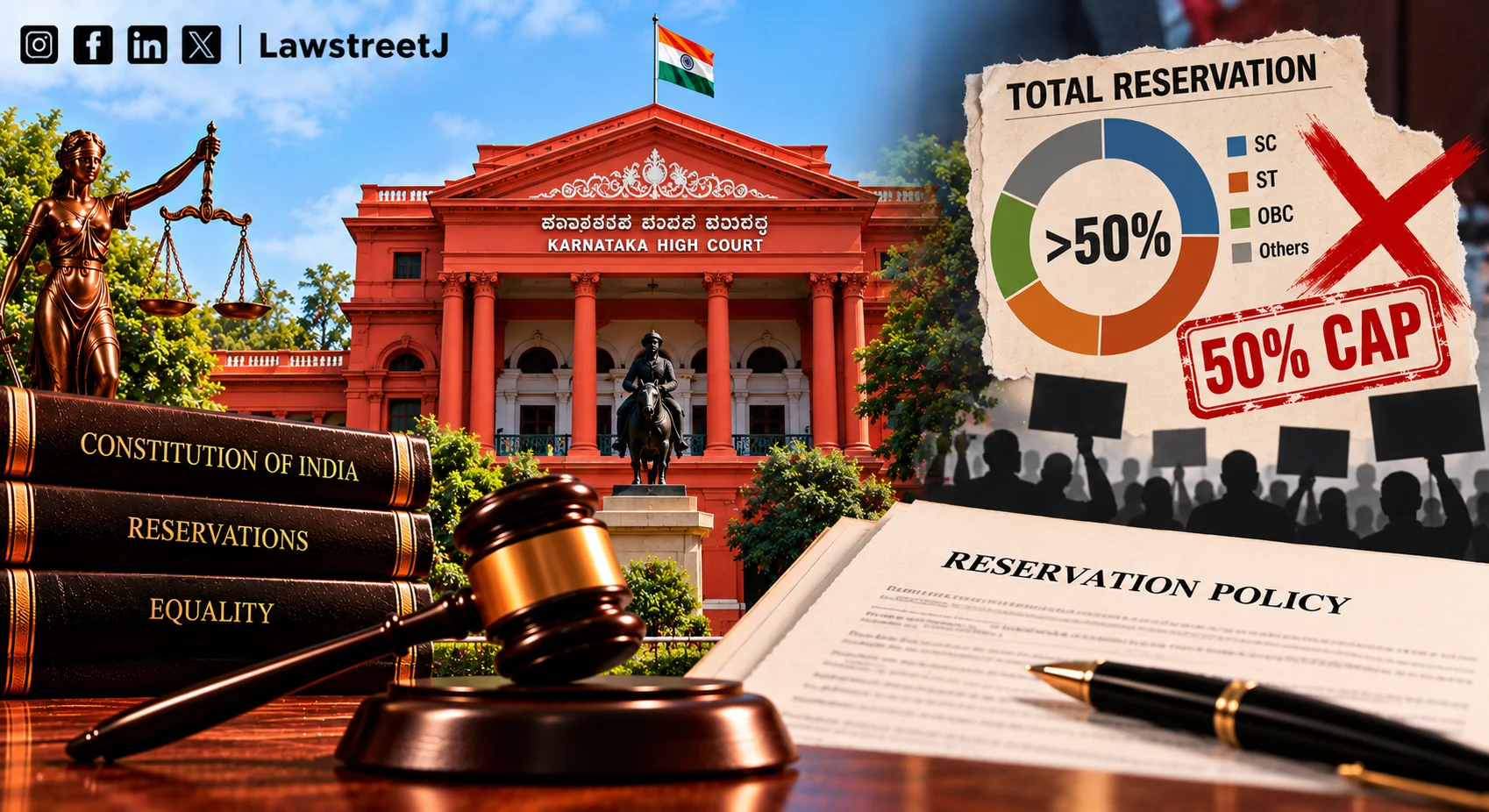
Bengaluru: The Karnataka High Court has struck down provisions of the Karnataka Scheduled Castes and Scheduled Tribes (Reservation of Seats in Educational Institutions and of Appointments or Posts in the Services under the State) Act, 2022 (Karnataka Act No. 01 of 2023), which raised reservation for Scheduled Castes from 15% to 17% and for Scheduled Tribes from 3% to 7%, holding that the increase took aggregate reservation to 56%, breaching the 50% ceiling laid down by the Supreme Court, and that the State had failed to establish any extraordinary circumstances justifying a departure from it.
A Division Bench of Chief Justice Vibhu Bakhru and Justice K.S. Hemalekha, in a judgment authored by the Chief Justice and pronounced on 12.10.2026 after orders were reserved on 09.09.2026, allowed W.P. No. 200448 of 2025, a public interest litigation by Mahendra Kumar Mitra, State President of the Dr. Ambedkar Scheduled Castes Federation, who appeared in person, along with W.P. No. 25515 of 2025, filed by three civil engineering graduates who had applied for Assistant Engineer (Civil) posts in the Bruhat Bengaluru Mahanagara Palike under a Karnataka Public Service Commission notification dated 13.03.2024. Three connected petitions were directed to be listed separately, and the judgment decides the lead petitions only insofar as they challenge the Act's validity.
The Court noted that the State of Mysore had tentatively fixed reservation at 15% and 3% in 1958, pending collection of data, and that a Government Order of 2002 provided aggregate reservation of 50%, including 32% for the other backward classes. A Commission headed by Justice H.N. Nagamohan Das, appointed in 2019, reported on 02.07.2020 recommending 17% and 7%. An Ordinance followed on 23.10.2022, and a Government Order of 28.12.2022 prescribed roster points leaving 56% of posts reserved and 44% for the general category. The Act received assent on 11.01.2023 and was deemed in force from 01.11.2022. Section 3 fixed the new percentages for educational institutions, Section 4 for State services, and Section 5 preserved eligibility of Scheduled Caste and Scheduled Tribe candidates for unreserved seats on merit. With the 32% quota for other backward classes untouched, overall reservation rose from 50% to 56%.
The impugned KPSC notification reserved 51 of 92 Assistant Engineer posts, about 55.4%, leaving 41 for general merit. The Karnataka State Administrative Tribunal had, on 28.05.2025, set aside the 2022 Government Order and a related notification for Gazetted Probationers, holding 56% reservation contrary to Indra Sawhney v. Union of India and Dr. Jaishri Laxmanrao Patil v. Chief Minister; the State's challenge to that ruling is pending separately. By interim orders of November 2025, the High Court had barred fresh recruitment on the increased reservation and made ongoing processes subject to the final outcome, with candidates barred from claiming equities.
Senior Advocate P.S. Rajagopal, for the petitioners in W.P. No. 25515/2025, argued that adequacy of representation could not be judged without studying the population and participation of every other community among the State's more than 210 castes and tribes, which neither the Nagamohan Das Commission nor the High Level Committee headed by Justice Subhash B. Adi had done. He contended that the Commission's findings on disparities within the Scheduled Castes and Scheduled Tribes could justify internal reservation but not a breach of 50%, that the Adi Committee report on record post-dated the Act, and that a Directorate of Economics and Statistics report dated 22.01.2024 showed Scheduled Caste representation of 18.65% and Scheduled Tribe representation of 5.05% in State civil services, against reservation of 15% and 3%. He also argued that the National Commissions had not been consulted under Articles 338(9) and 338A(9). Mr. Mitra adopted these submissions.
Senior Advocate Prof. Ravivarma Kumar, for the State, contended that the 50% rule stood obliterated by the Constitution (One Hundred and Third Amendment) Act, 2019, upheld in Janhit Abhiyan v. Union of India, and that with the economically weaker sections carved out, the pool open to backward classes had shrunk to 90%, so that 50% of the total already exceeded 50% of that pool. He submitted that Articles 338(9) and 338A(9) do not apply to legislation and that the State had in any event written to the Commissions after enactment, and invoked the presumption of constitutionality, limited judicial review, and the argument that the ceiling in M.R. Balaji v. State of Mysore was never inflexible. He relied on the Nagamohan Das, Adi and Ratnaprabha Committee reports as establishing a special case for exceeding the ceiling.
The Court began with the Constituent Assembly debates, noting Dr. B.R. Ambedkar's explanation that reservation must be "confined to a minority of seats", failing which the exception would eat up the rule, and held that the framers never intended proportionate representation. Surveying the case law from Balaji, where 68% reservation was struck down, through T. Devadasan, State of Kerala v. N.M. Thomas and K.C. Vasanth Kumar, it acknowledged that individual Judges had called the 50% limit a rule of thumb or caution, but held that the nine-Judge Bench decision in Indra Sawhney firmly establishes the ceiling under Articles 15(4) and 16(4), not as an elastic limit assessed case by case or by the population or backwardness of the classes concerned. Indra Sawhney described 50% as a "strict rule", held that adequate representation cannot be read as proportionate representation, and left room only for extraordinary situations, illustrated by far-flung populations outside the mainstream of national life, calling for extreme caution and a special case.
The Court found the ceiling reaffirmed in R.K. Sabharwal, M. Nagaraj, which treated it as a boundary of the width of the State's power, and Dr. Jaishri Laxmanrao Patil, which declined to refer Indra Sawhney to a larger Bench. It noted that Article 16(4B) itself recognises the 50% ceiling, and cited the observations of S. Ravindra Bhat, J. describing the ceiling with its extraordinary circumstances exception as the "Goldilocks solution". It also noted that the Madhya Pradesh High Court, on 09.10.2026 in Ashita Dubey v. State of Madhya Pradesh, struck down an increase in other backward class reservation from 14% to 27%, and that the Patna and Chhattisgarh High Courts had likewise set aside enhancements beyond 50%.
Rejecting the 103rd Amendment argument, the Court held that the 50% rule is, fundamentally, a rule of equality, and that the "shrunken pool" argument would leave the ceiling set at large and allow the State to keep reducing seats available on general merit. It noted that Janhit Abhiyan itself explained that the ceiling is apparently for the benefit of general merit candidates and cannot be stretched to the economically weaker sections, whose reservation is carved out from the general pool.
The Court accepted that the State's opinion on backwardness and inadequate representation is a matter of subjective satisfaction, reviewable only on limited grounds, but held that the challenge was not outside judicial review, since the question was not whether the State had quantifiable data but whether the exercise stayed within the limits of its power. Reliance on Nagaraj and S.V. Joshi v. State of Karnataka for the proposition that the ceiling can be breached on quantifiable data was held misplaced, Jaishri Patil having called that a misreading. Even if the reports established backwardness and inadequate representation, this would permit reservation only within 50%, and a subjective opinion that the reservation in favour of an identified backward class ought to be a few percentage points higher is not extraordinary enough to trigger the exception to the 50% rule.
On the State's three grounds for an extraordinary case, namely growth in Scheduled Caste and Scheduled Tribe numbers, demographic change, and the three reports, the Court accepted that backwardness was established but found no extraordinary circumstance. The Ratnaprabha Committee, whose data the Nagamohan Das Commission used, was constituted for reservation in promotion after B.K. Pavitra I and did not examine any community other than the Scheduled Castes and Scheduled Tribes. The Commission's terms of reference themselves specified 17% and 7% and framed the inquiry in proportion to population, rather than asking whether extraordinary circumstances existed. It collected no fresh data, relied on figures up to 2016 supplemented by departmental data for 2017 and 2018, left a sharp spike in Scheduled Tribe figures for 2015 unexplained, and its only comparative table of communities in public employment concerned Brahmins and non-Brahmins in the princely State of Mysore for 1916 to 1918.
The Commission's own data showed even the existing 15% and 3% had not been filled in some years, and the 2024 Directorate of Economics and Statistics report, on the position as on 31.03.2023, showed 18.65% Scheduled Caste and 5.05% Scheduled Tribe representation, with Scheduled Caste representation above 19% in 29 of 33 departments. The Court held that provisions operating in the present and future must rest on contemporaneous data, as held in Pattali Makkal Katchi v. A. Mayilerumperumal, and that adequacy is relative and requires comparison with other classes, which the Commission had not undertaken.
On population, the Court held that the very approach that, once a class has been identified as a backward class, the reservation in its favour is required to be in proportion to its population is debilitating to the rule of equality, which is a part of the basic structure of the Constitution, observing that every other backward class could make the same claim. That Scheduled Castes and Scheduled Tribes form 24.10% of the population but have 18% reservation was held not extraordinary, and in order to invoke the exception of extraordinary circumstances, the least that would be necessary is to establish that, but for exceeding the limit, there is no possibility for the left-out communities to have any meaningful participation, which was not the State's case. The Commission's findings on marginalised sub-groups might at best justify internal reservation. The Court also held that B.K. Pavitra II, which upheld reliance on the Ratnaprabha report for consequential seniority in promotions, did not assist the State.
The Court held that the principles under Article 16(4) apply equally to Article 15(4), noting that Balaji itself concerned educational institutions and that later decisions treated the ceiling as applicable to both Articles.
On consultation, the Court observed that the State admittedly did not consult the National Commissions before enacting the Act, that letters of 10.12.2025 and 20.01.2026, written nearly three years later and after the challenge, could not amount to consultation, which must precede the decision, and that legislative competence is circumscribed by other constitutional provisions. It added that it was not necessary to examine this challenge further, given its conclusion on Articles 14, 15 and 16.
Concluding, the Court struck down Section 3 of the Act insofar as it takes aggregate reservation beyond the 50% ceiling, as violative of Articles 14 and 15, and Section 4 as violative of Articles 14 and 16, allowing the petitions in those terms.
Appearances:
For the Petitioner in W.P. No. 200448/2025: Mr. Mahendra Kumar Mitra, Party-in-Person.
For the Petitioners in W.P. No. 25515/2025: Mr. P.S. Rajagopal, Senior Advocate, with Mr. Vinayaka S. Pandit, Advocate.
For the Union Respondents: Mr. Harsha P. Banad, CGSC.
For the State of Karnataka: Prof. Ravivarma Kumar, Senior Advocate, with Ms. Ashwini O., Special Counsel, and Mr. Sidharth Baburao, Special Government Advocate.
For the Karnataka Public Service Commission: Mr. Ruben Jacob, Senior Advocate, with Mr. K.M. Prakash, Advocate.
For the Bruhat Bengaluru Mahanagara Palike: Mr. B.L. Sanjeev, Advocate.
Case Title: Mahendra Kumar Mitra & Others vs. Union of India & Others, W.P. No. 200448 of 2025 (SC-ST-PIL) c/w Sagar H.R. & Others vs. State of Karnataka & Others, W.P. No. 25515 of 2025 (S-RES)


![Karnataka High Court: Cabinet Rank Status Not Equivalent to Ministerial Position [Read Order]](/secure/uploads/2023/09/lj_2318_fc1b99b7-aeed-472b-836e-33750bedb394.jpg)


![Woman living in adultery cannot claim maintenance: Karnataka High Court [Read Order]](/secure/uploads/2023/10/lj_3083_Women_living.jpg)