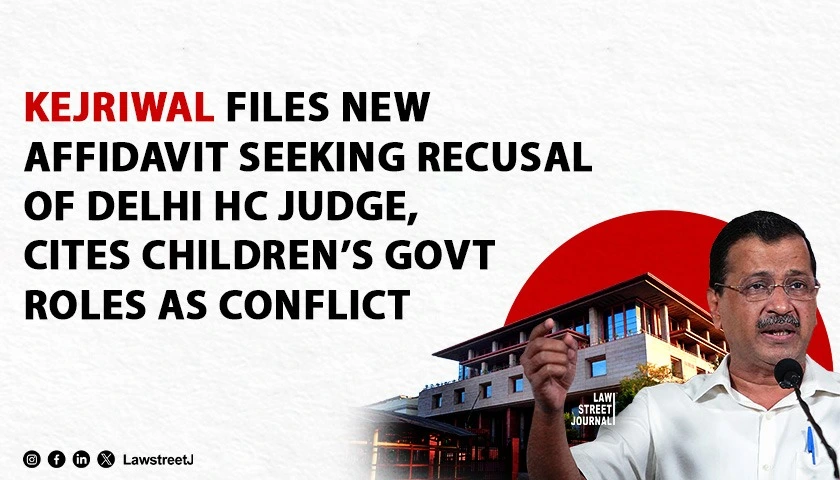
New Delhi: Arvind Kejriwal has filed an additional affidavit before the Delhi High Court seeking the recusal of Justice Swarana Kanta Sharma from hearing the revision petition filed by the Central Bureau of Investigation (CBI) in the liquor policy case, citing a perceived conflict of interest arising from the empanelment of the judge’s children as Central Government counsel.
In the affidavit, Kejriwal stated that both the son and daughter of Justice Sharma are empanelled as Central Government counsel and receive work through the office of the Solicitor General of India, who is appearing before the Court on behalf of the CBI in the present matter. According to him, this creates a “direct and serious appearance of conflict of interest.”
He submitted that the Solicitor General allocates government litigation work to panel counsel; therefore, the same legal establishment appearing before the Court is also responsible for assigning work to the immediate family members of the presiding judge.
“The very law officer and legal establishment representing the prosecuting side before this Hon’ble Court is also part of the institutional mechanism by which Central Government cases and government work are allocated to the immediate family members of the Hon’ble Judge hearing the matter,” the affidavit states.
Kejriwal further relied on publicly available material to contend that a substantial number of cases have been allocated to the judge’s son over the years. The affidavit refers to RTI material indicating that 2,487 cases were marked to him in 2023, 1,784 cases in 2024, and 1,633 cases in 2025.
It was also stated that the circumstances of the case heighten the apprehension of bias, given that the prosecuting agency is the CBI and the matter involves a challenge to the discharge of the accused in the liquor policy case.
Kejriwal clarified that he is not alleging actual bias or attributing any improper motive to the Court but submitted that the situation creates a reasonable apprehension that the proceedings may not reflect the required standards of judicial detachment and neutrality.
“I therefore respectfully submit that the continuance of the present revision petition before the Hon’ble Judge would give rise to an immediate and direct appearance of conflict of interest,” he stated, adding that the matter should not be heard further by the same Bench.
He also contended that he was not given an adequate opportunity to respond to the submissions made by the CBI. According to the affidavit, arguments on behalf of the CBI continued till after 6:15 PM, and proceedings concluded beyond 7:00 PM on the same day, without granting him sufficient time to prepare rejoinder submissions.
Kejriwal requested that the Court take the contents of the affidavit on record and grant him an opportunity to address the issues raised, submitting that the facts disclosed constitute a valid ground for recusal.
The recusal plea arises in the context of the revision petition filed by the CBI challenging the discharge of the accused in the liquor policy case. The Court had reserved orders on April 13 on the applications seeking recusal.
Case Details:
- Case Title: Directorate of Enforcement (ED) v. Arvind Kejriwal
- Case Number: CRL.L.P. 14/2026
- Court: Delhi High Court
- Judge: Justice Swarana Kanta Sharma
- Date of Hearing: April 13, 2026
- Application: Recusal application filed by Arvind Kejriwal
- Nature of Matter: Revision petition concerning discharge in the liquor policy case
- Key Issue: Alleged appearance of conflict of interest due to the empanelment of the judge’s children as Central Government counsel
- Appearing for CBI: Solicitor General Tushar Mehta; Additional Solicitors General S.V. Raju and D.P. Singh
- Appearing for Arvind Kejriwal: Arvind Kejriwal (party-in-person)
- Status: Orders reserved; additional affidavit filed thereafter

![Delhi High Court Sets Aside Arbitral Tribunal's Award Against NHAI in Highway Project Delay Case [Read Judgment]](/secure/uploads/2023/07/lj_9605_23374c2e-392c-4491-a2fe-f2f12fc5272f.jpg)
![Delhi Court Rejects Stay Request in Defamation Case Against Rajasthan CM Ashok Gehlot [Read Order]](/secure/uploads/2023/08/lj_5208_80de1ddc-d76a-4f7f-b180-408e3ae14fb4.jpg)