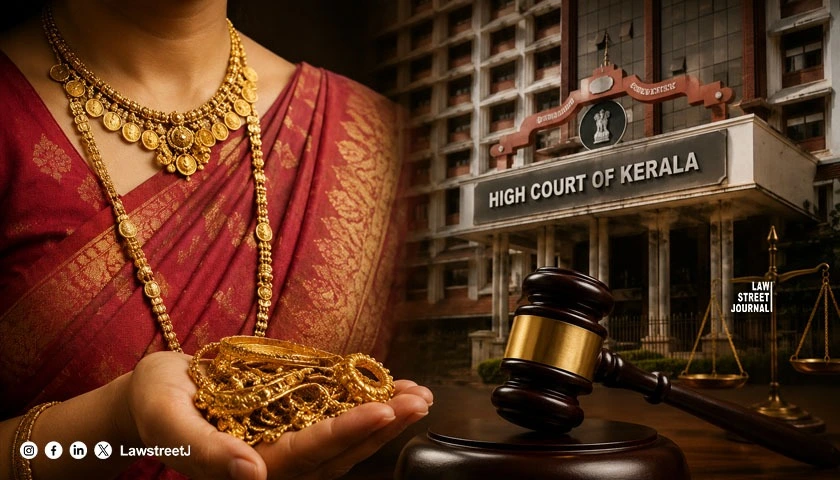
The Kerala High Court has ruled that matrimonial courts cannot assume that a wife entrusted her gold ornaments to her husband or in-laws merely because such practices may have been common in the past. The Court stressed that findings must rest on evidence and not on speculation or general social assumptions.
A Division Bench of Dr. Justice A.K. Jayasankaran Nambiar and Justice Preeta A.K. was hearing a Matrimonial Appeal filed by a husband and his father against a Family Court judgment that had directed them to return 80 sovereigns of gold ornaments or their market value, Rs.5,00,000 with 6% interest, and Rs.6,89,350 towards marriage expenses to the wife. The wife had approached the Family Court, Muvattupuzha, seeking return of 80 sovereigns of gold ornaments, Rs.5,00,000 paid at the time of engagement, Rs.12,00,000 spent on the marriage, and Rs.50,00,000 as compensation, alleging that her ornaments had been appropriated and that she was harassed for further cash after the marriage.
The Family Court had accepted the wife's case in substantial part, holding that she was entitled to the return of Rs.5,00,000 with interest and 80 sovereigns of gold or its market value, along with Rs.6,89,350 towards marriage and engagement expenses, while rejecting her claims for alimony and compensation. The husband and father-in-law appealed against this finding.
Before analysing the evidence, the Bench set out the standard applicable in matrimonial matters, noting that proof is tested on a preponderance of probabilities rather than beyond reasonable doubt, and that forensic probability must ultimately rest on a robust common sense and the trained intuitions of the judge. The Court observed that inferences drawn from evidence must be carefully distinguished from conjecture, cautioning that “the impossible is weeded out at the first stage, the improbable at the second.”
The Bench held that a claim for return of gold or money by a wife requires proved facts, oral, documentary or circumstantial, from which entrustment to the husband or his relatives, and misappropriation by them, can be inferred. Only once such entrustment is established does the burden shift to the husband to show that the gold or money was returned or utilised for the wife's benefit.
The Court also cautioned against the practice of courts relying on the general observation in Bexy Michael v. A.J. Michael that documentary evidence need not be insisted upon for gold or money exchanged at marriage, noting that this had often been used to bypass a genuine search for evidence and to rely instead on a judge's personal perception of custom.
The Bench added that under the Bharatiya Sakshya Adhiniyam, 2023, custom is a question of fact requiring proof, and that assumptions about a bride handing over her ornaments for safekeeping may not reflect the reality of financially independent, well-educated women who retain control over their own possessions after marriage.
Applying these principles, the Court upheld the finding that Rs.5,00,000 had been paid to the father-in-law at the time of engagement, since the wife's evidence was corroborated by her father and an independent witness who had seen the money change hands, and was further supported by documentary evidence. On the gold ornaments, however, the Bench found no evidence of entrustment beyond 242.9 grams that the husband had admittedly pledged with a bank shortly after the marriage. The husband's claim that this gold belonged to his sister was disbelieved, since the pledge documents were dated over a year after his own claimed date for pledging his sister's ornaments. The Court held that “in all probability, the ornaments that were pledged were the ornaments of the respondent.”
The Family Court's finding that the wife was entitled to 80 sovereigns of gold was accordingly set aside and her entitlement was restricted to the 242.9 grams shown to have been pledged.
On the claim for marriage expenses, the Bench held that the Family Court's direction to the husband to refund Rs.6,89,350 was legally unsustainable. Since the marriage had not been declared null or void but had ended through a legally granted divorce, the Court held that both spouses bear the costs of their own marriage celebrations, and that saddling one side with the other's expenses was unjustified, particularly where the husband's family too would have incurred considerable expenditure and where the bulk of the wedding guests belonged to the wife's side.
The Mat. Appeal was accordingly partly allowed. The Family Court's judgment was set aside, and the appellants were directed to return Rs.5,00,000 with 6% interest from the date of filing of the original petition, along with 30 sovereigns of gold or its market value as on the date of payment, failing which the wife would be entitled to realise the amount from the appellants or their assets.
Appearances:
For the Appellants/Respondents: Adv. S. Sreedev, Adv. Enoch David Simon Joel, Adv. Rony Jose, Adv. Leo Lukose, Adv. Karol Mathews Sebastian Alencherry, Adv. Derick Mathai Saji, Adv. Karan Scaria Abraham, Adv. Ittoop Joy Thattil.
For the Respondent/Petitioner: Adv. T.S. Maya (Thiyadil), Adv. K.A. Sunitha, Adv. K. Rajeev (Thiyadil).
Case Title: Vinu K.S. and Another vs. Veena Viswan, Mat. Appeal No.1095 of 2024



![Kerala HC Quashes 498A Dowry Harassment Case Against Live-In Partner, Citing Lack of Relative Status [Read Order]](/secure/uploads/2023/08/lj_5693_1057c042-1e57-4e27-8c9e-25af0ec38ec4.jpg)
![Watching porn on mobile: Kerala HC highlights importance of mother cooked meals, outdoor sports [Read Order]](/secure/uploads/2023/09/lj_9155_Parental_supervision_of_mobile_phone_usage.jpg)
![Lakshadweep MP Mohammed Faizal Disqualified from Lok Sabha After Conviction Suspension Plea Rejected by Kerala High Court [Read Notice]](/secure/uploads/2023/10/lj_9640_87b5fd97-0e05-4ff8-9a99-3be1e4446192.jpg)