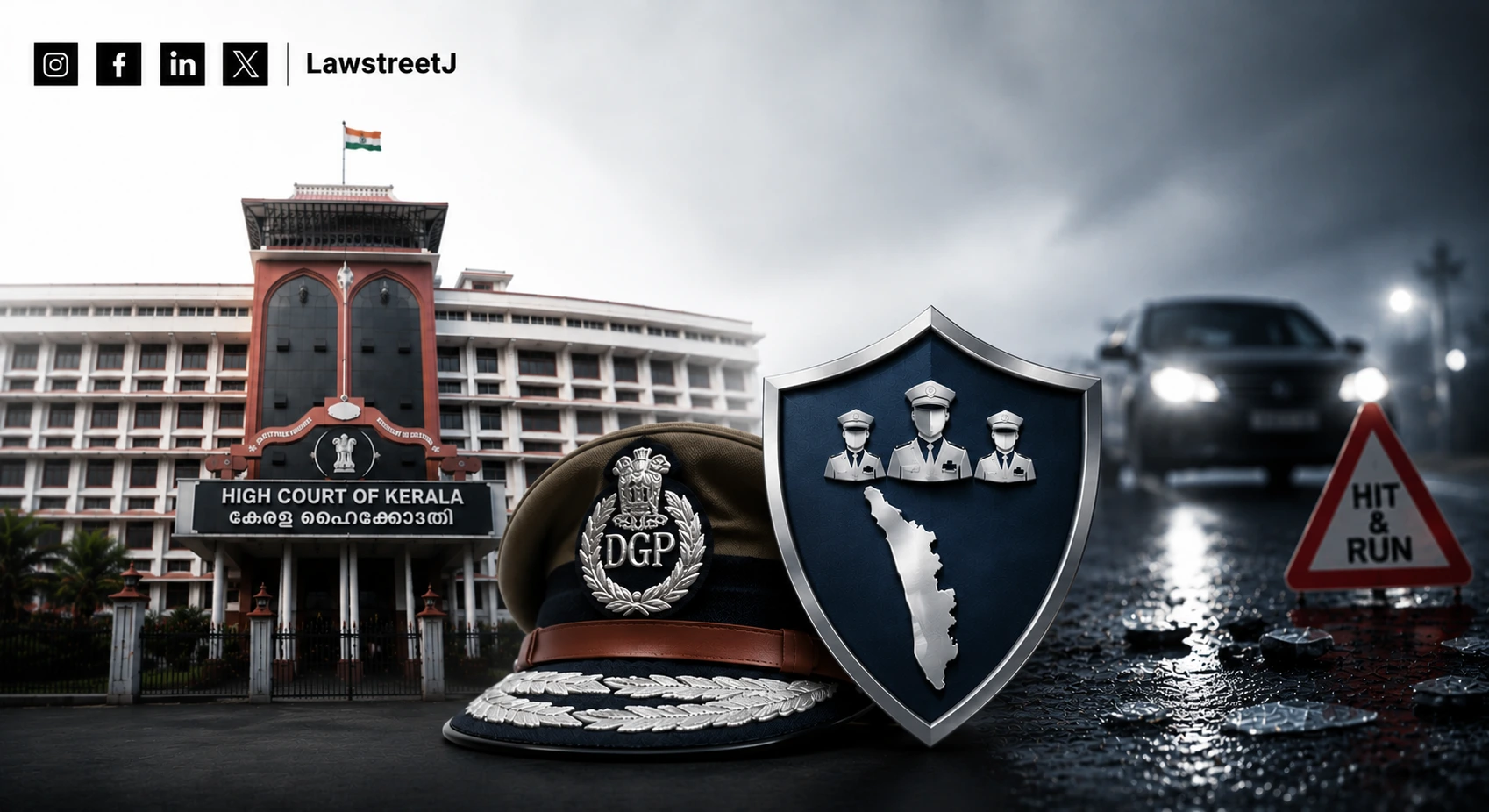
Kerala: Hearing three hit-and-run cases together, the Kerala High Court has directed the State Police Chief to set up special squads in every district to trace absconding drivers, while flagging the Centre's continued failure to make its hit-and-run compensation scheme work for victims.
Background
Justice G. Girish was hearing three writ petitions filed by victims and relatives of hit-and-run accidents whose offenders remained untraced. In the first, Geetha's husband, a 60-year-old mason and sole breadwinner, was fatally struck by a car near Ethukkad market in Thiruvananthapuram in August 2025 and died after two weeks on ventilator support; the Kallambalam police had no lead on the vehicle despite CCTV footage she herself produced before the Court on a pen drive.
In the second, George, a 35-year-old bank employee, was hit by an XUV on the Angamaly-Aluva road in December 2025, sustaining a spine injury that left him crippled after over Rs.20 lakh in treatment, with the driver still untraced despite CCTV cameras lining the stretch.
In the third, Anjana, a 24-year-old woman, was knocked down from behind by a motorcyclist in broad daylight on the Kadavanthra-Panampilly Nagar road in Ernakulam in June 2025, suffering multiple facial and hand fractures and losing several teeth, with the rider escaping despite heavy police presence for traffic control nearby. All three petitioners sought a direction to hand over investigation to a senior police officer.
Arguments
The petitioners, represented by counsel across the three matters, argued that despite CCTV coverage becoming near-universal on Kerala's roads, hit-and-run investigations were being handled without urgency, leaving victims and their families to bear the medical and economic consequences alone. The State, represented by the Public Prosecutor, did not dispute the facts of non-detection but left it to the Court to consider what institutional response was warranted.
Analysis
The Court itself opened its judgment by observing that hit-and-run cases form a category “not given proper attention by the law enforcers, legal practitioners, and even to a certain extent, by Courts,” despite CCTV cameras now covering almost every stretch of road, and that victims are left to bear treatment costs and lost earnings because the Centre's Compensation to Victims of Hit and Run Motor Accidents Scheme, 2021 remains largely unimplemented.
The Court held that tracing offending vehicles requires coordinated, timely action across the police force of the district where the accident occurred and neighbouring areas the vehicle may have passed through, backed by the latest telecommunication and forensic technology, failing which such cases are quietly shelved once they lose media attention. It cautioned that some hit-and-run incidents may in fact be deliberate attempts to endanger life amounting to murder or attempted murder, making the failure to investigate them a serious lapse in the administration of criminal justice.
Turning to the compensation framework, the Bench traced the Supreme Court's ten-point directions in Rajaseekaran v. Union of India, which required State Standing Committees and district Monitoring Committees to improve implementation of the 2021 Scheme, mandated police to inform victims of their right to claim compensation when a vehicle cannot be traced within a month, and directed the Centre to consider enhancing the scheme's compensation of Rs.2 lakh for death and Rs.50,000 for grievous injury, an exercise the Centre had still not completed despite being given eight weeks to do so.
The Court also surveyed comparative models, noting that Australia's Motor Accident Injuries Act, 2019 funds a 'nominal defendant' authority to compensate victims of unidentified or uninsured vehicles, while the United Kingdom's Motor Insurers' Bureau, funded through mandatory insurer contributions, does the same under its Uninsured and Untraced Drivers Agreements.
It suggested that India's lawmakers examine funding such compensation through cess on registration, permit, licence and insurance fees, or deductions from fines under the Motor Vehicles Act and the Bharatiya Nyaya Sanhita, 2023, to spare victims the burden of chasing vehicle owners for their claims.
Conclusion
The Court directed the State Police Chief to constitute Special Squads in every district, under the direct supervision of District Police Chiefs, to trace and apprehend offending vehicles and drivers in hit-and-run cases, with all police personnel directed to alert these squads of relevant incidents and Cyber Police units instructed to prioritise their requests. It further directed that the squads' contact details be publicised for witnesses to report incidents, and urged the Central Government to expedite compliance with the Rajaseekaran directions and consider the Australian and British funding models. On the specific petitions, the Court directed that investigation in each of the three cases be handed over to a District Crime Branch team headed by an officer not below the rank of Deputy Superintendent of Police, and ordered that copies of the judgment be sent to the Cabinet Secretary, the State Chief Secretary and the State Police Chief for urgent action.
Appearances:
For the Petitioners: Adv. M.R. Sarin; Adv. Vivek Venugopal; Advs. Santhosh Peter (Mamalayil), P.N. Anoop, M.S. Sandeep Sudhakaran, Nadeem Nazar and Nissi V. Rajesh
For the Respondents: Sri. Sameer S., Public Prosecutor.
Case Title: Geetha vs. State Police Chief of Kerala and Others, with connected matters, W.P.(Crl.) Nos.15/2026, 721/2026 and 829/2026



![Kerala HC Quashes 498A Dowry Harassment Case Against Live-In Partner, Citing Lack of Relative Status [Read Order]](/secure/uploads/2023/08/lj_5693_1057c042-1e57-4e27-8c9e-25af0ec38ec4.jpg)
![Watching porn on mobile: Kerala HC highlights importance of mother cooked meals, outdoor sports [Read Order]](/secure/uploads/2023/09/lj_9155_Parental_supervision_of_mobile_phone_usage.jpg)
![Lakshadweep MP Mohammed Faizal Disqualified from Lok Sabha After Conviction Suspension Plea Rejected by Kerala High Court [Read Notice]](/secure/uploads/2023/10/lj_9640_87b5fd97-0e05-4ff8-9a99-3be1e4446192.jpg)
.jpeg)