Ernakulam: A Division Bench of the Kerala High Court has set aside an interim order that had permitted suspended students of Sree Sankaracharya University of Sanskrit, Kalady, to appear in examinations commencing on 4 November 2026, holding that no court can direct a university to act contrary to its regulations and that the writ petition had no pleadings on the students’ eligibility to appear.
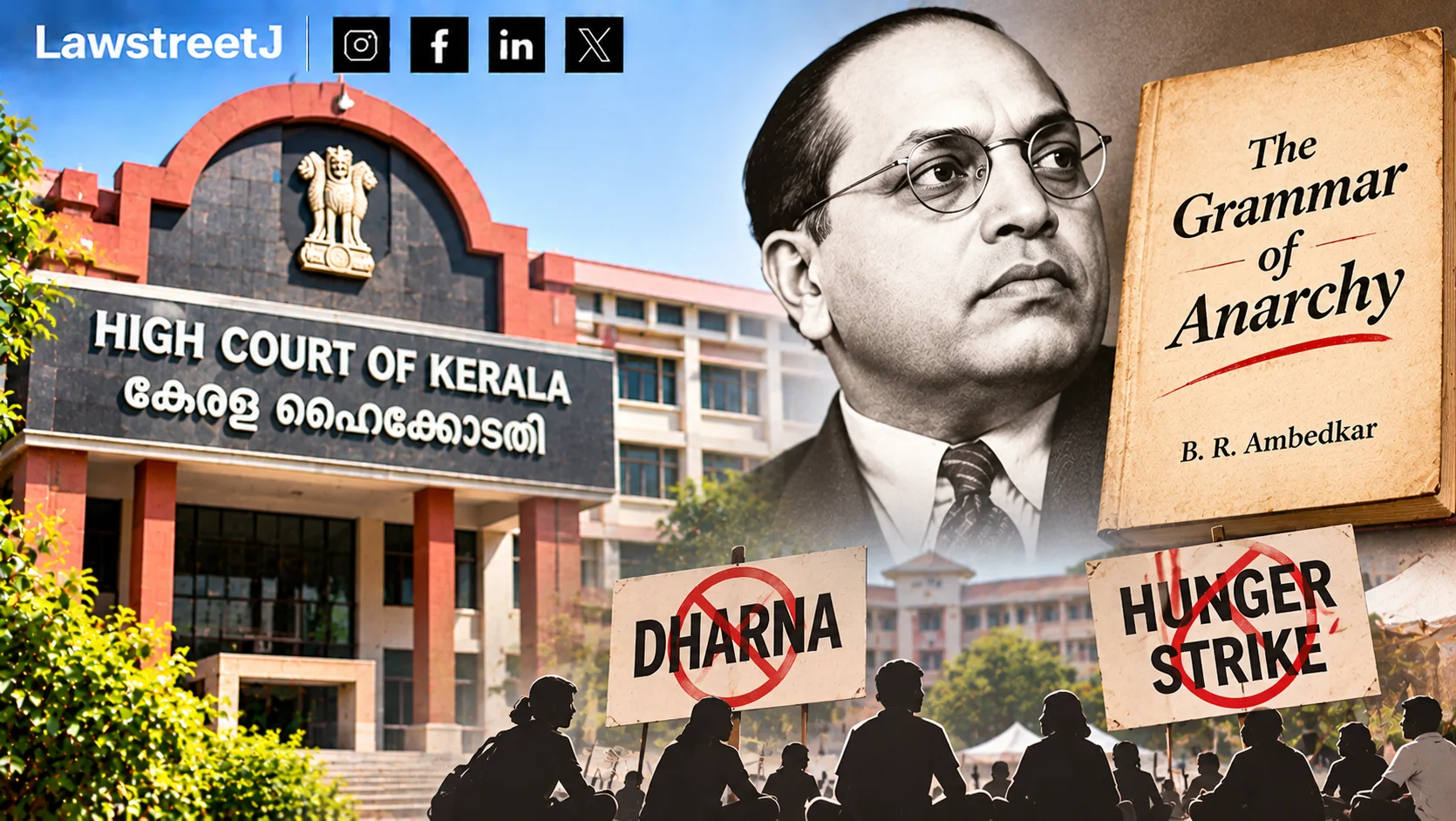
Justice Anil K. Narendran and Justice Muralee Krishna S. passed the judgment on 3 November 2026 in W.A. No. 2276 of 2026. In doing so, the Bench cited its own earlier ruling, which in turn quoted Dr. B.R. Ambedkar’s warning against “the Grammar of Anarchy” in the context of protests in educational institutions.
The University, its Syndicate and the Vice Chancellor appealed against the interim order dated 30.10.2026 of a Single Judge in I.A. No. 2 of 2026 in W.P.(C) No. 35256 of 2026. The writ petition was filed by sixteen students, challenging their suspension by an order dated 01.09.2026 pending an enquiry into certain incidents alleged to have happened on 13.08.2026 on the campus, in relation to which two FIRs have been registered at Kalady Police Station. The Single Judge had directed the University to accept the examination fee and permit them to appear in the examinations, subject to the result of the writ petition, and had said that their appearance would give them no equity.
The University contended that none of the petitioners has the requisite attendance or has passed the internal examinations, that they had not applied within the time stipulated in the University’s notification dated 03.10.2026, and that there were no pleadings or materials for condonation of shortage of attendance. It relied on the regulations for the MSW, MFA, MA and four-year undergraduate programmes, which prescribe minimum attendance of 75% or 80% and allow condonation only on an application, in the prescribed format, within the stipulated time and with medical or documentary proof.
The students’ Senior Counsel, Sri T.A. Shaji, argued that any shortage of attendance was on account of the suspension and should not defeat their entitlement to appear. He conceded that the averments in the writ petition did not specifically deal with minimum attendance or the internal examinations. The Court expressly declined to consider the rival contentions on the incidents of 13.08.2026, as the investigation is going on.
Relying on Bharat Singh v. State of Haryana, the Court held that, in a writ petition, a petitioner must plead and prove facts by evidence annexed to the petition. It found a “total lack of pleadings” on the entitlement of the petitioners, other than the Ph.D. research scholars, to appear in the examinations, and that none had applied for condonation of shortage of attendance. Relying on State of U.P. v. Harish Chandra and Bhaskara Rao v. CBI, it held that no court can issue a direction contrary to law or the relevant regulations.
The Bench recalled the Division Bench ruling in Principal, IES College of Engineering v. Anas P.M., which held that shortage of attendance caused by a suspension is a just consequence of the suspension that students must suffer, as otherwise permitting them to appear in examinations would be a premium on the offence. It also noted the Division Bench ruling in Dr. Antony Thomas v. V.M. Muhammed Rafique (2017), which held that political activities such as dharna and hunger strikes have no place in academic institutions.
That judgment, as quoted by the present Bench, recalled Dr. Ambedkar’s words to the Constituent Assembly on 25 November 1949, that those who wish to maintain democracy in fact must hold fast to constitutional methods, abandon civil disobedience, non-cooperation and satyagraha where constitutional methods are open, and that such methods are nothing but the “Grammar of Anarchy”. The present judgment reproduces this passage only as part of its quotation of the 2017 ruling, and does not make a separate finding on the students’ conduct.
The Court also held that the interim relief was virtually the main relief sought in the writ petition. Relying on State of Kerala v. Pradeepkumar A.V. and Deoraj v. State of Maharashtra, it held that such relief can be granted only where there is a very strong prima facie case and that the pleadings did not make one out. It added that the order was passed as a ‘today motion’ without giving the University’s Standing Counsel an opportunity to get instructions.
On maintainability, the Court held, following K.S. Das v. State of Kerala and M/s. Grids Engineers and Contractors v. Union Bank of India, that the appeal under Section 5(i) of the Kerala High Court Act, 1958 is maintainable because the order substantially affects the University’s rights.
Allowing the appeal, the Court set aside the Single Judge’s order of 30.10.2026. It clarified that its observations on the merits are made only for the limited purpose of disposing of this appeal. The writ petition remains pending before the Single Judge, where it was listed on 17.11.2026.
Appearances: For the Appellants: Smt. Silpa Sreekumar, Standing Counsel (argued by Adv. Navaneeth Krishnan A.L.). For the Respondents: Sri T.A. Shaji, Senior Advocate, instructed by Sri P.G. Pramod and Smt. Nadiya K.M., Advocates.
Case Title: Sree Sankaracharya University of Sanskrit and Others v. Archana P.S. and Others, W.A. No. 2276 of 2026