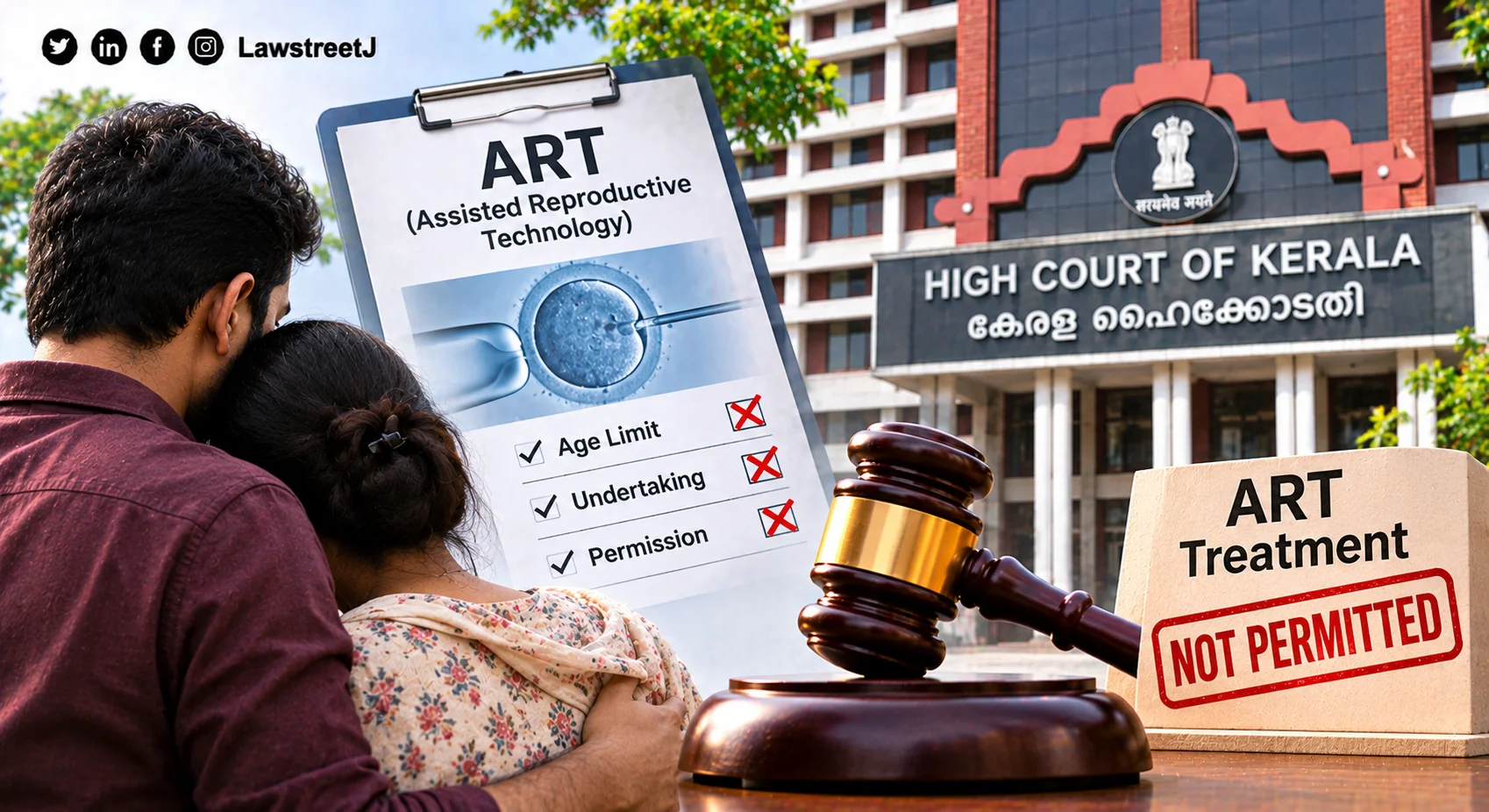
Ernakulam: The Kerala High Court has dismissed a batch of seven writ petitions filed by married couples, in each of which one spouse is above the age limit under Section 21(g) of the Assisted Reproductive Technology (Regulation) Act, 2021, seeking permission to continue assisted reproductive procedures.
Justice Harisankar V. Menon, following a Division Bench judgment of the Court in Union of India v. Nandhini K., held on 22 October 2026 that the petitioners are not entitled to relief.
The batch is led by WP(C) No. 33447 of 2026 and includes WP(C) Nos. 34872, 35476, 35509, 35541, 35565 and 35656 of 2026. The respondents include the Union of India, the State of Kerala and the National and State ART and Surrogacy Boards, along with the hospitals and district officers concerned in some of the petitions. The petitioners contended that they had already commenced the procedure under the Act at a time when no age limit was prescribed, and that they should therefore be permitted to avail the services despite the age restriction.
The petitioners relied on the judgment of the Punjab and Haryana High Court in Dr. Pushpa and Another v. Union of India (CWP No. 13085 of 2026, decided on 19.05.2026), which, following Sarbjit Kaur v. State of Punjab (22.01.2026), allowed couples to continue the services on furnishing an undertaking. They pointed out that the Kerala High Court itself had followed this view in W.P.(C) No. 28787 of 2026 dated 23.09.2026.
The Central Government Counsel, Sri Arjun Venugopal, opposed the petitions, relying on the Division Bench judgment in Union of India v. Nandhini K. [2025 KHC Online 2087], which upheld the age limit in Section 21(g) and reversed the leniency shown to the petitioners there in similar circumstances. He also relied on another Division Bench judgment in W.A. No. 701 of 2024 dated 18.07.2025, which found that granting such permission through interim orders would amount to overruling the statutory provisions, which cannot be permitted.
The Court accepted that the Punjab and Haryana High Court had considered the entitlement on the basis of Sarbjit Kaur, and that this Court had also followed it. However, it noted, as pointed out by the Central Government Counsel, that the Division Bench judgment in Nandhini had not been relied on or pointed out when W.P.(C) No. 28787 of 2026 was decided. The Court held that merely because the Punjab and Haryana High Court allowed services on an undertaking, similar treatment need not be extended to the petitioners.
Dr. K.P. Pradeep, counsel for one of the petitioners, also relied on the Supreme Court’s judgment in Vijaya Kumari S. v. Union of India [(2026) 2 SCC 96], which protected couples who had already begun the procedure before the enactment of the statute. The Court observed that this judgment was rendered with reference to the Surrogacy (Regulation) Act, 2021, whereas the Division Bench in Nandhini considered the issue specifically under the ART Act. Even though the provisions may be pari materia, it held, reliance on Vijaya Kumari cannot be said to be correct.
Following the Division Bench judgment in Nandhini, the Court concluded that the writ petitions are only to be dismissed, and dismissed all of them.
Appearances: For the Petitioners: Dr. K.P. Pradeep, Smt. Soniya S., Sri U. Balagangadharan and Sri K.C. Maneesh Charly, Advocates. For the Respondents: Sri Arjun Venugopal, Central Government Counsel, and Smt. Mintu Cherian, Government Pleader.
Case Title: Dileep A. and Another v. Union of India and Others, WP(C) No. 33447 of 2026 and connected cases