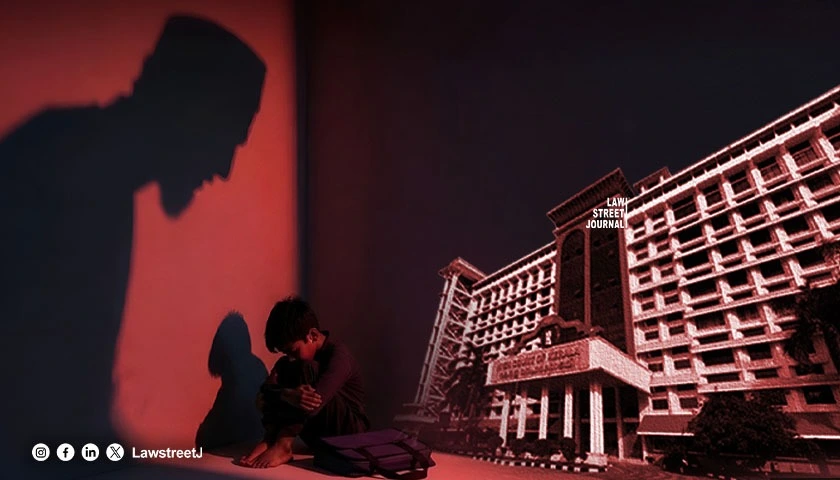
The Kerala High Court has upheld the conviction and sentence of a madrassa teacher found guilty of sexually assaulting a nine-year-old student, holding that the trial court was fully justified in relying on the child’s testimony to convict him.
A Single Bench of Justice A. Badharudeen dismissed the criminal appeal filed by the convict, against the judgment of the Fast Track Special Court (POCSO), Kunnamkulam, by which he was convicted for offences under the Protection of Children from Sexual Offences (POCSO) Act, 2012, the Indian Penal Code, and the Juvenile Justice (Care and Protection of Children) Act, 2015.
According to the prosecution, the appellant was the Usthad, or teacher, of Noorul Hidaya Madrassa at Mullassery in Thrissur district, and resided in a building owned by the mosque adjacent to the madrassa. The survivor, a nine-year-old student of the madrassa, had gone to the appellant’s room on 25 August 2020 to clear doubts ahead of an online examination conducted amid the Covid-19 pandemic. The prosecution’s case was that the appellant sexually assaulted the child during this visit and later warned him not to disclose the incident. The child eventually informed his mother, who alerted relatives and approached the police the following day. The appellant was booked under Section 377 of the IPC, Sections 4(2) read with 3(d), 6(1) read with 5(f) and 5(m), 8 read with 7, and 10 read with 9(o) and 9(m) of the POCSO Act, and Section 75 of the JJ Act.
After trial, during which twenty prosecution witnesses and twenty-seven documents were examined, the Special Court convicted the appellant on all counts. He was sentenced to ten years’ rigorous imprisonment under Section 377 IPC, twenty years each under Sections 5(f) and 5(m) read with Section 6(1) of the POCSO Act, seven years each under Sections 9(m) and 9(o) read with Section 10, and three years under Section 75 of the JJ Act, with all substantive sentences directed to run concurrently. The trial court also ordered that Rs 40,000 from the fine realised be paid to the survivor as compensation.
Before the High Court, counsel for the appellant argued that the entire prosecution case was a sectarian fabrication. It was contended that the appellant belonged to the Sunni sect of the Muslim community in Kerala and had been falsely implicated by relatives of the survivor belonging to a rival sect, owing to internal community rivalry. It was further argued that the Special Court erred in convicting the appellant on the solitary testimony of the child witness, which counsel described as neither reliable nor trustworthy, and that contradictions existed between the child’s statement to police and his deposition in court. Reliance was placed on the Supreme Court’s rulings in Pancchi v. State of UP and Rai Sandeep alias Deepu v. State of NCT of Delhi to argue that the child could not be treated as a sterling witness whose testimony alone could sustain a conviction.
The Public Prosecutor supported the verdict, submitting that the survivor’s minority had been proved through the evidence of several witnesses along with documentary records, and that no material contradictions had been elicited during the child’s cross-examination. It was argued that the survivor’s evidence was wholly trustworthy on its own and that the conviction warranted no interference.
On reappreciating the evidence, the High Court found no infirmity in the trial court’s findings. It held that the survivor’s account of the assault was corroborated by his mother, the secretary of the mosque committee, medical evidence, the seizure of clothing worn at the time of the incident, and call detail records placing the appellant’s phone near the scene. The Court observed that the survivor’s evidence was “wholly reliable, supported by other evidence discussed in detail,” and rejected the defence argument that he was not a sterling witness. On the claim of sectarian conspiracy, the Bench noted that the appellant’s own witnesses had admitted he belonged to a different sect from certain relatives of the survivor, but found no convincing material to show that this difference had any bearing on the registration of the case.
Turning to sentence, the Court noted that Section 6(1) of the POCSO Act prescribes a minimum punishment of twenty years’ rigorous imprisonment for aggravated penetrative sexual assault, extendable to imprisonment for life, and that since the trial court had imposed only the statutory minimum for the offences under Sections 5(f) and 5(m), no reduction was legally possible. The sentences under the remaining provisions were also found to be proportionate and were left undisturbed.
Holding that the conviction and sentence required no interference, the High Court dismissed the appeal, recording that “this appeal fails and is dismissed accordingly.” The Registry was directed to forward a copy of the judgment to the jurisdictional court for information and compliance.
Case Title: Rasheed v. State of Kerala [CRL.A No. 421 of 2023]



![Kerala HC Quashes 498A Dowry Harassment Case Against Live-In Partner, Citing Lack of Relative Status [Read Order]](/secure/uploads/2023/08/lj_5693_1057c042-1e57-4e27-8c9e-25af0ec38ec4.jpg)
![Watching porn on mobile: Kerala HC highlights importance of mother cooked meals, outdoor sports [Read Order]](/secure/uploads/2023/09/lj_9155_Parental_supervision_of_mobile_phone_usage.jpg)
![Lakshadweep MP Mohammed Faizal Disqualified from Lok Sabha After Conviction Suspension Plea Rejected by Kerala High Court [Read Notice]](/secure/uploads/2023/10/lj_9640_87b5fd97-0e05-4ff8-9a99-3be1e4446192.jpg)