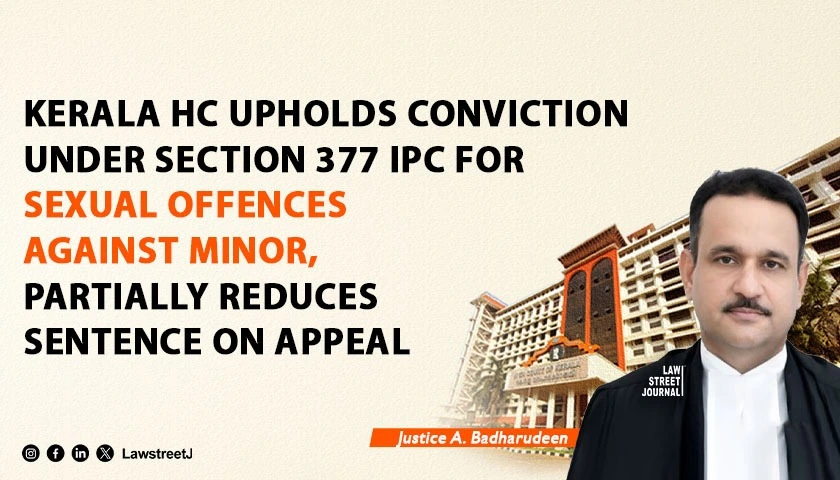
The Kerala High Court has confirmed the conviction of an accused person under Sections 354, 377, and 450 of the Indian Penal Code, 1860 for sexual offences committed against an eleven-year-old girl, holding that the provision under Section 377 continues to apply without qualification where the victim is a minor, even in light of the Supreme Court’s ruling in Navtej Singh Johar decriminalising consensual same-sex relationships between adults.
Justice A. Badharudeen, allowed the appeal in part, confirming the conviction on all three counts while modifying the sentence imposed under Section 377 from seven years to five years of rigorous imprisonment.
The case arose from an incident on December 12, 2010, when the accused, allegedly entered the residence of the victim a minor girl who was alone at home on the pretext of inquiring about a bicycle for sale. According to the prosecution, the accused returned shortly thereafter, forcibly entered the victim’s room, restrained her using cloth, subjected her to sexual assault including forced oral penetration, photographed her without consent, and threatened her with a knife to prevent disclosure. The victim did not reveal the incident immediately, owing to threats made by the accused that he would harm her father and circulate her photographs. The matter was disclosed to a doctor at Valluvanad Hospital several days later, following which a statement was recorded before the Women Cell, Palakkad, on December 27, 2010, and a first information report was registered on January 4, 2011.
The Ist Additional Sessions Court, Palakkad, convicted the accused under all three charges after a full trial in which sixteen prosecution witnesses were examined. The Sessions Court sentenced the accused to four years’ rigorous imprisonment under Section 450 IPC, two years under Section 354 IPC, and seven years under Section 377 IPC, with fines prescribed for each offence. The accused challenged the conviction and sentence before the High Court.
Before the High Court, counsel for the appellant contended principally that the ingredients of Section 377 were not made out from the evidence of the prosecutrix, PW1, and that consequently Section 450 which requires that the house-trespass be committed in order to perpetrate an offence punishable with imprisonment for life would also not be attracted. It was further urged that the delay in registering the FIR, given that the occurrence was on December 12, 2010 and the FIR was registered only on January 4, 2011, cast doubt on the prosecution case, and that a prior statement given before the Vanitha Cell had not formed part of the prosecution record. The Public Prosecutor, supporting the Sessions Court verdict, submitted that the delayed disclosure was fully explained by the threats administered by the accused, and that PW1’s testimony was corroborated by the evidence of PWs.
On the question of Section 377, the High Court scrutinised the testimony of PW1 and found that she had categorically deposed that the accused forcibly penetrated his sexual organ into her mouth after untying the cloth. The court held that this evidence was sufficient to establish carnal intercourse against the order of nature as required under Section 377, and that the Supreme Court’s holding in Navtej Singh Joha that consensual sexual acts between adults do not attract Section 377 had no application where the victim was a minor.
The conviction under Section 377 was accordingly confirmed. Since Section 377 carries a maximum punishment of imprisonment for life, the court further held that the offence of house-trespass under Section 450 IPC, which is attracted when the trespass is committed in order to perpetrate a life-imprisonable offence, was also made out on the facts. The conviction under Section 354 was equally confirmed, the court finding that PW1’s evidence satisfied the requirements of assault or criminal force to a woman with intent to outrage her modesty.
On the delay in lodging the complaint, the court accepted the explanation offered by the victim and her mother noting that the delayed disclosure was entirely consistent with the threats of violence and exposure administered by the accused, and that in cases involving sexual assault against a minor such delay cannot be held against the prosecution.
As to sentence, the court, taking into account the submissions of the appellant’s counsel, reduced the sentence under Section 377 IPC from seven years to five years of rigorous imprisonment, while maintaining all other sentences and fines as imposed by the Sessions Court. The bail bond and suspension of sentence granted to the accused during the pendency of the appeal were cancelled, and the accused was directed to surrender forthwith before the Additional Sessions Court, Palakkad.
For Appellant/Accused: Sri. P. Vijaya Bhanu (Sr.), Sri. M. Revikrishnan, Sri. Vipin Narayan
For Respondent/State: Sri. Renjith George, Senior Public Prosecutor
Case Title: Anil N. v. State of Kerala [Crl.A. No. 581 of 2016, 2026:KER:32737]



![Kerala HC Quashes 498A Dowry Harassment Case Against Live-In Partner, Citing Lack of Relative Status [Read Order]](/secure/uploads/2023/08/lj_5693_1057c042-1e57-4e27-8c9e-25af0ec38ec4.jpg)
![Watching porn on mobile: Kerala HC highlights importance of mother cooked meals, outdoor sports [Read Order]](/secure/uploads/2023/09/lj_9155_Parental_supervision_of_mobile_phone_usage.jpg)
![Lakshadweep MP Mohammed Faizal Disqualified from Lok Sabha After Conviction Suspension Plea Rejected by Kerala High Court [Read Notice]](/secure/uploads/2023/10/lj_9640_87b5fd97-0e05-4ff8-9a99-3be1e4446192.jpg)