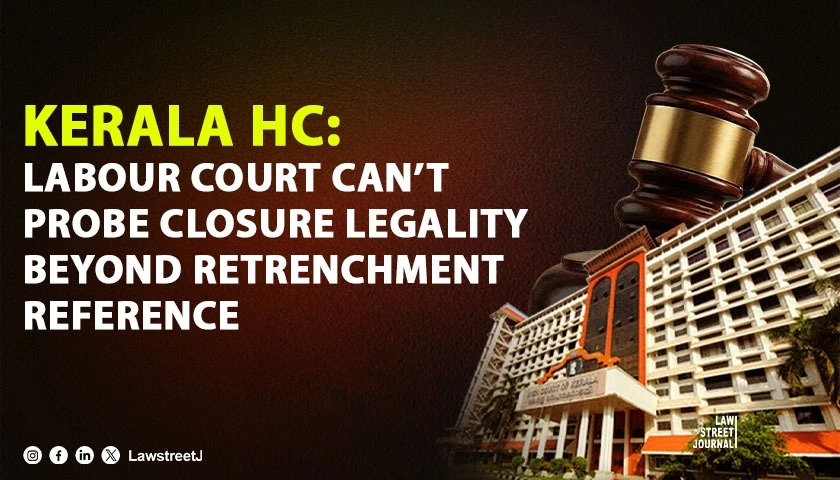
Kerala: The Kerala High Court has held that a Labour Court cannot adjudicate upon the legality or bona fides of an alleged closure when the reference made by the appropriate Government is limited only to the question of whether the retrenchment of workmen was justified.
Justice Mohammed Nias C.P. delivered the ruling while allowing two writ petitions filed by Lunar Rubbers and Viking Rubbers Pvt. Ltd., challenging awards passed by the Labour Court, Ernakulam, which had ordered reinstatement of workmen with continuity of service and back wages after holding that the closure of the units was sham and mala fide.
The dispute arose after the management declared closure of their manufacturing units in April 2016, citing severe labour unrest, mass resignation of workers, and non-viability of operations. Closure notices were issued to the remaining workmen, and statutory closure compensation and gratuity were offered. While some workmen accepted the compensation, others, through their union, raised an industrial dispute alleging that the closure was not genuine and that only selected union members were terminated, while others were retained and transferred to sister concerns.
Upon failure of conciliation, the Government referred the dispute to the Labour Court. However, the reference was framed narrowly, limiting the issue to whether the retrenchment of the concerned workmen was legal and justified and, if not, the relief to which they were entitled.
Before the Labour Court, the union contended that the closure was only a ruse to victimise union members and relied on alleged functional integrality between the closed unit and other establishments of the management. Accepting this contention, the Labour Court went into the question of the bona fides of the closure, held that it was sham, and directed reinstatement of the workmen in other units of the management.
Allowing the writ petitions, the High Court held that the Labour Court had clearly exceeded its jurisdiction. The Court observed that under Section 10(4) of the Industrial Disputes Act, an adjudicating authority is strictly bound by the terms of reference and must confine itself to the points specifically referred and matters incidental thereto.
The Court emphasised that where the reference proceeds on the basis that retrenchment has taken place, the Labour Court cannot go behind the reference to examine whether there was, in fact, a closure, or whether such closure was genuine, sham, or mala fide, unless the reference itself calls for such an adjudication.
Relying on decisions of the Supreme Court, including Pottery Mazdoor Panchayat v. Perfect Pottery Co. Ltd., Workmen of Straw Board Manufacturing Co. Ltd., and other precedents, the Court reiterated that once the factum of closure is admitted or established, the motive or propriety of the employer’s decision ordinarily ceases to be relevant, unless the reference specifically authorises such an inquiry.
The High Court held that by deciding the issue of sham closure and granting reinstatement, the Labour Court effectively substituted its own formulation of the dispute in place of that framed by the Government, which is impermissible in law. Such an adjudication, the Court held, is coram non judice and liable to be set aside.
Accordingly, the High Court quashed the impugned awards as well as the defective references and directed the appropriate Government to reconsider the matter and make a fresh reference, if necessary, properly reflecting the real dispute between the parties.
Appearances: Senior Advocate E.K. Nandakumar appeared for the petitioners in W.P.(C) No. 1003 of 2020, while Advocate P. Ramakrishnan appeared for the petitioners in W.P.(C) No. 5381 of 2020. Senior Government Pleader Sreejith V.S. appeared for the State. Advocate Tom Mathew appeared for the contesting respondents.
Case Title: Lunar Rubbers v. Kerala Head Load and Timber Workers and Factory Workers Union & Ors. and Viking Rubbers Pvt. Ltd. v. State of Kerala & Ors.



![Kerala HC Quashes 498A Dowry Harassment Case Against Live-In Partner, Citing Lack of Relative Status [Read Order]](/secure/uploads/2023/08/lj_5693_1057c042-1e57-4e27-8c9e-25af0ec38ec4.jpg)
![Watching porn on mobile: Kerala HC highlights importance of mother cooked meals, outdoor sports [Read Order]](/secure/uploads/2023/09/lj_9155_Parental_supervision_of_mobile_phone_usage.jpg)
![Lakshadweep MP Mohammed Faizal Disqualified from Lok Sabha After Conviction Suspension Plea Rejected by Kerala High Court [Read Notice]](/secure/uploads/2023/10/lj_9640_87b5fd97-0e05-4ff8-9a99-3be1e4446192.jpg)