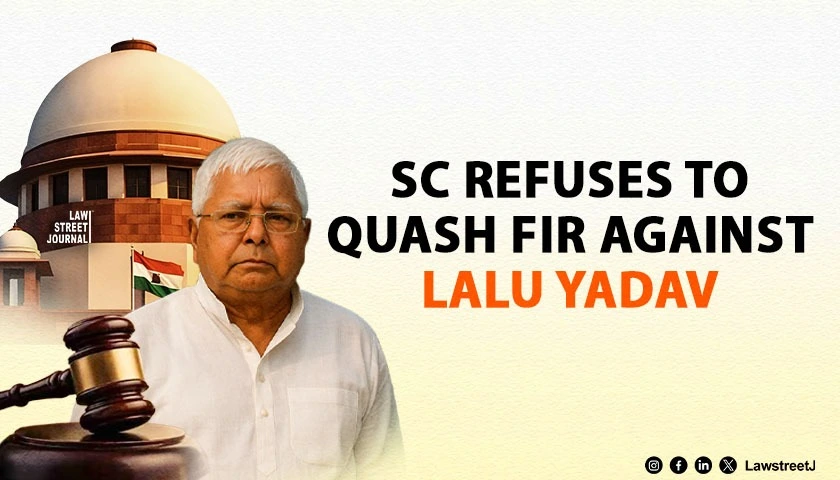
New Delhi: In a significant development concerning the long-standing legal battle surrounding the alleged land-for-jobs scam, the Supreme Court of India has declined to quash the criminal proceedings against Rashtriya Janata Dal (RJD) chief and former Union Railway Minister Lalu Prasad Yadav.
The bench, comprising Justices MM Sundresh and N Kotiswar Singh, delivered its order on Monday, April 13, 2026, after hearing a Special Leave Petition filed by former Bihar Chief Minister Lalu Yadav. While the Court refused to quash the First Information Report (FIR) and subsequent charge sheets, it granted the veteran leader limited relief by permitting him to raise specific legal objections during the trial.
The apex Court specifically allowed the request to raise the issue of mandatory prior sanction under Section 17A of the Prevention of Corruption Act, 1988, before the trial court. This provision, inserted via an amendment in 2018, acts as a protective shield for public servants by requiring prior government approval before an investigation can be initiated into decisions taken in the discharge of official duties. Additionally, the Supreme Court dispensed with Yadav’s personal appearance before the trial court, providing him interim relief as the proceedings move forward.
During the hearing, the Court noted that two primary legal issues were at the heart of the petition: the scope and applicability of Section 17A, and whether the provision operates prospectively or retrospectively. The bench chose not to adjudicate on these merits at this stage, leaving the questions open for determination during the trial. The judges clarified that the findings previously recorded by the Delhi High Court would not preclude Yadav from raising these legal arguments afresh before the trial judge.
The prosecution, represented by Additional Solicitor General (ASG) S.V. Raju, strongly opposed the plea for quashing. The ASG argued that Section 17A was not applicable to Yadav’s case because the provision only protects “recommending” or “decision-making” authorities. According to the Central Bureau of Investigation (CBI), Yadav did not fall into these categories for the railway appointments in question, as the statutory authority to make or recommend such appointments rested with the General Managers of the railways, not the Union Minister.
The CBI further contended that the acts alleged in the land-for-jobs case were not connected to the discharge of any official duty and therefore did not require the protection of Section 17A. The agency maintained that the provision is intended to protect honest public servants making bona fide decisions, rather than acts that are inherently criminal or dehors official duty. The ASG also pointed out that the petition was filed with significant delay, long after the investigation had concluded and cognizance had been taken by the trial court.
Countering these submissions, Senior Advocate Kapil Sibal, appearing for Yadav, argued that the prosecution’s own case was built on the allegation that Yadav used his official position as the Union Railway Minister to influence the appointments. Sibal contended that if the Minister is accused of using his official influence to direct appointments, the act is intrinsically linked to his official functions, thereby attracting the mandatory requirement of prior sanction under Section 17A before any investigation could legally begin.
Sibal emphasized that Section 17A operates at the stage of investigation, which is distinct from the sanction for prosecution required under Section 19 at the trial stage. He argued that the absence of this prior approval at the threshold vitiated the entire investigation, the FIR, and the subsequent charge sheets. Sibal also criticized the filing of a supplementary charge sheet nearly nine years after an earlier closure of the case on similar grounds, characterizing the renewed investigation as a violation of the right to a fair probe.
The legal backdrop of this case includes a ruling by the Delhi High Court in March 2026, which had dismissed Yadav’s plea to quash the FIR. The High Court had held that Section 17A is prospective in its operation and does not apply to alleged offences committed between 2004 and 2009, long before the 2018 amendment was enacted. The High Court had also ruled that the protection of Section 17A is not blanket and does not extend to acts that are ex facie criminal or unrelated to official recommendations and decisions.
The land-for-jobs case relates to alleged irregularities in Group D appointments in various railway zones during Yadav’s tenure as Railway Minister between 2004 and 2009. The CBI alleges a quid pro quo arrangement where candidates or their family members gifted or transferred land parcels to Yadav’s family members or associated companies at prices significantly below market rates in exchange for railway jobs.
The investigation has seen multiple charge sheets filed in 2022, 2023, and 2024, naming various members of the Yadav family, including former Bihar Chief Minister Rabri Devi and their son, Tejashwi Yadav. In a related development, President Droupadi Murmu recently accorded sanction for the prosecution of Lalu Prasad Yadav in connection with a parallel money laundering investigation being conducted by the Enforcement Directorate (ED). This sanction was granted under Section 197(1) of the Criminal Procedure Code (now Section 218 of the Bharatiya Nyaya Sanhita, 2023).
The trial court has already taken cognizance of the charge sheets and framed charges of corruption and criminal conspiracy. In January 2026, the trial court observed that the Railway Ministry had allegedly been used as a “personal fiefdom” to carry out a criminal enterprise. More recently, the trial court rejected a plea by the accused seeking access to documents not relied upon by the prosecution, holding that there is no automatic right to such unrelied documents at the current stage of the trial.
The constitutional validity of Section 17A itself remains a subject of intense judicial scrutiny. In January 2026, a two-judge bench of the Supreme Court delivered a split verdict on the provision in a separate case. While one judge upheld the section subject to it being administered by an independent authority like the Lokpal, the other judge held it to be unconstitutional for creating arbitrary classifications and shielding corruption. That matter has been referred to a larger bench for a final ruling.
Case Title: Lalu Prasad Yadav v. Central Bureau of Investigation
Court: Supreme Court of India
Bench: Justice MM Sundresh and Justice N. Kotiswar Singh
Date of Order: April 13, 2026
Appearances:
- For Petitioner: Senior Advocate Kapil Sibal
- For Respondent: ASG S.V. Raju for Central Bureau of Investigation