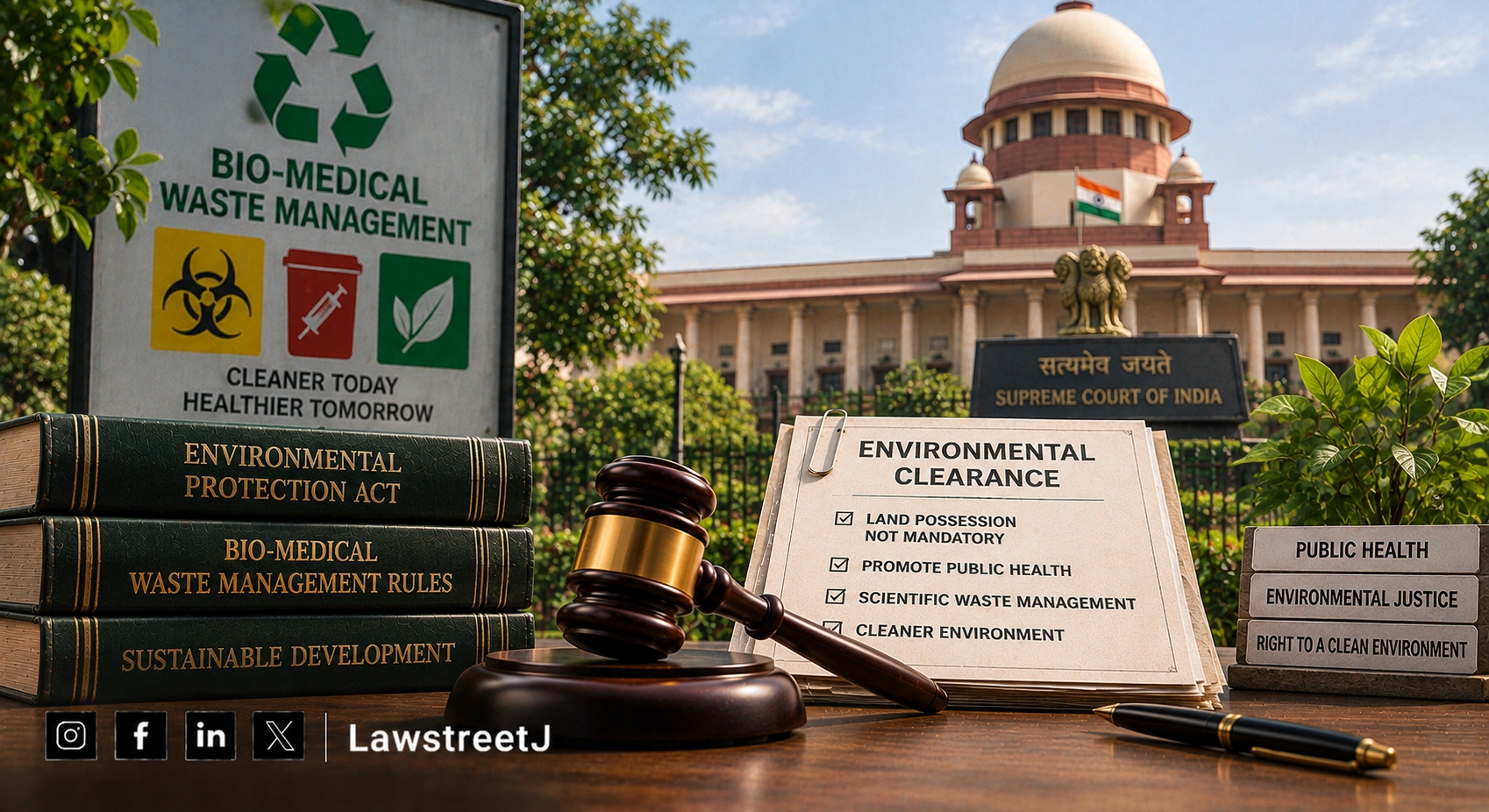
New Delhi: The Supreme Court has restored the environmental clearance and consent to establish granted to M/s Punahchakran Private Limited for a Common Bio Medical Waste Treatment Facility (CBWTF) in Babrala, Uttar Pradesh, setting aside a National Green Tribunal order that had quashed these approvals, and clarifying that land procurement is not a mandatory precondition for initiating the clearance process under the applicable guidelines.
A Bench of Justice J.B. Pardiwala and Justice Manoj Misra was hearing an appeal against the judgment of the NGT, Principal Bench, which had set aside the environmental clearance (EC) and consent to establish (CTE) granted to the appellant for its proposed CBWTF at the UPSIDC Industrial Area, Babrala, District Sambhal.
The dispute traced back to 2021, when the appellant applied for allotment of two plots in Babrala for setting up an industrial equipment fabrication unit, while separately pursuing a Terms of Reference (ToR) and environmental clearance process for a CBWTF on the same site. An earlier EC and CTE granted to the appellant in 2022 were struck down by the NGT in a decision styled Aniruda Panwar, on the ground that Clause 2 of the Revised Guidelines for Common Bio Medical Waste Treatment and Disposal Facilities, 2016 (RG 2016) required land procurement before an EC or CTE application, and that the appellant's plot size of 0.89 acres fell short of the one acre requirement under Clause 7 without the necessary relaxation having been obtained.
Following that decision, the appellant obtained a relaxation in the land area requirement from the Central Pollution Control Board (CPCB) in November 2023, along with additional control measures, and was granted a fresh EC and CTE on 20.12.2023, again based on the original ToR issued in 2021. This second set of approvals was challenged before the NGT by Indotech Waste Solution, a rival operator in the bio medical waste treatment business, which contended that the clearances were vitiated by concealment of material facts and non-compliance with the RG 2016. The NGT accepted this challenge and set aside the second EC and CTE as well.
Before the Supreme Court, counsel for the appellant argued that its facility was located in a rural area under Village Noorpur, outside the limits of the Babrala Nagar Panchayat, so that the precondition for relaxation under Clause 7(b) of the RG 2016 stood satisfied, and that the original ToR remained valid for four years and had never itself been set aside by the NGT, so that its use for the second clearance could not be faulted.
Counsel for Indotech Waste Solution argued that both the first and second ToRs were obtained on the basis of concealment or misleading information, that the NGT's earlier decision had already held land procurement to be a mandatory precondition under Clause 2 of the RG 2016, and that the relaxation granted by the CPCB was vitiated by reliance on an incorrect premise regarding the effect of the earlier NGT decision, besides being granted based on irrelevant considerations such as the appellant's investment rather than the facility's operational effectiveness.
Examining the scheme of the RG 2016 and related regulations, the court held
the guidelines were mandatory in nature despite not having been published in the Official Gazette, since publication on the CPCB's official website was a reasonable mode of publication where no strict mode was prescribed by statute, but that Clause 2 of the RG 2016 did not make land procurement a strict precondition for initiating the process of obtaining either an environmental clearance or a consent to establish.
The court held that under Clause 6 of the EIA Notification, 2006, an application in Form 1 could be made merely upon identification of prospective sites, and that a credible document showing the landowner's intent to sell, such as a provisional allotment, would suffice at the appraisal stage, with actual land allotment or the requisite relaxation required only before a consent to establish could be issued. On facts, since the appellant's facility fell within a rural area and relaxation had been granted by the CPCB after due consultation and with additional control measures, the grant of relaxation could not be faulted.
The court further held that the NGT's earlier decision in Aniruda Panwar had not set aside the original ToR itself, only the first EC and CTE, and that since the ToR remained valid for four years and no deliberate concealment affecting the Form 1 application was found, reliance on the original ToR for the second clearance could not be said to be wrong. Since land had in fact been allotted to the appellant before the second EC and CTE were granted, and the required relaxation had been obtained from the CPCB after due process, the court held that these approvals were not vitiated on the grounds relied upon by the NGT.
Holding that the NGT had committed an egregious error in setting aside the second EC and CTE, the Supreme Court allowed the appeal and set aside the impugned NGT judgment, with the Registry directed to forward a copy to the NGT, Principal Bench, for circulation to all its circuit benches.
Case Title: M/s Punahchakran Private Limited vs. Indotech Waste Solution & Ors., Civil Appeal No. 7367 of 2024