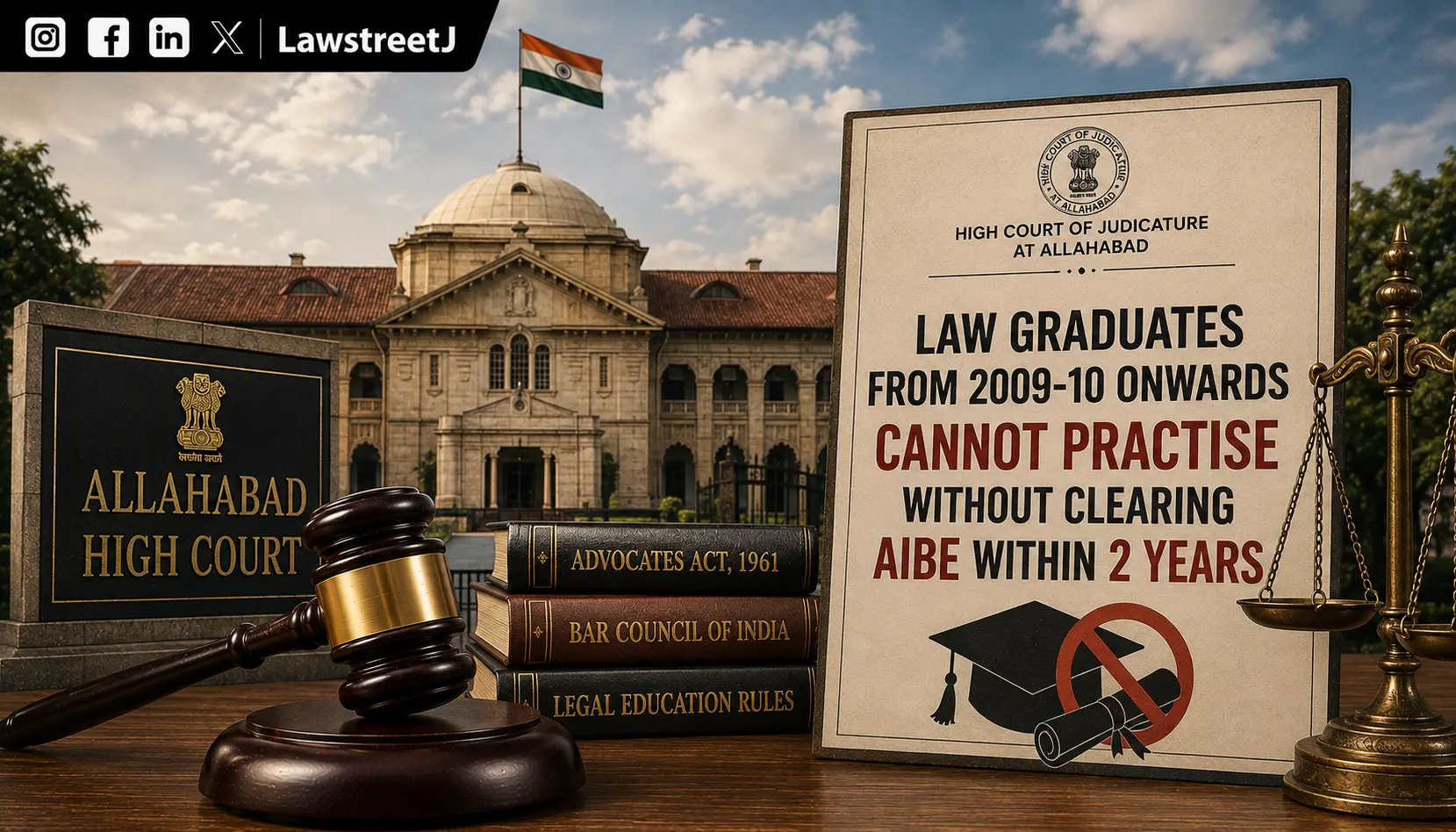
Allahabad: The Allahabad High Court has clarified that law graduates of the academic session 2009-10 or thereafter, who are provisionally enrolled as advocates under Section 24 of the Advocates Act, 1961, cannot continue to practice law if they fail to qualify the All India Bar Examination (AIBE) within two years of such enrolment.
Justice Arun Kumar Singh Deshwal delivered the ruling while disposing of ancillary questions that arose during a bail application, after hearing representatives of the Bar Council of India, the Bar Council of Uttar Pradesh, and the Bar Association of Allahabad.
The issue surfaced when a question was raised on whether counsel appearing for the bail applicant, who had graduated after the 2009-10 academic session but had not cleared the AIBE despite the expiry of two years, could argue the case. Although the Court permitted the advocate to argue as a one-time exception under Section 32 of the Advocates Act, it kept the underlying legal questions pending and sought assistance from the Bar Council of India, the Bar Council of Uttar Pradesh, and the two High Court bar bodies.
Counsel for the Bar Council of India explained the regulatory history: under Rule 9 of the All India Bar Examination Rules, 2010, no advocate enrolled under Section 24 is entitled to practice unless the AIBE is cleared. Following representations from State Bar Councils, the Bar Council of India's resolution dated 12.04.2013 permitted graduates of 2009-10 onwards to be provisionally enrolled for two years, failing which their enrolment would stand automatically cancelled. A subsequent clarification dated 31.01.2017 confirmed that such candidates remain free to attempt the AIBE without any limit on attempts even after the two-year window lapses, though they may not practice until they clear it.
The Court also examined Rule 5 of the Bar Council of India Certificate and Place of Practice (Verification) Rules, 2015, which requires advocates to hold a valid and verified certificate of practice, and held that this disability arises only once the State Bar Council publishes the list of non-practising advocates under Rule 20.4 of the 2015 Rules meaning an advocate does not automatically lose the right to practice merely because five years have elapsed since the certificate was issued.
Tracing the Bar Council of India's rule-making authority to Sections 24, 49(1)(ag) and 49(1)(ah) of the Advocates Act, the Bench relied on the Supreme Court's ruling in Bar Council of India v. Bonnie Foi Law College, (2023) 7 SCC 756, which upheld the Bar Council's power to prescribe a pre-enrolment examination and overruled the earlier view in V. Sudeer v. Bar Council of India, (1999) 3 SCC 176. The judgment recorded that the Apex Court in Bonnie Foi had also flagged that advocates who take up non-legal employment for a substantial period, such as five years, ought to be treated as fresh enrolees and required to clear the AIBE again a direction the Court noted the Bar Council of India appears not to have implemented yet.
On the requirement of a High Court advocate roll, the Bench referred to Jamshed Ansari v. High Court of Judicature at Allahabad, (2016) 10 SCC 554, which upheld Rules 3 and 3A of Chapter XXIV of the Allahabad High Court Rules, 1952, making it compulsory for advocates to be on the High Court's roll to file a Vakalatnama, holding that the right to practice under Section 24 remains subject to rules framed by the High Court under Section 34 and by the Bar Council of India under Section 49.
The Court concluded that provisionally enrolled advocates who fail to clear the AIBE within two years, “would not be entitled to practice civil, criminal or revenue court (from the court of Tehsildar up to the Board of Revenue),” and that presiding officers may refuse to hear them or act on their Vakalatnama, with such advocates additionally liable to prosecution under Section 45 of the Advocates Act.
The Advocate Roll Section of the High Court was directed to strike off or suspend provisionally enrolled advocates who fail to qualify the AIBE within two years, after due publication of notice. The Bar Council of Uttar Pradesh was directed to issue enrolment numbers to successful AIBE candidates within four weeks of receiving their result cards, and the Director General of Police, U.P. was directed to complete police verification of law graduates seeking enrolment within two weeks of receiving the verification form. Copies of the order were directed to be sent to the Chief Secretary, U.P., the Secretary of the Bar Council of U.P., the Director General of Police, U.P., and the Chairman of the Bar Council of India.
Appearances:
For the Applicant: Jayhind Gaund, Kripa Shankar Yadav, Mohd Aadil Raza, Pawan Kumar Yadav, Praveen Tiwari and Satyvendra Singh Yadav, Advocates.
For the Bar Council of Uttar Pradesh: Ashok Kumar Tiwari, Standing Counsel.
For the Bar Council of India: Sai Girdhar, Standing Counsel.
For the State: D.P.S. Chauhan, learned AGA, assisted by Mayuri Mehrotra, State Law Officer.
Case Title: Yogendra vs. State of U.P. and 3 Others, Criminal Misc. Bail Application No. 17377 of 2026


!["No Loudspeakers For Azan, No Fundamental Right To Create Noise," Says Allahabad HC To Two Mosques [Read Judgment]](/secure/uploads/2020/01/lj_4995_Allahabad_HC_AZAN.jpg)